Samsung C&T, Samsung Engineering, Samsung Heavy Industries
[Asia Economy Reporter Sunmi Park] As Samsung Electronics expands its semiconductor investments, Samsung C&T, Samsung Engineering, and Samsung Heavy Industries are benefiting from increased orders. Following the United States, countries around the world are sending investment love calls to Samsung for semiconductors, raising expectations that stable order performance in Korea will create synergy when establishing overseas factories.
According to the quarterly report submitted to the Financial Supervisory Service on the 19th, Samsung C&T recently established a Semiconductor Infrastructure Research Institute within its construction division and assigned 53 personnel. This institute focuses on key business tasks such as ▲research on future FAB structure solutions ▲development and improvement of module construction methods in high-tech fields ▲optimization of semiconductor and display fab utility operations.
It is interpreted as a newly established organization to respond to the order volume resulting from Samsung Electronics' expanded semiconductor investments. As of the third quarter of this year, Samsung C&T's total construction contract orders amount to KRW 79.2916 trillion. Contracts related to Samsung Electronics' semiconductors this year include Pyeongtaek Plant 3 (P3), the semiconductor research and development (R&D) center in Giheung, the new Fab 1 construction in Taylor, USA, the second retrofit (performance improvement) project in Austin, USA, and the retrofit in Xi'an, China.
Lee Seon-il, an analyst at BNK Investment & Securities, explained, "The third-quarter new orders in the construction division exceeded the annual target of KRW 11.7 trillion, reflecting the increased proportion of high-tech projects with fast construction periods and good profitability, such as Pyeongtaek semiconductor plants 3 and 4 (KRW 6.1 trillion) and the Taylor Fab in the U.S. (KRW 2.1 trillion)."
Samsung Engineering also revealed in its third-quarter quarterly report that its largest customer is Samsung Electronics. As of the third quarter, sales to Samsung Electronics amounted to KRW 2.2012 trillion, accounting for 30.94% of total sales. Last year's third-quarter sales to Samsung Electronics were KRW 1.3825 trillion, representing 27.8% of total sales, but the proportion of orders from Samsung Electronics increased due to the expansion of Samsung Electronics' semiconductor plants, including orders for wastewater, ultrapure water, purified water treatment facilities, and other environmental auxiliary facilities by Samsung Engineering.
Even Samsung Heavy Industries, which has focused its capabilities on shipbuilding orders, has actively entered the semiconductor plant construction order market. This month, Samsung Heavy Industries secured an order worth KRW 242 billion for part of the Samsung Electronics Pyeongtaek semiconductor plant construction. The contract amount represents about 3.7% of last year's total sales.
Samsung Heavy Industries has experience performing pilot projects such as EUV (extreme ultraviolet lithography) factories since 2020, based on its accumulated automatic welding and large module capabilities from shipbuilding and offshore plant construction. Additionally, in April this year, it took charge of finishing work for a factory where wafer processing is conducted within the Samsung Electronics Pyeongtaek campus, further enhancing its semiconductor plant construction capabilities.
Samsung Heavy Industries has announced its intention to focus on high-tech construction projects that can be accomplished based on its accumulated construction and shipbuilding experience and technology outside the shipbuilding and offshore sectors, so it is expected to continue actively participating in semiconductor plant construction in the future.
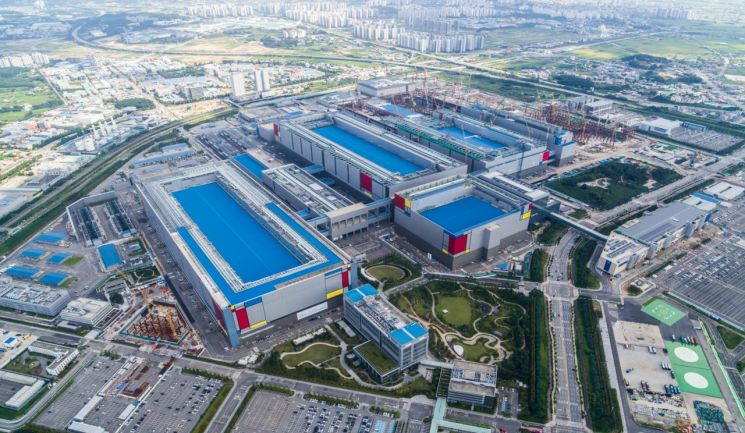
Samsung Electronics' semiconductor business sites are continuously expanding with new lines and buildings amid the investment expansion atmosphere, so the benefits for these three major companies are expected to continue. In particular, the Pyeongtaek campus is a large-scale project where Samsung Electronics is building six semiconductor production lines (P1L~P6L) and auxiliary buildings in phases by 2030 on a 2.89 million square meter (approximately 870,000 pyeong) site. Currently, only up to Plant 3 has been completed and is operational.
Previously, in the United States, plans were submitted to the state government to build nine additional semiconductor production plants in Taylor, Texas, and two in Austin. Moreover, countries worldwide aiming to foster the semiconductor industry are sending love calls to Samsung to attract semiconductor factories to their own countries.
© The Asia Business Daily(www.asiae.co.kr). All rights reserved.
![Clutching a Stolen Dior Bag, Saying "I Hate Being Poor but Real"... The Grotesque Con of a "Human Knockoff" [Slate]](https://cwcontent.asiae.co.kr/asiaresize/183/2026021902243444107_1771435474.jpg)











