Looking Back on 10 Years of 'Tizen'
Smartphone Withdrawal from Android and iOS Duopoly
Tizen Remains Only in TVs and Home Appliances

[Asia Economy Reporter Han Yeju] Samsung Electronics' self-developed smart device operating system (OS) 'Tizen' has reached its 10th anniversary. Born to counter Google and Apple in the smartphone market, Tizen has now disappeared from the mobile business and is expanding its ecosystem mainly in the TV sector. Samsung's strategy to establish leadership not only in hardware but also in software is ongoing.
According to the industry on the 20th, Samsung Electronics exhibited products commemorating the 10th anniversary of the Tizen OS at the 'Samsung Software Developer Conference (SSDC) 2022' booth held on the 15th and 16th. This was the first event since the release of Tizen 7.0 last October.
Tizen is an open-source OS developed by the Linux Foundation in 2012. After forming an alliance of major domestic and international telecommunications companies including Intel, Samsung Electronics has led its development. Initially known as a mobile OS to compete against Apple's iOS and Google's Android, it ultimately aimed to be a comprehensive open-source platform connecting various devices such as smartphones, tablets, smart TVs, wearables, and automobiles.
Samsung Electronics tried to establish an independent OS base by launching Tizen smartphones in 2014 and Tizen smart TVs in 2015 but struggled. Since the emergence of the iPhone in 2007, the 'ecosystem duopoly' created by Google and Apple has solidified, leaving no room for new OSs to penetrate. Apps integrated into users' daily lives on the two OSs continue through developers' consistent updates. Developers inevitably prefer the two operating systems with high market shares.
As the perception that Tizen is essentially Samsung Electronics' proprietary OS spread, it faced difficulties in ecosystem formation. If smartphone manufacturers chose Tizen, it would appear as if they were empowering their biggest competitor, Samsung. From the competitors' perspective, expanding Tizen ultimately benefits Samsung Electronics, so there is no reason to adopt it.
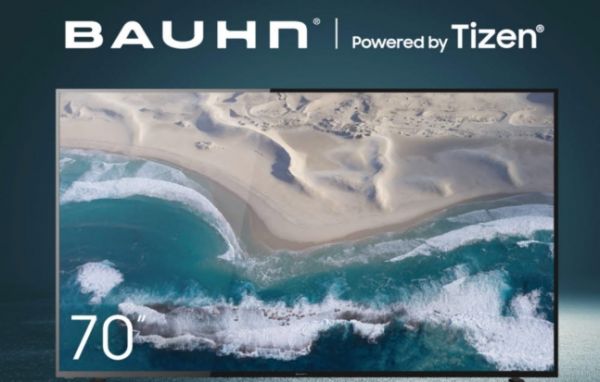 The TV from this brand, supplied with the Tempo operating system (OS) based on Tizen.
 [Photo by Samsung Electronics]
Ultimately, Samsung Electronics, which failed to shine in the mobile business, has turned its attention to smart TVs, air conditioners, refrigerators, and other appliances to maintain its presence. The company intends to strengthen competitiveness by expanding its footprint with Tizen in smart home appliances where other companies have not yet firmly established themselves.
Tizen was first applied to Samsung smart TVs in 2015, and recently, for the first time in 10 years, it has been installed on TVs from other companies. Australian TV company Tempo was the first to release a TV with Tizen OS, and Turkish TV manufacturer Artmaca and China's HKC also plan to launch Tizen TVs in Europe and Turkey. Currently, Samsung smart TVs equipped with Tizen are used by nearly 200 million consumers in about 200 countries worldwide. According to market research firm Omdia, as of the first half of this year, Google Android holds the top spot in the smart TV OS market with a 41.3% share, while Samsung's Tizen ranks second with 22.7%.
Tizen is also showing its presence in game services. Last year, Samsung Electronics announced for the first time its goal to launch cloud-based game services on the Tizen platform. Samsung collaborates with major gaming companies such as Xbox and NVIDIA GeForce Now to integrate the 'Samsung Gaming Hub' service, offering features like AI upscaling and multitasking.
Samsung Electronics aims to apply Tizen to various types of products under development to ensure smooth product operation. As Samsung's own OS, it has the advantage of adding and modifying new functions and services at the appropriate time, which is beneficial for product development.
A Samsung Electronics official said, "Not only finished products centered on hardware but also software-based platform areas are important businesses," adding, "Starting with the newly released Tizen TV, we will provide the Tizen OS to more countries, brands, and products."
© The Asia Business Daily(www.asiae.co.kr). All rights reserved.


















