Yejeongcheo "Investment Needed in Higher Education Support Projects Linked to Primary and Secondary Education"
Proposal to Promote Teacher Retraining Projects and Support for Regional National Universities
Conflicts with Government Plan Presenting 11.2 Trillion Won Special Higher Education Account
Proposal to Link Grant Calculation to 'OECD Education Finance Government Expenditure'
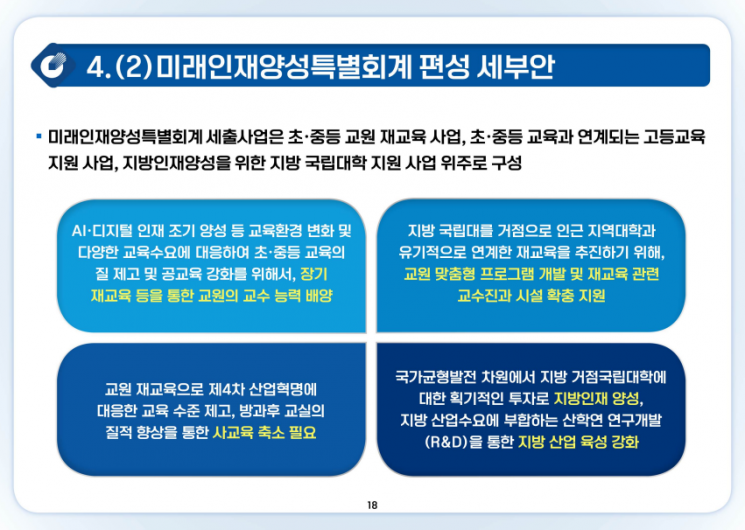 Key points of the reform plan for the Special Account for High School and Lifelong Education Support from the presentation "Current Status and Improvement Measures of Local Education Finance Grants" announced by Choi Byung-kwon, Director of the Budget Analysis Office at the National Assembly Budget Office.
[Asia Economy Reporter Han Jinju] On the day the proposal to establish a ‘Special Account for Higher and Lifelong Education Support,’ which invests a portion of local education finance grants into higher education, was announced, the National Assembly Budget Office suggested reorganizing it into a ‘Special Account for Future Talent Development.’
At the ‘2023 Education Finance Forum’ held on the 15th at the National Assembly Members’ Office Building, Choi Byung-kwon, Head of the Budget Analysis Office at the National Assembly Budget Office, stated, "There is a lack of social consensus and public discussion to convert the entire 33 trillion won national education tax, currently used for elementary and secondary education funding, into higher and lifelong education, and opposition from stakeholders is expected. Considering that the existing funds are used for elementary and secondary education, investments should focus on higher education support projects linked to elementary and secondary education."
The detailed plan for the Special Account for Future Talent Development by the Budget Office includes ▲ re-education projects for elementary and secondary school teachers ▲ higher education support projects linked to elementary and secondary education ▲ support projects for local national universities to foster local talent. It proposes initiatives such as supporting teacher re-education, securing new teacher appointments and personnel expenses during the re-education period, fostering national universities and expanding facilities, and expanding national scholarships for low-income students. This content mainly supports the elementary and secondary education sector, which conflicts with the plan announced by the government on the same day. The Budget Office supports the National Assembly’s budget-related legislative activities.
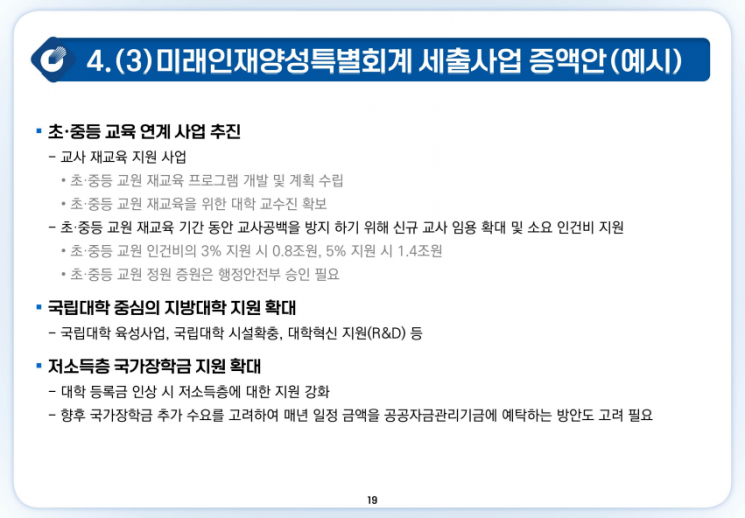 Key points of the reform plan for the Special Account for High School and Lifelong Education Support from the presentation "Current Status and Improvement Measures of Local Education Finance Grants" announced by Choi Byung-kwon, Director of the Budget Analysis Office at the National Assembly Budget Office.
Choi also argued that the current method of calculating local education finance grants should be changed. He explained, "Due to the structure linked to domestic taxes, the predictability of grants decreases depending on tax revenue size, it does not meet education finance demands, and there is a distribution gap between the central government and local education finance." He added, "We should use key indicators such as the proportion of elementary and secondary education finance expenditure to total government expenditure in OECD countries and government expenditure per student for elementary and secondary education in OECD countries." He proposed calculating the grant size by using the education finance expenditure ratio of the top 30-50% of OECD countries. It is known that this presentation was not shared with the discussants in advance.
During the discussion, participants were divided between those representing the elementary and secondary education sector, supporting the government’s announced plan, and those advocating for the expansion of higher education finance, rather than the plan proposed by the Budget Office. Ban Sang-jin, a professor at Jeonbuk National University, said, "Maintaining the current scale of local education finance will turn the factor of declining student numbers into an opportunity to improve Korea’s educational conditions beyond the OECD average." However, he also explained, "We should consider enacting the ‘Higher Education Finance Grant Act’ to secure additional university finance resources and the ‘Special Account Act for Balanced University Development’ to promote coexistence between local and metropolitan universities, as well as national/public and private universities, with focused investment for five years."
Ham Young-gi, Secretary General of the National Association of Metropolitan and Provincial Superintendents of Education, pointed out, "In 2019, the ratio of government resources for higher education to GDP was 0.6%, lower than the OECD average final resource ratio of 0.9%. However, considering Korea’s reality with many private universities and that university education is not compulsory, we should not say that higher education in the UK (1.4%) and the US (1.6%), where private education expenses are 1% higher than the OECD average, is poor." He continued, "If the government intends to significantly expand investment in higher education beyond OECD levels and strengthen national responsibility, it should introduce the ‘Higher Education Finance Grant Act’ that can fundamentally solve higher education finance issues rather than temporary measures like the special account for early childhood education with sunset provisions."
There was also a claim that government support exceeding 5 trillion won is necessary for higher education finance, which was a campaign pledge of President Yoon Suk-yeol, to reach the level of 1% of GDP. Nam Soo-kyung, a professor at Kangwon National University, explained, "It is now time to combine university innovation that educates excellent talent qualitatively with Korea’s quantitatively world-class higher education. We need to move beyond debates on whether public support for universities subject to restructuring is appropriate and restore the talent development ecosystem through support for local universities, while actively discussing digital talent development."
© The Asia Business Daily(www.asiae.co.kr). All rights reserved.

![Clutching a Stolen Dior Bag, Saying "I Hate Being Poor but Real"... The Grotesque Con of a "Human Knockoff" [Slate]](https://cwcontent.asiae.co.kr/asiaresize/183/2026021902243444107_1771435474.jpg)
















