KOFIX 3.98%, Mortgage Loans Near 8%
Even Prime Borrowers Can't Access 1st Tier Banks if Overleveraged
No DSR Easing... 'Financial Congestion' Continues Next Year
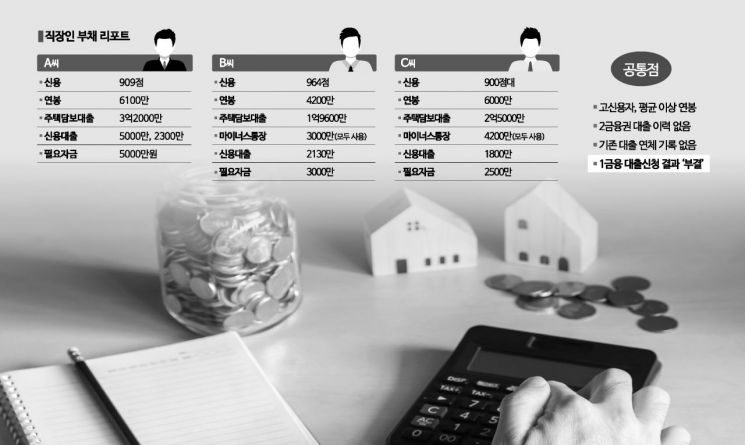
[Asia Economy Reporter Song Seung-seop] Mr. A, a man in his 30s living in Gangseo-gu, Seoul, needed 50 million won immediately and visited two commercial banks. With an excellent credit score of 909 and an annual salary of 61 million won, he expected approval but was rejected. This was because he had already used funds from a loan to buy a house last November. For that, he took out a mortgage loan of 320 million won and credit loans of 50 million won and 23 million won. Mr. A said, "I didn't expect them not to lend me even a single won," adding, "I have to go to the secondary financial sector, but if I can't borrow enough there, I will have to cover the difference through the tertiary financial sector."
Mr. B, a man in his 40s working at a mid-sized company in Nampo-dong, Busan, has a credit score of 964 and an annual salary of about 42 million won. He needs an additional 30 million won for his side business in internet e-commerce but was rejected by commercial banks. His mortgage loan balance of 196 million won, a 30 million won overdraft, and a 21.3 million won credit loan with a five-year term were obstacles. Mr. B said, "I went to the secondary financial sector, but I could only borrow up to 3 million won at the desired interest rate," adding, "With loan interest rates rising further, I am worried whether I should borrow at high interest rates."
Employees with credit scores over 900 and above-average incomes are having difficulty borrowing money. Not only financially vulnerable groups but also prime borrowers with no history of loans from secondary or tertiary financial sectors and no delinquencies are suffering from a 'financial choke' due to financial regulations and conservative loan screening by banks. Most of them are 'Young Chul Jok' who bought homes with excessive loans in the past one to two years, and their debt burden is expected to increase further due to the rise in base interest rates.
According to the financial sector on the 16th, the Korea Federation of Banks announced the COFIX (Cost of Funds Index) rate at 3.98% starting today. It rose by 0.58 percentage points in one month. COFIX is an index calculated as the weighted average of funding costs from eight major banks and serves as the basis for banks' loan interest rate calculations. As a result, commercial bank mortgage loan rates have exceeded 7% and are approaching 8%.
Loans Becoming Increasingly Difficult to Obtain... Harsh 'Financial Choke' to Continue Next Year
The problem is that the higher the loan interest rates rise, the harder it becomes to get new loans. The Debt Service Ratio (DSR) regulation implemented by the government calculates all principal and interest payments that must be repaid within one year relative to income. The third-stage DSR ratio, which started in July, is 40%, and it applies once total loan amounts exceed 100 million won. As loan interest rates rise, the amount to be repaid increases, reducing the available loan limit for new borrowing.
Mr. C, living in Seo-gu, Daejeon, is a typical example. He tried to borrow 25 million won from a commercial bank but failed due to the DSR regulation. He still has a mortgage loan balance of 250 million won, has fully used an overdraft of over 40 million won, and has a credit loan of 18 million won. Mr. C said, "My annual salary is 60 million won, but I doubt I can borrow money from the secondary financial sector."
The common factor among them is that they all bought houses. According to the '2021 Housing Ownership Statistics' released by Statistics Korea the day before, 15.089 million people owned homes at the end of last year. Among them, 1.036 million people who were previously non-homeowners bought homes, marking the first time since the 2017 statistics compilation that this number exceeded one million. The number of homeowners under 30 years old, who generally have lower purchasing power, also increased by 9.9% to 291,000.
The problem lies with those who took on multiple debts (loans from three or more sources) to make excessive home purchases. The debt burden due to rising interest rates is inevitably increasing. According to data submitted by the Bank of Korea to Rep. Yoon Chang-hyun of the People Power Party, 22.4% of household borrowers in the first quarter of this year were multiple debtors. This is an increase of 0.3 percentage points from 22.1% at the end of last year, the highest since statistics began.
It is expected that employees will continue to face difficulties borrowing money for the time being. Although the Financial Services Commission relaxed the loan-to-value ratio (LTV) for mortgage loans for non-homeowners at the real estate ministerial meeting on the 10th, the DSR regulation will be maintained at the current level. Kim Ju-hyun, chairman of the Financial Services Commission, recently said about the possibility of easing the DSR, "I think the DSR regulation should be handled cautiously in the current situation."
© The Asia Business Daily(www.asiae.co.kr). All rights reserved.
![Clutching a Stolen Dior Bag, Saying "I Hate Being Poor but Real"... The Grotesque Con of a "Human Knockoff" [Slate]](https://cwcontent.asiae.co.kr/asiaresize/183/2026021902243444107_1771435474.jpg)











