-Two Leaders Emphasize the 'Importance' of Bilateral Relations... Yoon: "Close Communication and Mutual Respect"
-Denuclearization and Regional Peace Discussed... Differences in Views on the 'North Korean Nuclear' Issue After Exploratory Talks
-President Xi Adds Condition to Yoon's 'Bold Initiative': 'If North Korea Responds'
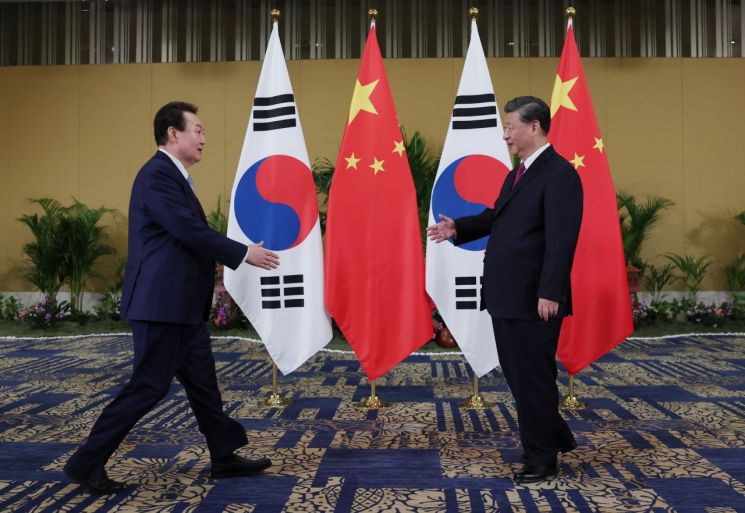
[Asia Economy Reporter Baek Kyunghwan] The first South Korea-China summit under the new administration lasted only 25 minutes. President Yoon Suk-yeol exchanged greetings with Chinese President Xi Jinping via a phone call in March during his president-elect period, but a face-to-face meeting between the two leaders took place for the first time in three years since December 23, 2019, at the Great Hall of the People in Beijing during the previous Moon Jae-in administration.
The South Korea-China summit held at a hotel in downtown Bali on the afternoon of the 15th (local time) started at 17:11 and ended at 17:36. Compared to the 50-minute South Korea-US summit and the 45-minute South Korea-Japan summit held in Phnom Penh, Cambodia, on the 13th, it was about half the length.
During the brief 25 minutes, the two leaders discussed denuclearization and regional peace, but regarding North Korea's nuclear issue, exploratory talks continued and ultimately revealed differences in perspectives.
In fact, the two leaders reaffirmed the importance of bilateral relations. President Yoon emphasized, "Based on the consensus to open a new era of South Korea-China cooperation, our government will cooperate closely with China through communication based on mutual respect and reciprocity to build a mature South Korea-China relationship." President Xi also said, "South Korea and China are inseparable close neighbors and partners. The calls and letters we exchanged show how much we value the South Korea-China relationship."
However, differences emerged on the North Korean nuclear issue. President Yoon pointed out North Korea's provocations and nuclear threats, emphasizing, "As a permanent member of the Security Council and a neighboring country, we expect China to take a more active role," but President Xi responded, "I hope South Korea will actively improve inter-Korean relations."
Regarding President Yoon's 'Bold Initiative,' President Xi added a caveat, saying "if North Korea responds," indicating that he would prioritize North Korea's stance. The day before, President Xi also expressed at the US-China summit the existing view that North Korea's legitimate concerns should be addressed in a balanced manner.
President Xi also distanced himself from South Korea's Indo-Pacific strategy. President Yoon stated that "our government's diplomatic goal is to pursue freedom, peace, and prosperity in the international community based on universal values and norms" regarding regional issues, but President Xi said, "China wants to jointly create genuine multilateralism to provide more positive energy and stability to the world." Some interpret the 'genuine multilateralism' mentioned by President Xi as a response to strategies aimed at containing China.
Nonetheless, the two leaders agreed that exchanges and cooperation between South Korea and China have grown dramatically since establishing diplomatic relations in 1992, and on the occasion of the 30th anniversary of diplomatic ties, they agreed to further mature bilateral relations based on mutual respect, reciprocity, and common interests. In particular, to jointly overcome complex challenges such as the pandemic, global economic downturn, and climate change, they decided to actively promote regular high-level dialogues between the two countries.
© The Asia Business Daily(www.asiae.co.kr). All rights reserved.
![Clutching a Stolen Dior Bag, Saying "I Hate Being Poor but Real"... The Grotesque Con of a "Human Knockoff" [Slate]](https://cwcontent.asiae.co.kr/asiaresize/183/2026021902243444107_1771435474.jpg)
















