Naver and AfreecaTV Secure Broadcast Rights... TVING 'Gives Up' and WAVVE 'Considering'
High Expectations for Success but Reluctant Due to High Costs
120 Billion KRW for Three Major Broadcasters... Online Broadcasts Start from Tens of Billions KRW
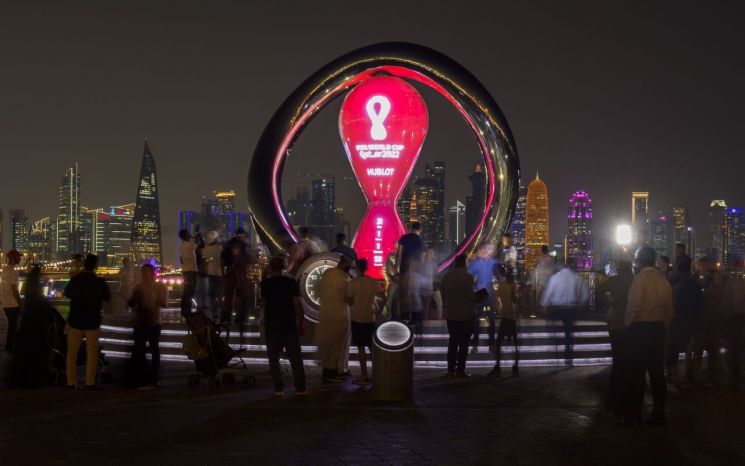
[Asia Economy Reporter Oh Su-yeon] With less than a week remaining until the opening of the 2022 Qatar World Cup on the 20th (local time), competition among online video service (OTT) providers to secure online broadcasting rights is not as intense as before. Although they have used sports broadcasting to attract subscribers, they are hesitant to jump in due to the excessively high price of World Cup broadcasting rights.
According to the industry on the 16th, only Naver and AfreecaTV had secured the Qatar World Cup broadcasting rights as of the previous day. Kakao and Wavve are continuing negotiations for the broadcasting rights.
Some companies have already withdrawn early. Tving, which benefited from sports broadcasting, and LG Uplus's Spoky, launched last month as an integrated sports community platform. LG Uplus has live-streamed the 2020 Tokyo Summer Olympics and the 2022 Beijing Winter Olympics through U+ Mobile TV, but will not broadcast this World Cup. Tving and tvN Sports are not participating in the competition to secure World Cup broadcasting rights.
Coupang Play stated that it is difficult to disclose whether it is negotiating for World Cup broadcasting rights.
Ahead of the Tokyo Olympics last year, platform companies including OTTs engaged in an unprecedented competition to secure broadcasting rights. Coupang attracted attention by proposing broadcasting rights fees exceeding 40 billion KRW and pushing for exclusive online broadcasting on Coupang Play. Later, Coupang withdrew from exclusive broadcasting, and Naver, Wavve, AfreecaTV, and LG Uplus sequentially secured online broadcasting rights.
Major OTT providers have been eager to secure sports broadcasting rights by attracting subscribers through exclusive broadcasts of major matches in the German professional football Bundesliga or the visit of Tottenham Hotspur FC, where Son Heung-min plays, to Korea in the English Premier League (EPL). The strategy is to capture the attention of loyal sports fans with differentiated content.
This model is inspired by Amazon's OTT 'Prime Video.' Amazon has grown by securing exclusive rights to popular sports at great expense, creating synergy with its core online shopping business and differentiating itself from competing OTTs. Notably, it secures exclusive rights to "Thursday Night Football" every year for about 1 billion USD (approximately 1.3135 trillion KRW). Although official viewership ratings have not been released, Amazon announced that the number of viewers exceeded expectations after the first game broadcast in September.
The main reason why competition to secure broadcasting rights ahead of the World Cup, one of the world's top three sports events with the highest interest, is weaker than before is cost. Unlike the Summer and Winter Olympics, where most events are less popular except for some, the broadcasting rights fees are relatively low. The online broadcasting rights fee for the World Cup is more than twice that of the Summer Olympics. Although high viewership is expected, it is difficult to invest costs recklessly. The broadcasting rights fee paid by the three terrestrial broadcasters for this World Cup is in the 120 billion KRW range. The online broadcasting rights fees purchased from the three terrestrial broadcasters vary depending on platform size and negotiation conditions, but are known to start from at least several billion KRW per company.
An industry insider from the video platform sector said, "There is a gap between the expected prices of platforms and terrestrial broadcasters," adding, "From the terrestrial broadcasters' perspective, since it is a non-exclusive sale, the more they sell, the more profit they make, so one or two more companies may secure broadcasting rights at the last minute."
© The Asia Business Daily(www.asiae.co.kr). All rights reserved.
![User Who Sold Erroneously Deposited Bitcoins to Repay Debt and Fund Entertainment... What Did the Supreme Court Decide in 2021? [Legal Issue Check]](https://cwcontent.asiae.co.kr/asiaresize/183/2026020910431234020_1770601391.png)