December 31st End of 1.5% Point Reduction in Excise Tax
"Need to Consider Possibility of Economic Recession" Voices Also Raised
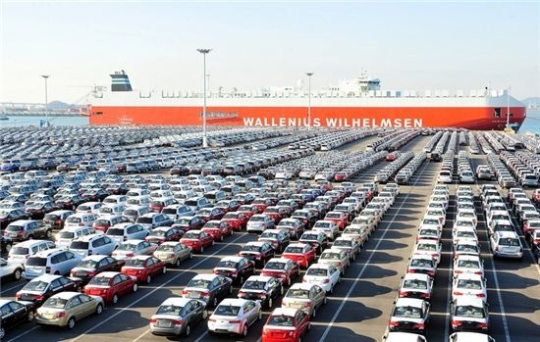 (Photo by Asia Economy)
[Asia Economy Reporter Kiho Sung] The policy to reduce the individual consumption tax on automobiles (known as 개소세, Gaesose) imposed when purchasing a vehicle will end at the end of this year. Industry insiders are voicing strong calls to extend the Gaesose reduction, as many consumers are currently waiting for vehicle deliveries due to ongoing supply shortages of auto parts. However, there are also expectations that the extension will not be implemented due to policies promoting the spread of eco-friendly vehicles, drawing attention to the government's decision next month.
According to the automotive industry on the 20th, the temporarily reduced Gaesose benefit will expire on December 31.
Under tax law, consumers must pay a 5% Gaesose when purchasing a passenger car. In addition, an education tax of 30% of the Gaesose and a value-added tax (VAT) of 10% on the sum of the vehicle price, Gaesose, and education tax are imposed. Therefore, when the Gaesose is reduced, the education tax and VAT also decrease, significantly lowering the overall tax burden. For example, when purchasing a passenger car priced at 20 million KRW, if the Gaesose is reduced from 5% to 3.5%, consumers can receive a tax benefit of about 430,000 KRW.
The government has lowered the Gaesose to 3.5% since July 2020 to stimulate consumption. Since this benefit lasts only until the end of this year, it is expected to return to 5% from next year if the current situation continues.
Because the effect of the Gaesose reduction is significant, both the industry and consumers have shown interest in related policies. The reality that it is difficult to receive the Gaesose benefit when ordering a vehicle now also plays a part.
Currently, the waiting period for popular vehicles exceeds two years. For the Genesis GV80 gasoline 2.5 turbo model, it takes more than 30 months to receive delivery. Hyundai Motor Company's Santa Fe Hybrid takes over 24 months, and Kia's Sorento Hybrid requires a wait of more than 18 months.
For Hyundai's recently launched new Grandeur, consumers are also expected to pay the increased Gaesose. It is known that pre-orders for the Grandeur have already exceeded 100,000 units, making delivery within this year difficult.
Because of this, some automakers are using fast delivery as a marketing point. Renault Korea Motors is promoting that for the SM6, QM6, and XM3 gasoline models, contracts made this month can be delivered by the end of this year.
Considering the auto parts supply shortage and economic downturn, voices from the industry are calling for an extension of the Gaesose reduction period. An industry official said, "Due to the global supply shortage causing prolonged new car waiting times, many consumers who want to benefit from the Gaesose reduction cannot do so. Also, the potential sharp decline in vehicle demand due to next year's economic downturn should be considered."
On the other hand, there are also forecasts that extending the Gaesose reduction will be difficult. Professor Pilsoo Kim of Daelim University's Department of Automotive Studies said, "Because the new car waiting period is long, even if the Gaesose reduction is extended, many consumers may not benefit," and added, "The government may judge that the effect of extending the Gaesose reduction is not significant."
© The Asia Business Daily(www.asiae.co.kr). All rights reserved.
![Clutching a Stolen Dior Bag, Saying "I Hate Being Poor but Real"... The Grotesque Con of a "Human Knockoff" [Slate]](https://cwcontent.asiae.co.kr/asiaresize/183/2026021902243444107_1771435474.jpg)















