Janssen's 'Sparavato' for Treatment-Resistant Depression
Improved 'Ketamine' to Reduce Drug Abuse Concerns... Side Effects Not Significant
FDA-Approved 'Oberity'
Overcoming Side Effects with a New Mechanism
Domestic Attempts to Overcome Depression Using Electronic Medicine
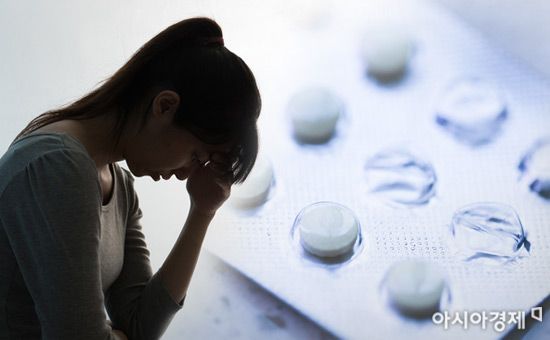
[Asia Economy Reporter Lee Chun-hee] The number of depression patients in South Korea has rapidly increased, reaching 850,000 as of 2020. As the number of depression patients grows, the market for antidepressants is also expanding rapidly, with ongoing efforts to overcome side effect concerns of existing treatments or to treat 'treatment-resistant depression (TRD)' where medications are ineffective.
Depression is known to occur due to a decrease in neurotransmitters such as dopamine, serotonin, and norepinephrine. Treatment mainly involves prescribing antidepressants that maintain these brain neurotransmitters at certain levels to alleviate depressive symptoms. In South Korea, selective serotonin reuptake inhibitors (SSRIs) are the most commonly used drugs, along with serotonin-norepinephrine reuptake inhibitors (SNRIs), tricyclic antidepressants (TCAs), and monoamine oxidase inhibitors (MAOIs). However, since maintaining neurotransmitters affects related enzymes and receptors, concerns about side effects have persisted.
While early treatment can lead to rapid symptom improvement, it has been continuously reported that about 30% of all depression patients suffer from TRD, which does not respond to various medications even when used simultaneously.
The drug 'Ketamine' has emerged as a treatment for such TRD. Originally used as an anesthetic, its use expanded rapidly after its effectiveness in treating treatment-resistant depression was confirmed by blocking the N-methyl-D-aspartate (NMDA) receptor, a neurotransmitter involved in mood regulation. In terms of efficacy, effects can appear as soon as 2 hours after administration, and a single dose can provide benefits for several weeks, bringing innovation to TRD treatment. However, since the U.S. Food and Drug Administration (FDA) approved it only as an anesthetic and not as an antidepressant, its use has been limited as an 'off-label' treatment.
Additionally, ketamine induces 'dissociation,' a state where the body feels detached and sensory perception in limbs disappears, causing hallucinations. This property has raised concerns about its abuse as a drug. At one point in South Korea, it was known as 'Special K' and was reportedly used as a club drug.
This is why Janssen (a Johnson & Johnson subsidiary) developed the TRD treatment 'Spravato' (active ingredient esketamine), which has gained attention. Following FDA approval in 2019 and its release in South Korea the following year, Spravato became the first approved TRD treatment. Esketamine is a 'mirror isomer' with a structure similar to ketamine but different properties. It rapidly improves depressive symptoms by regulating NMDA receptor activity in the brain and restoring connections between brain nerve cells (synapses). Clinical trials comparing it with ketamine demonstrated non-inferiority. Moreover, it was developed as a nasal spray formulation, greatly enhancing ease of administration.
Regarding side effects, dissociative symptoms may occur but tend to decrease with subsequent doses after the initial administration, and the intensity of these symptoms is generally mild.
A new drug with a novel mechanism recently received FDA approval. In August, the FDA approved Axsome Therapeutics' depression treatment 'Auvelity.' Auvelity is an oral medication combining dextromethorphan, an NMDA receptor antagonist and SNRI, with bupropion, a dopamine reuptake inhibitor.
In phase 3 clinical trials, while existing antidepressants showed effects only after 6 weeks of administration, Auvelity demonstrated efficacy within just one week. Side effects included headache, diarrhea, and sexual dysfunction, but no serious adverse reactions were observed.
In South Korea, there is no clear movement toward developing new antidepressants yet. However, Bukwang Pharmaceutical recently acquired the licensing rights from Japan's Sumitomo Pharma for 'Lurasidone,' a treatment for schizophrenia and bipolar depression, and has applied for domestic product approval. It is reported to have lower metabolic side effects such as weight gain, increased prolactin, and dyslipidemia compared to existing atypical antipsychotics.
Electronic medicine company Vibraion launched 'Mind Steam,' an electronic medicine that treats depression by normalizing frontal lobe function through micro electrical stimulation. Since its release in July, it has recorded over 6,000 in-hospital prescriptions.
© The Asia Business Daily(www.asiae.co.kr). All rights reserved.
![User Who Sold Erroneously Deposited Bitcoins to Repay Debt and Fund Entertainment... What Did the Supreme Court Decide in 2021? [Legal Issue Check]](https://cwcontent.asiae.co.kr/asiaresize/183/2026020910431234020_1770601391.png)