US COVID-19 Bivalent Vaccine Uptake at 26.9% for 65+
South Korea Only 10.3% for 60+... Less Than Half
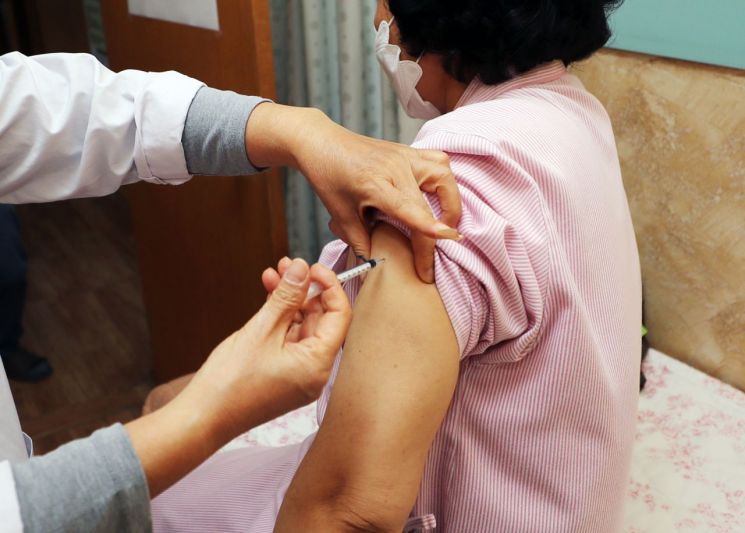
[Asia Economy Reporter Kim Young-won] The COVID-19 winter vaccination rate and pre-registration rate in South Korea have been found to be about half the level of overseas countries. Experts urged high-risk groups to get vaccinated and emphasized the need for active response and guidance from health authorities.
According to the Korea Disease Control and Prevention Agency (KDCA) on the 15th, as of midnight the previous day, the domestic winter vaccination rate was 3.5% of the total population. Among high-risk groups aged 60 and over, the rate was relatively high at 10.3% of that age group’s population, but it was low at 0.4% among those aged 18 to 59.
Vaccinations based on the BA.4/5 variant vaccine also began the previous day, but the reservation rate remains low. As of midnight the previous day, the cumulative reservation numbers for bivalent vaccines were 1,562,577 for Moderna’s BA.1 bivalent vaccine, 240,041 for Pfizer’s BA.1 bivalent vaccine, and 211,198 for Pfizer’s BA.4/5 bivalent vaccine, with only 3.9% of the total population having made winter vaccination reservations.
In overseas countries, the additional vaccination rate using bivalent vaccines (updated vaccines) was found to be more than twice as high as in South Korea. According to the U.S. Centers for Disease Control and Prevention (CDC), as of the 9th, the bivalent vaccine vaccination rate among the U.S. population aged 65 and over was 26.9%, more than twice the winter vaccination rate of the elderly in South Korea. When comparing the vaccination rates of the U.S. population aged 5 and over with the total population of South Korea, the U.S. bivalent vaccine vaccination rate was 10.1%, while South Korea’s was 3.5%, showing a difference of about 2.9 times.
The United Kingdom, which began fall additional vaccinations on September 11, also has a higher vaccination rate than South Korea. The UK Health Security Agency (UKHSA) reported that the fall additional vaccination rate using bivalent and existing vaccines was 55.1% of the population aged 50 and over. In the age group with the highest vaccination rate, 80 to 84 years old, 76.8% of that age group had completed the fall additional vaccination.
Despite having lower primary vaccination (first and second doses) completion rates than South Korea, the U.S. and the U.K. showed high additional vaccination rates with fewer eligible individuals. According to the international statistics site Our World in Data, 86.26% of South Korea’s total population has completed primary vaccination, compared to 75.19% in the U.K. and 68.61% in the U.S.
Jung Ki-seok, head of the COVID-19 Special Response Team and chair of the National Infectious Disease Crisis Response Advisory Committee, cited the role of health authorities and public awareness of the crisis as the background for these differences in vaccination rates. Jung said, “(Compared to the U.S.) the vaccination rate is worryingly low,” adding, “The U.S. had the highest number of cases and was one of the countries with the most deaths, so high-risk groups likely made their own decision to get vaccinated in preparation for this winter, and the administrative authorities probably provided appropriate guidance and information.”
Concerns were also raised about the low public awareness of the COVID-19 crisis. Kim Woo-joo, professor of infectious diseases at Korea University Guro Hospital, said, “The government has continuously sent signals that ‘COVID-19 has a low fatality rate,’ and such side effects have led the public to firmly decide not to get vaccinated,” emphasizing, “In a situation where severe cases and death indicators are rising, social leaders need to step forward and set an example by getting vaccinated.”
© The Asia Business Daily(www.asiae.co.kr). All rights reserved.
![Clutching a Stolen Dior Bag, Saying "I Hate Being Poor but Real"... The Grotesque Con of a "Human Knockoff" [Slate]](https://cwcontent.asiae.co.kr/asiaresize/183/2026021902243444107_1771435474.jpg)











