Nationwide First in Si/Gun/Gu: Secured 50 Million Won Special Grant for 'Daycare Class Size Adjustment Project'
Evaluated as a Policy Meeting the Demand of Childcare Sites Requiring Quality Improvement in Childcare Services
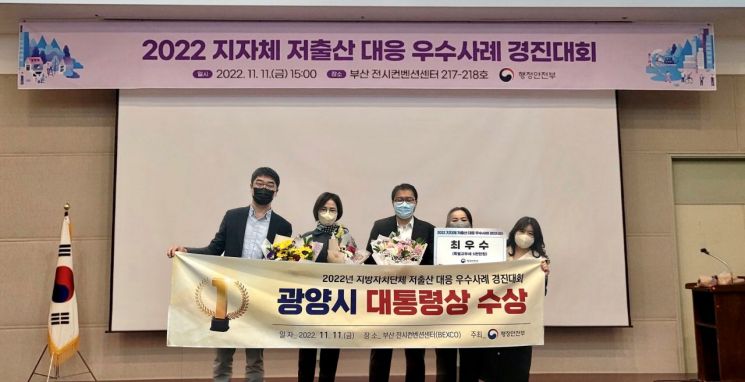
[Asia Economy Honam Reporting Headquarters, Reporter Heo Seon-sik] Gwangyang City, Jeollanam-do announced that it won the 'Presidential Award,' the first place in the basic local government category, at the '2022 Local Government Low Birthrate Response Best Practice Competition' hosted by the Ministry of the Interior and Safety held at BEXCO in Busan on the 11th, receiving a special grant of 50 million KRW.
The competition was conducted by selecting 11 cases (3 metropolitan, 8 basic) out of 41 local government cases nationwide through city/province internal screening, written evaluation by a panel of expert judges, and online public voting, followed by ranking based on case presentations.
The topic presented by Lee Hwa-yeop, Director of the Education and Childcare Division, was 'Safe Childcare Achieving Child Happiness, Parental Trust, and Teacher Satisfaction,' which detailed the 'Childcare Class Size Adjustment System,' the first of its kind implemented nationwide in city, county, and district levels, earning high praise from the judges.
The 'Childcare Class Size Adjustment Project' is a program that adjusts the 'childcare teacher-to-child ratio' set by the Ministry of Health and Welfare, reducing the number of children per teacher by one from the government standard for children aged 0 to 1.
For infants aged 0, the number of children per teacher is reduced from 3 to 2 according to the Ministry of Health and Welfare standards, and for 1-year-olds, from 5 to 4 children per teacher, enabling close care of infants, with the city fully covering the additional labor costs.
Gwangyang City has been responding to overcoming low birthrates and fostering a community atmosphere that emphasizes the social value of child-rearing, where all citizens unite to support having and raising children, while meeting demands for a trustworthy childcare environment and qualitative improvement of childcare services.
To this end, the city has allocated budgets of 1.5 billion KRW in 2020, 2.337 billion KRW in 2021, and 3.239 billion KRW in 2022 to support childcare centers, contributing to high parental satisfaction and improved awareness of child safety management, with the project becoming a benchmark model for other local governments.
Currently, the Ministry of Health and Welfare's teacher-to-child ratio standards make close infant care difficult. Although the Ministry is preparing to revise the standards for infant and toddler class composition, the timing remains uncertain due to the enormous project costs.
The city received high evaluation for proactively adjusting the number of children directly related to childcare services ahead of the government's revision, thereby improving the childcare environment through enhanced interaction between children and teachers.
Mayor Jeong In-hwa of Gwangyang said, "Although the government and local governments have implemented various policies to overcome the national issue of low birthrates, the birthrate continues to decline, increasing the seriousness of the problem," adding, "Achieving first place among basic local governments in the low birthrate response competition hosted by the Ministry of the Interior and Safety is meaningful, and it increases our sense of duty to make broader efforts to address low birthrates."
He continued, "We will continue to foster a child-rearing friendly atmosphere throughout the community to raise the birthrate and implement policies that enable work-family balance."
Meanwhile, the childcare class size adjustment policy was pilot-operated in April 2019 by selecting three childcare centers exclusively for ages 0 to 1 under the Gwangyang City Childcare Foundation, and in August of the same year, it was confirmed to be promoted as a city policy project rather than a foundation project.
Starting with 0-year-old classes in March 2020, and including 1-year-old classes in March 2021, the program has been expanded nationwide since March this year, supporting 86 childcare centers and 303 classes.
Asia Economy Honam Reporting Headquarters, Reporter Heo Seon-sik hss79@asiae.co.kr
© The Asia Business Daily(www.asiae.co.kr). All rights reserved.
![Clutching a Stolen Dior Bag, Saying "I Hate Being Poor but Real"... The Grotesque Con of a "Human Knockoff" [Slate]](https://cwcontent.asiae.co.kr/asiaresize/183/2026021902243444107_1771435474.jpg)
















