"Initial Information Advantage, but Japan Also Has Strengths"
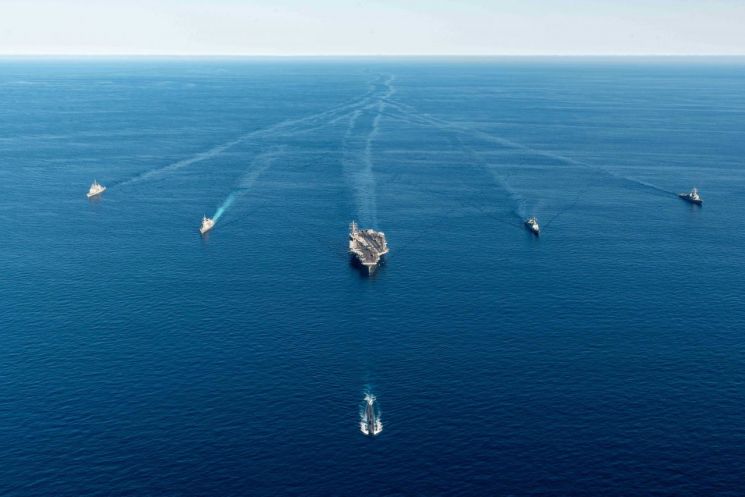 The U.S. Navy attack submarine Annapolis and the nuclear-powered aircraft carrier Ronald Reagan, along with the South Korean and Japanese navies, are conducting joint exercises in the East Sea.
 [Photo by Ministry of National Defense]
[Asia Economy Reporter Jang Hee-jun] The Ministry of National Defense stated that the decision by the leaders of South Korea, the United States, and Japan to share North Korea's missile warning information in real time will be discussed in a way that benefits all three countries.
Moon Hong-sik, deputy spokesperson for the Ministry of National Defense, said at a regular briefing on the 14th, "If the three countries cooperate, it will be possible to share more accurate North Korean missile information," adding, "Discussions will not be conducted to favor any one side, but will proceed in a way that benefits all three countries."
This was in response to a question about whether the real-time sharing of North Korean missile warning information, given the existing frameworks such as the Trilateral Information Sharing Agreement (TISA) among South Korea, the U.S., and Japan, and the General Security of Military Information Agreement (GSOMIA) between South Korea and Japan, would create a new system advantageous to Japan.
Earlier, President Yoon Suk-yeol, U.S. President Joe Biden, and Japanese Prime Minister Fumio Kishida held a summit in Phnom Penh, Cambodia, the previous day and issued a joint statement including the intention to "share North Korean missile warning information in real time."
Some argue that since South Korea is geographically closer to North Korea, it is more likely to detect initial North Korean missile information accurately, and that this information would be given to Japan, while there is little information to receive from Japan in return.
On the other hand, considering the radar detection range affected by the Earth's curvature, it is argued that South Korea can more accurately observe the launch point, direction, and trajectory of short-range missiles, but Japan is more likely to precisely detect medium- and long-range missiles heading toward the Pacific Ocean.
In fact, on the 4th of last month, a North Korean intermediate-range ballistic missile (IRBM) passed beyond the detection range of South Korea’s Aegis destroyers and ballistic missile radar, crossing the Japanese archipelago. The South Korean military assessed the flight distance and altitude as 4,500 km and 970 km respectively, while Japan detected them as 4,600 km and 1,000 km, showing a difference in detection.
Moreover, TISA involves South Korea and Japan sharing information via the United States, and GSOMIA exchanges information upon request, so neither system achieves real-time sharing.
Deputy Spokesperson Moon explained, "GSOMIA and others are not systems for real-time information sharing," adding, "We have an advantage in initial information, but the other side also has Japan’s strengths. The value of information will vary depending on the launch point or direction."
Regarding concerns that real-time sharing of North Korean missile warning information might ultimately lead to integration into the U.S.-led missile defense (MD) system, the Ministry of National Defense drew a clear line. Moon said, "It is inappropriate to talk about MD integration based on partial aspects, and it does not imply that," emphasizing, "To discuss MD, it must be at the same level from missile development to operational deployment, so concerns about MD integration are an overinterpretation."
© The Asia Business Daily(www.asiae.co.kr). All rights reserved.

















