China's Water Shortage: 171 Trillion Won Invested in Water Resources This Year
Chemicals like Arsenic in Tibet Plateau Permafrost Threaten 2 Billion People
[Asia Economy Senior Reporter Cho Young-shin] China has invested 921.1 billion yuan (approximately 171 trillion KRW) in water resource improvement projects this year, according to the state-run Xinhua News Agency on the 14th.
Xinhua cited statistics from China's Ministry of Water Resources, reporting that from January to October this year, a record amount was invested in flood prevention maintenance projects for 24,000 rivers and streams, as well as hydropower-related projects. Xinhua added that the amount China invested in water resources last year was 757.6 billion yuan.
Xinhua emphasized that the construction of an underground pipeline in the Zhujiang (Pearl River) was a representative water resource development project this year. The project involves installing a 113.2 km long pipe at a depth of 40 to 60 meters underground, supplying 1.78 billion cubic meters of water annually to the Zhujiang Delta region, according to Xinhua.
The dominant interpretation is that the Chinese government poured massive funds into water resource infrastructure construction this year to stimulate the economy.
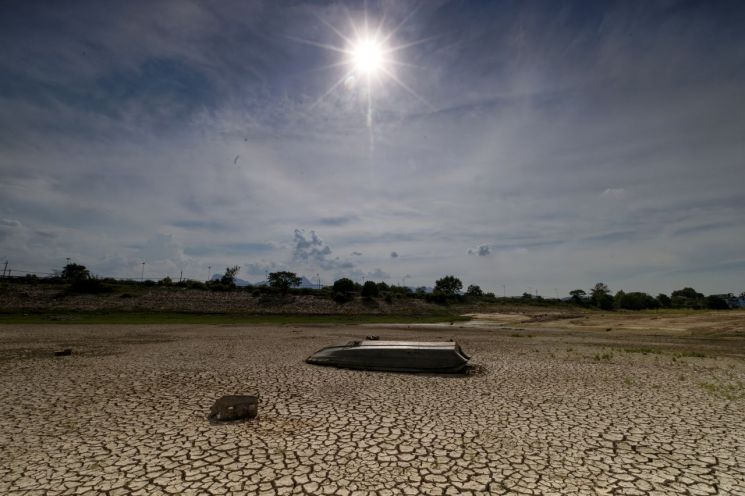
However, there is also analysis that China is investing huge amounts in water resources due to the fact that it is not a country free from water issues and ongoing concerns about potential water shortages caused by climate change.
First, China has a topography characterized by "West High East Low" (西高東低). Because of this, there are no large rivers flowing strictly from north to south or vice versa. This is why China frequently digs canals.
The melting of glaciers on the Tibetan Plateau and surrounding highlands at altitudes of 5,000 to 6,000 meters due to climate change is also a problem. Most of China's major rivers originate from the Tibetan Plateau and flow eastward. The water originating from the Tibetan Plateau flows not only through China but also into India and Southeast Asia.
The South China Morning Post (SCMP) also expressed concern that Asia's "water tower" is in crisis, noting the disappearance of glaciers on the Tibetan Plateau and surrounding highlands. SCMP reported that the Tibetan Plateau and surrounding mountainous areas are the sources of Asia's ten major rivers (including the Yangtze River, Yellow River, Ganges River, Mekong River, etc.) and serve as the water source for 2 billion people.
SCMP cited a paper published by Chinese scientists in October in Nature Reviews Earth & Environment, stating that permafrost on the Tibetan Plateau is melting rapidly due to global warming, which could significantly deteriorate water quality.
It also cited a paper released in June, emphasizing that from 1979 to 2020, the average temperature in this region has risen by 0.44 degrees Celsius every decade, which is twice the global average rate. It pointed out that as glaciers melt, chemicals such as arsenic, calcium, and magnesium accumulated upstream could flow downstream, polluting water quality. This is a warning that the river ecosystems of China, India, and Southeast Asia could be disrupted.
SCMP added that investigations into changes in water flow and speed due to climate change in the Tibetan Plateau and surrounding highlands, as well as the chemicals accumulated in the permafrost, need to be conducted.
© The Asia Business Daily(www.asiae.co.kr). All rights reserved.

















