Bitcoin Plummets Over 20%
Crypto-Related Stocks Also Fall Sharply
Industry Says "Impact May Be Greater Than Terra and Luna"
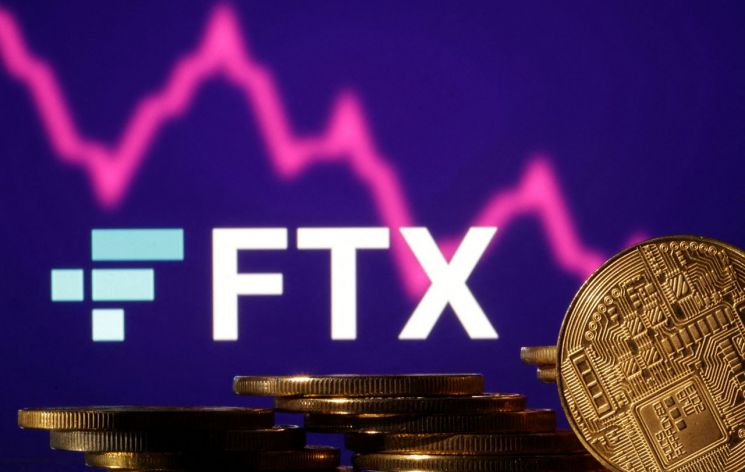
[Asia Economy Reporter Myunghwan Lee] As FTX, one of the world's top three cryptocurrency exchanges, has filed for bankruptcy, attention is focused on the impact this bankruptcy will have on the financial market. Given that this is an unprecedentedly large-scale bankruptcy in the history of the cryptocurrency market, there is concern about potential chain reactions. Upon news of FTX's bankruptcy filing, the entire cryptocurrency market wavered.
According to the global cryptocurrency market tracking site CoinMarketCap, as of 10 a.m. on the 14th, the price of the representative cryptocurrency Bitcoin was recorded at $16,258 (approximately 21.39 million KRW), down 3.48% from the previous day. Just a week ago, Bitcoin was trading around the $20,000 mark, but its price dropped nearly 20% as FTX's liquidity crisis emerged. The cryptocurrency FTT, issued by FTX?the main party in this incident?is in an even more severe situation. Before the crisis, FTT was priced in the low $20 range, but at the same time on the 14th, it plummeted to $1.48, a drop of over 90% in just one week.
The plunge in Bitcoin also affected related stocks in the domestic stock market. On the 10th, when FTX's liquidity crisis became prominent, cryptocurrency-related stocks such as Vidente (-7.15%), Wooree Technology Investment (-3.30%), and Wizit (-2.77%) all closed down. On the first trading day after the bankruptcy filing, as of 10 a.m., Vidente, the largest shareholder of the domestic cryptocurrency exchange Bithumb, was trading at 4,145 KRW, down 6.43% (285 KRW) from the previous trading day.
Experts have assessed that the ripple effects of the FTX bankruptcy could be greater than those of the Terra-Luna crash in May. Jaeyoung Oh, a researcher at KB Securities, said, "If the bankruptcy leads to the collapse of exchanges, the impact will be significant and the duration will likely be prolonged for at least several months. The scale of FTX exchange, Alameda Research, related projects, and venture capital (VC) is much larger than that of the Luna incident."
Given the unprecedented scale of this bankruptcy, there is also a diagnosis that attention should be paid to its impact on the real financial market. Sehee Kim, a researcher at Eugene Investment & Securities, warned, "There is a possibility that FTX's liquidity crisis could spread to existing financial firms and institutional investors, including global VCs. If the liquidity crisis spreads and exerts selling pressure on U.S. Treasury bonds held as reserves by stablecoins, it could affect the traditional financial sector." She also explained that the number of major creditors worldwide, including the Canada Teachers' Pension Plan, Singapore's sovereign wealth fund Temasek, and Japan's SoftBank Vision Fund, reaches as many as 100,000 institutions.
© The Asia Business Daily(www.asiae.co.kr). All rights reserved.

















