Government Finalizes Public Institution Asset Efficiency Plan
Disposal of 14.5 Trillion KRW in Assets by 2027... Recovered Funds to Support Financial Soundness of Public Institutions and Implementation of National Tasks
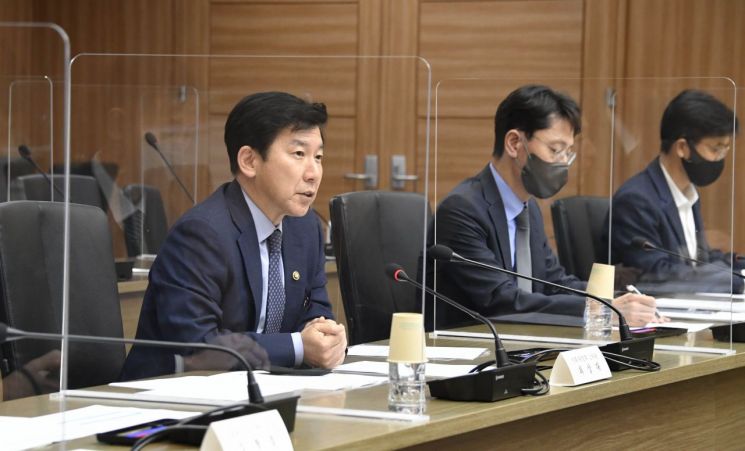
[Asia Economy Sejong=Reporter Kwon Haeyoung] The government plans to sell public institution assets worth a total of 14.5 trillion KRW, including non-core real estate, by 2027. As part of public institution innovation, the funds recovered through asset efficiency will be used to improve the financial soundness of public institutions and to implement national agenda tasks.
On the 11th, the Ministry of Economy and Finance held a Public Institution Management Committee meeting chaired by Second Vice Minister Choi Sang-dae and approved the asset efficiency plan included in the public institution innovation plan.
According to the public institution asset efficiency plan, 177 institutions will promote asset efficiency totaling 14.5 trillion KRW (799 cases) from this year until 2027 through disposal of ▲non-core real estate worth 11.6 trillion KRW (330 cases) ▲unnecessary other assets worth 700 billion KRW (189 cases) ▲non-core and insolvent investee company shares worth 2.2 trillion KRW (275 cases).
Korea Railroad Corporation (KORAIL) plans to sell the Yongsan Station area site, a non-core real estate asset. The planned sale price is 6.3146 trillion KRW based on book value and is expected to be disposed of within two years. Including the Korea Racing Authority Seocho site, Government Employees Pension Service road site, and Korea Veterans Welfare and Medical Service Construction Business Unit site, the total scale of idle real estate disposal is 9.4 trillion KRW (107 cases). Asset efficiency of 1 trillion KRW will be pursued through office building maintenance, and 300 billion KRW and 900 billion KRW respectively through maintenance of company housing and business support facilities.
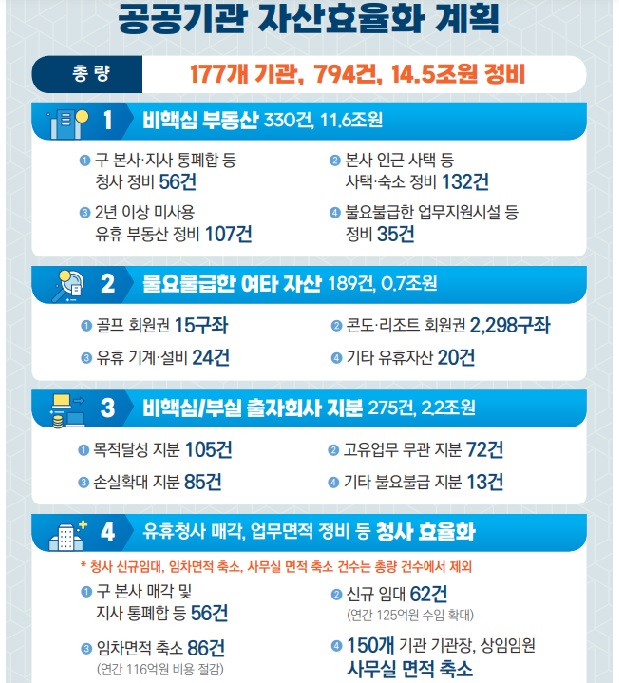
Unnecessary other assets such as golf memberships, condo and resort memberships, and idle machinery and equipment will also be disposed of by 107 institutions for about 700 billion KRW (189 cases). Korea Electric Power Corporation (KEPCO) will sell 4 golf memberships and 792 condo and resort memberships.
The announced plan also includes the sale of YTN shares held by KEPCO KDN and the Korea Racing Authority. Both companies hold 21.43% and 9.52% of YTN shares unrelated to their business, respectively. Five power generation companies have decided to dispose of the Bayan mine in Indonesia. The total scale of disposal of non-core and insolvent investee company shares that have achieved their purpose or are unrelated to core and unique tasks is about 2.2 trillion KRW (275 cases).
Furthermore, office building efficiency will also be promoted. Twenty-six institutions including Korea Electric Power Technology, Korea Land and Housing Corporation (LH), and Korea Educational Development Institute will secure 1 trillion KRW (56 cases) through the sale of old headquarters and consolidation of branch offices. They plan to increase annual income by 12.5 billion KRW through new leases of idle space resulting from office area adjustments and reduce costs by 11.6 billion KRW annually by reducing 86 leased spaces.
The scale of public institution asset sales this time is smaller than the original plans submitted by 176 institutions (23.2 trillion KRW). The Ministry of Economy and Finance explained that through discussions with the innovation task force (TF), items that did not conform to the asset efficiency plan such as public fund recovery and land for sale related to core business execution were excluded. The amounts submitted by each institution (book value or self-assessed value) are estimates, and actual disposal amounts may differ during the sales process.
A Ministry of Economy and Finance official said, "Each public institution has reorganized around essential assets necessary for performing core and unique functions, creating an opportunity to eliminate management inefficiencies and accumulated losses. While asset sales are based on institutional autonomy, transparent and fair sales procedures will be observed, and the implementation status of the finalized asset efficiency plan will be monitored and reflected in management evaluations to ensure smooth progress."
The Ministry of Economy and Finance plans to continuously discover and manage unnecessary assets and non-core and insolvent investee company shares annually.
Meanwhile, the plan for public institution function and organization and workforce efficiency will be finalized and announced in December after review by the innovation TF and inter-ministerial consultation and coordination.
© The Asia Business Daily(www.asiae.co.kr). All rights reserved.
![Clutching a Stolen Dior Bag, Saying "I Hate Being Poor but Real"... The Grotesque Con of a "Human Knockoff" [Slate]](https://cwcontent.asiae.co.kr/asiaresize/183/2026021902243444107_1771435474.jpg)

















