Opposition and Labor Groups Focus on Amending Article 2 of the Labor Union Act
Expansion of Union Scope and Legal Strike Range
[Asia Economy Reporter Seong Gi-ho] The National Assembly’s Environment and Labor Committee’s bill review subcommittee has resumed operations after six months. The opposition party has expressed its intention to actively discuss the passage of the "Trade Union and Labor Relations Adjustment Act (Trade Union Act) Amendment Bill" (commonly known as the Yellow Envelope Act), which limits damage compensation lawsuits arising from labor union strikes. The core of the Yellow Envelope Act is the amendment of Articles 2 and 3 of the Trade Union Act. However, recently, there has been a noticeable trend among the opposition and labor groups emphasizing a significant expansion of the definitions of workers and employers in Article 2 of the Trade Union Act, signaling potential conflicts ahead.
According to political circles on the 11th, the Environment and Labor Committee has been holding the Employment and Labor Bill Review Subcommittee since the 8th, reviewing 20 bills. The opposition plans to formally introduce the Yellow Envelope Act to the subcommittee for in-depth discussion following a public hearing scheduled for the 17th. The Korean Confederation of Trade Unions plans to hold a "100,000 Nationwide Workers Rally" near the Presidential Office in Yongsan-gu, Seoul, on the 12th to bolster support for the amendment of the Yellow Envelope Act.
The Yellow Envelope Act advocated by the opposition and labor groups centers on amendments to Articles 2 and 3 of the Trade Union Act. The amendment to Article 2 aims to broaden the scope of workers, employers, and strike actions, while the amendment to Article 3 seeks to limit claims for damages related to illegal strike actions.
Until now, the opposition and labor groups have focused primarily on amending Article 3, but recent developments indicate a shift. On the 25th of last month, the two major labor unions?the Korean Confederation of Trade Unions and the Federation of Korean Trade Unions?emphasized the need to amend Article 2 of the Labor Act during a National Assembly forum. The Korean Confederation of Trade Unions recently announced ten legislative tasks for the second half of the year. Unlike before, when the focus was on amending Article 3, this time the amendment of Article 2 has been included in their demands.
From the business community’s perspective, this shift is seen as an attempt to reduce the possibility of strike actions being deemed illegal by expanding Article 2, given the strong opposition to amending Article 3 of the Labor Act.
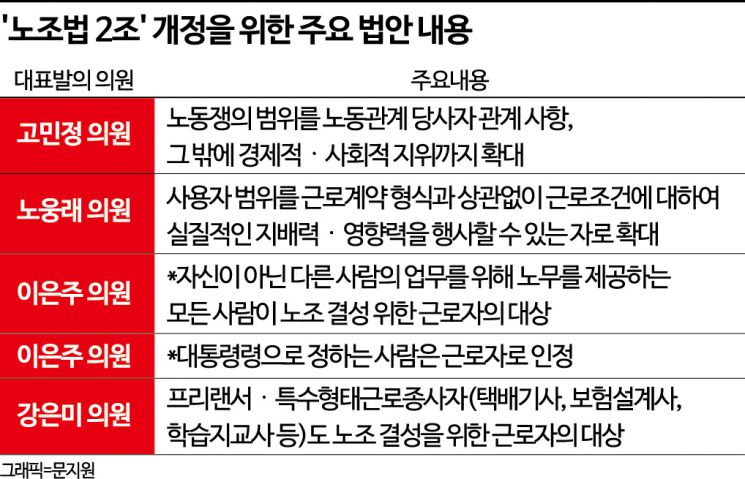
In fact, there have been consistent calls for the amendment of Article 2 of the Trade Union Act. Since the 21st National Assembly, a total of nine Yellow Envelope Act bills have been proposed. Among them, eight bills primarily focus on amending Article 2. These proposed amendments include adding “persons with substantial control or influence over working conditions” to the definition of employers or extending the employer category to include “dispatching and subcontracting employers.”
The scope of workers is also expanded to include special types of workers such as freelancers, delivery drivers, insurance planners, and private tutors as subjects eligible to form unions. For example, if the government commissions a public project, the union of the contracted service provider could negotiate directly with the government.
Additionally, the scope of strike actions could be expanded beyond employment and wages to include economic and social status, potentially legitimizing political strikes by unions.
The business community strongly opposes these amendment moves. Hwang Yong-yeon, Head of Labor Policy at the Korea Employers Federation, stated, "Our labor laws contain many penal provisions, so the principle of clarity must be upheld. However, if the amendment passes as is, the concept of workers will be greatly broadened, and the definition of employers will become vague, leading to significant confusion in labor-management relations."
Professor Kim Hee-sung of Kangwon National University Law School emphasized, "With the current power balance tilted toward unions, amending the Trade Union Act will further complicate the business environment. Legislative improvements such as removing the prohibition on replacement labor, banning strike actions involving workplace occupation, and clarifying the conditions for workplace lockouts are necessary as supplementary legislative measures to the Trade Union Act amendment."
© The Asia Business Daily(www.asiae.co.kr). All rights reserved.

















