Net Purchase of 5.7 Trillion KRW in One Month on the KOSPI Market... Focused Mainly on Large-Cap Stocks
Mixed Outlook on Whether the Net Buying Streak Will Continue
US October CPI as a Key Variable
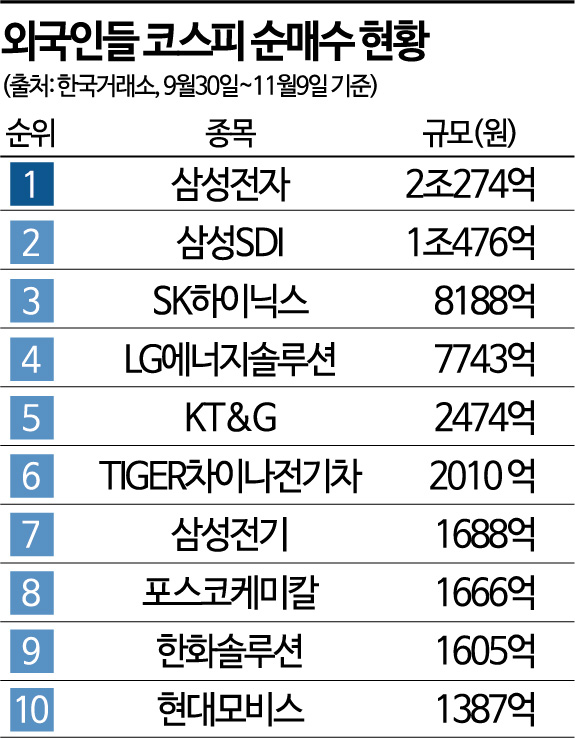
[Asia Economy Reporter Kwon Jae-hee] Amid a continued wave of net buying by foreign investors, Samsung Electronics has emerged as the most heavily purchased stock. Foreign investors have net bought over 2 trillion won worth of Samsung Electronics shares in just over a month. During this period, Samsung Electronics' stock price also rose by about 20% in response to the foreign investors' strong demand.
According to the Korea Exchange on the 10th, from September 30, when the KOSPI hit its lowest point this year (2134.77 points), until the previous day, foreign investors' most purchased stock over 27 trading days was Samsung Electronics. During this period, foreign investors net bought a total of 2.0274 trillion won worth of Samsung Electronics shares. This amount accounts for nearly 40% of the 5.728 trillion won net buying by foreign investors in the securities market during the same period. Due to the steady buying by foreign investors, Samsung Electronics' foreign ownership ratio rose to 49.86%. During this period, Samsung Electronics' stock price increased from 51,800 won to 62,200 won, nearly a 20% rise.
Alongside Samsung Electronics, SK Hynix, considered a leading semiconductor stock, was also net bought by foreign investors to the tune of 818.8 billion won during the same period. SK Hynix, which had fallen just before breaking below 80,000 won, rose nearly 9%, climbing from 80,400 won to 89,200 won.
The concentrated buying of semiconductor stocks by foreign investors appears to reflect expectations of an improvement in the semiconductor industry outlook. Due to the nature of semiconductors, stock prices tend to lead the industry conditions by about six months. Do Hyun-woo, a researcher at NH Investment & Securities, analyzed, "DRAM global suppliers are expected to reduce investments and cut production next year, and due to supply reduction, the industry outlook is anticipated to improve from the second quarter of next year."
Choi Do-yeon, a researcher at Shinhan Investment Corp., also interpreted, "This fourth quarter is a turning point testing the bottom of semiconductor companies' stock prices," adding, "Supply reduction is the key logic forming the bottom of the down cycle."
Besides the semiconductor sector, foreign investors also net bought mainly large-cap stocks during this period. The second most purchased stock after Samsung Electronics was Samsung SDI, with net buying of 1.0476 trillion won. Following were SK Hynix (818.8 billion won), LG Energy Solution (774.3 billion won), KT&G (247.4 billion won), Samsung Electro-Mechanics (166.8 billion won), POSCO Chemical (166.6 billion won), and Hanwha Solutions (160.5 billion won) in order of net buying volume.
In the securities industry, opinions are divided on whether the foreign investors' net buying streak will continue. Those who expect the rally to persist argue that the launch of Xi Jinping's third term as China's president will lead to continued benefits for the domestic stock market from foreign funds exiting the Chinese market. Park Sang-hyun, a researcher at Hi Investment & Securities, said, "The 'China Run' risk paradox is likely to drive foreign investors' net buying of domestic stocks for the time being."
Meanwhile, some predict that if the U.S. Consumer Price Index (CPI) for October, to be announced on the 10th, does not show a slowdown in inflation, the market could contract again. If the CPI exceeds the market forecast of 7.9%, the tightening stance could strengthen again, negatively impacting the Korean stock market. Kim Seok-hwan, a researcher at Mirae Asset Securities, said, "If the U.S. CPI announced on the 10th exceeds market expectations, the Federal Reserve's tightening stance could intensify."
© The Asia Business Daily(www.asiae.co.kr). All rights reserved.

















