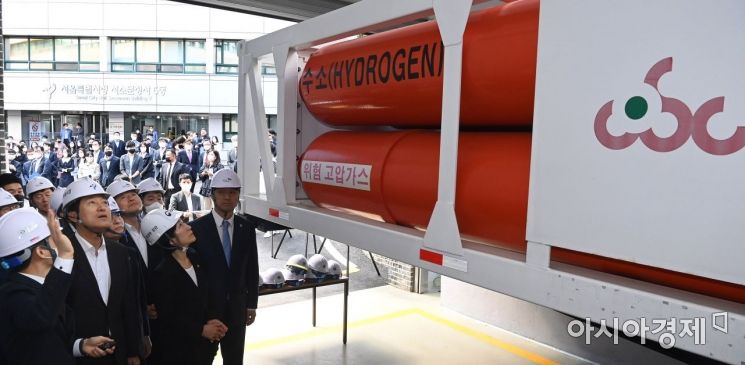
 Seoul Mayor Oh Se-hoon and Environment Minister Han Hwa-jin, among others, are attending the 'Seosomun Government Complex Hydrogen Charging Station Completion Ceremony' held on the 7th at the Seosomun Government Complex in Jung-gu, Seoul, and are inspecting the facility. Photo by Kim Hyun-min kimhyun81@
[Asia Economy Sejong=Reporter Dongwoo Lee] The government plans to lay the foundation for becoming a hydrogen powerhouse by distributing 30,000 hydrogen commercial vehicles and 70 liquefied hydrogen charging stations by 2030. It will build eco-friendly ammonia-powered carriers by 2026 and liquefied hydrogen carriers by 2029 to establish large-scale clean hydrogen production bases and supply chains domestically and internationally.
The Ministry of Trade, Industry and Energy announced this strategy on the 9th at the 5th Hydrogen Economy Committee held at Lotte Hotel in Jung-gu, Seoul, chaired by Prime Minister Han Duck-soo.
First, the number of hydrogen commercial vehicles, currently 211, will be increased to 30,000 by 2030, and 70 liquefied hydrogen charging stations will be distributed. The share of clean hydrogen power generation is planned to expand to 7.1% by 2036. Through this, an economic ripple effect of 47.1 trillion KRW, creation of 98,000 jobs, and reduction of approximately 28 million tons of greenhouse gases are expected by 2030.
The government will also complete technology development and demonstration for co-firing power generation with over 50% hydrogen and 20% ammonia by 2027 and gradually expand co-firing power generation from 2028. To establish hydrogen distribution infrastructure, it will build a liquefied hydrogen plant with an annual capacity of 40,000 tons, one of the largest in the world, and by 2030, create an ammonia receiving base with an annual capacity of 4 million tons in coal power plant dense areas, a liquefied hydrogen receiving base with an annual capacity of 100,000 tons in LNG power plant dense areas, and a dedicated hydrogen pipeline network.
It will also establish large-scale clean hydrogen production bases and supply chains domestically and internationally. The plan is to build eco-friendly ammonia-powered carriers by 2026 and liquefied hydrogen carriers by 2029. Starting from the first half of next year, the government will open a hydrogen power generation bidding market to create an institutional foundation for activating the clean hydrogen market. Korea Electric Power Corporation (KEPCO) and district electricity business operators will be designated as mandatory purchasers of hydrogen power generation, but general companies will also be allowed to purchase directly. The amount of hydrogen power generation will be set annually considering the basic power supply plan and greenhouse gas reduction targets.
The government plans to nurture 600 hydrogen-specialized companies and create regionally specialized clusters. From next year, it will produce 30,000 tons of liquefied hydrogen. The government aims to become a global leading country in the hydrogen industry by securing core technologies throughout the entire hydrogen cycle from production to storage, transportation, and utilization, fostering hydrogen-specialized companies, and easing regulations. It will focus on supporting the development of core technologies at the level of advanced countries in seven strategic areas: water electrolysis, liquefied hydrogen carriers, trailers, charging stations, mobility and power generation fuel cells, and hydrogen turbines.
Unreasonable regulations will be improved, private investment will be induced, and safety standards will be promptly established in areas lacking them. The government aims to increase the number of globally leading export items in five promising fields?hydrogen mobility, power generation fuel cells, water electrolysis systems, liquefied hydrogen carriers, and hydrogen charging stations?to 10 by 2030 through active support for export commercialization.
© The Asia Business Daily(www.asiae.co.kr). All rights reserved.
![Clutching a Stolen Dior Bag, Saying "I Hate Being Poor but Real"... The Grotesque Con of a "Human Knockoff" [Slate]](https://cwcontent.asiae.co.kr/asiaresize/183/2026021902243444107_1771435474.jpg)
















