In the Seoul Metropolitan Area, 53 out of 62 Locations Fail to Meet Criteria for 'Public Golf Course' Designation
[Asia Economy Reporter Choi Taewon] An analysis has emerged that 40% of existing public golf courses (so-called public golf courses) will not be recognized as 'public-type golf courses' due to changes in the government's golf course designation criteria.
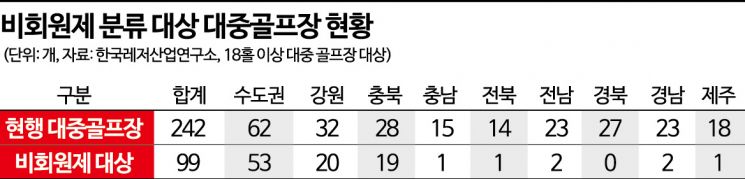
On the 9th, the Korea Leisure Industry Research Institute announced that when applying the 'Notice on Designation of Public-type Golf Courses' disclosed by the Ministry of Culture, Sports and Tourism, 99 out of 242 public golf courses nationwide with 18 holes or more, accounting for 40.9%, did not meet the notice standards.
According to the notice, to be designated as a public-type golf course, the usage fee (green fee) must be at least 34,000 KRW lower than the average non-member fee of member golf courses in the metropolitan area. The 34,000 KRW was calculated by converting the difference in individual consumption tax and property tax between metropolitan member golf courses and public golf courses on a per-user basis.
Previously, the government revised the Act on Installation and Use of Sports Facilities by dividing golf courses into member and non-member types, and designating only those non-member courses that meet usage fee requirements as 'public-type golf courses.' If designated as a public-type golf course, benefits such as exemption from individual consumption tax and reduction of property tax rates for three years are provided.
The average non-member green fee for metropolitan member golf courses is 221,000 KRW on weekdays and 280,000 KRW on Saturdays, and the green fee excluding tax differences is 187,000 KRW on weekdays and 246,000 KRW on Saturdays. If a golf course charges more than this amount, it is classified only as a simple non-member course, not a public-type golf course, and will be subject to higher taxes.
According to the institute's analysis, existing public golf courses in the metropolitan area and Gangwon and Chungbuk provinces, where green fees are relatively high, are expected to be excluded from tax reduction targets if they maintain current fees. In the metropolitan area, 53 out of 62 golf courses did not meet the notice standards. In Chungbuk, 19 out of 28, and in Gangwon, 20 out of 32 golf courses failed to meet the public-type designation requirements, the institute explained.
On the other hand, relatively inexpensive local public golf courses were found to maintain existing tax benefits. There were no golf courses failing to meet the requirements in Daegu and Gyeongbuk, and only one each in Chungnam, Jeonbuk, and Jeju. Busan and Gyeongnam had two such courses.
To maintain tax reduction benefits, non-member golf courses must submit a usage fee plan, including usage fee plans that limit the maximum price, to be designated as public-type golf courses.
The government expects that more than 60% of existing golf courses will lower usage fees to maintain tax benefits. However, some raise concerns that many golf courses may instead pass the increased tax burden onto customers through usage fee hikes.
Meanwhile, the government has not yet decided whether to impose individual consumption tax (21,120 KRW) on non-member golf courses other than public-type or to apply property tax surcharges like member golf courses. Seo Cheonbeom, director of the Leisure Industry Research Institute, said, "Considering the purpose of introducing the system to reduce the economic burden on users, property tax surcharges rather than individual consumption tax seem appropriate."
© The Asia Business Daily(www.asiae.co.kr). All rights reserved.

















