KAIST Develops Ultra-Small System Capable of Brain Stimulation and EEG Measurement
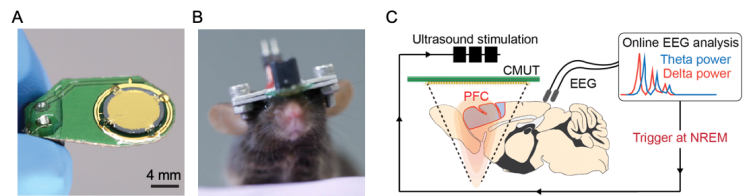 Technology to Stimulate the Brain Without Surgery Using Ultra-Miniature Ultrasound Devices - MEMS-Based Ultra-Miniature Ultrasound Components
[Asia Economy Reporter Kim Bong-su] A technology has been developed that installs a miniature ultrasound device in the brain to regulate sleep and enhance short-term memory without surgery, and can be used to treat various brain diseases.
The Korea Advanced Institute of Science and Technology (KAIST) announced on the 9th that a joint research team led by Professor Hyun-Joo Lee of the Department of Electrical Engineering and Electronics and Dr. Jung-Yeon Kim of the Korea Brain Research Institute developed a miniature system capable of simultaneous ultrasound brain stimulation and electroencephalogram (EEG) measurement in small animals. Using this technology, which allows real-time ultrasound brain stimulation according to sleep states, they demonstrated that stimulating the prefrontal cortex (PFC) during non-rapid eye movement (NREM) sleep can regulate sleep and short-term memory in real time.
The miniature ultrasound stimulation and EEG measurement system developed in this study can perform long-term simultaneous stimulation and measurement in freely moving mice, unlike existing systems that require anesthesia. The ultrasound stimulation device was fabricated using silicon processes of Micro Electro Mechanical Systems (MEMS), enabling highly precise, ultra-small production and mass manufacturing. If this ultra-lightweight system is applied to various animal models of brain diseases in the future, it is expected to evaluate the effects of ultrasound brain stimulation on multiple brain disorders.
Unlike existing neural stimulation technologies, ultrasound can stimulate localized small areas deep within the brain without surgery, making low-intensity focused ultrasound therapy a promising technology. Recently, research on the therapeutic effects and efficacy of low-intensity focused ultrasound has been actively conducted. Numerous studies have reported improvements in Alzheimer's disease, Parkinson's disease, epilepsy, obesity, and arthritis after ultrasound exposure to the brain or human body.
Methods to verify the efficacy of neural stimulation include in vivo signal measurement and behavioral observation. However, implementing these in small animals, which have many disease models, is not easy. Existing ultrasound stimulation technologies are bulky, making them unusable in moving mice, or generate noise signals during operation, making simultaneous electrophysiological signal measurement difficult. In particular, there was no system capable of providing long-term ultrasound stimulation while measuring in vivo responses in real time in small animals like mice. Therefore, ultrasound stimulation experiments in small animals typically involve short-term stimulation followed by immediate response observation or multiple stimulations under anesthesia to observe long-term responses.
To address these issues, the research team has continuously conducted studies on MEMS-based miniature ultrasound devices (CMUT, Capacitive Micromachined Ultrasound Transducer). In this study, by integrating EEG signal measurement and real-time sleep analysis technology, they developed a customized closed-loop stimulation system that delivers stimulation based on the brain's current state. The closed-loop stimulation algorithm analyzes sleep stages in real time every 6 seconds and delivers ultrasound stimulation during the NREM sleep stage. This system enables simultaneous stimulation and measurement without noise signals. When stimulating the prefrontal cortex of sleep-deprived mice during NREM for 10 hours, short-term spatial memory was preserved, and rapid eye movement (REM) sleep increased.
The research team is currently developing a follow-up system capable of stimulating very small single brain regions to further advance this new technology. They expect that precise sleep stage regulation through localized stimulation will open the door to non-invasive treatment of sleep disorders, Alzheimer's disease, Parkinson's disease, and other brain diseases without surgery.
Professor Hyun-Joo Lee stated, "Ultrasound is one of the safe human exposure technologies, as it is used for fetal imaging, and it can penetrate deep inside the human body and focus without spreading, making it a very attractive non-surgical human exposure technology for treatment." He added, "However, due to the lack of preclinical stimulation systems, research evaluating the efficacy of ultrasound stimulation is currently insufficient. We hope that many neuroscience research teams will utilize the system we developed to reveal various therapeutic effects of ultrasound."
The research results were published on the 19th of last month in the international journal Advanced Science.
© The Asia Business Daily(www.asiae.co.kr). All rights reserved.
![Clutching a Stolen Dior Bag, Saying "I Hate Being Poor but Real"... The Grotesque Con of a "Human Knockoff" [Slate]](https://cwcontent.asiae.co.kr/asiaresize/183/2026021902243444107_1771435474.jpg)
















