BOK Announces October Trends in International Finance and Foreign Exchange Markets
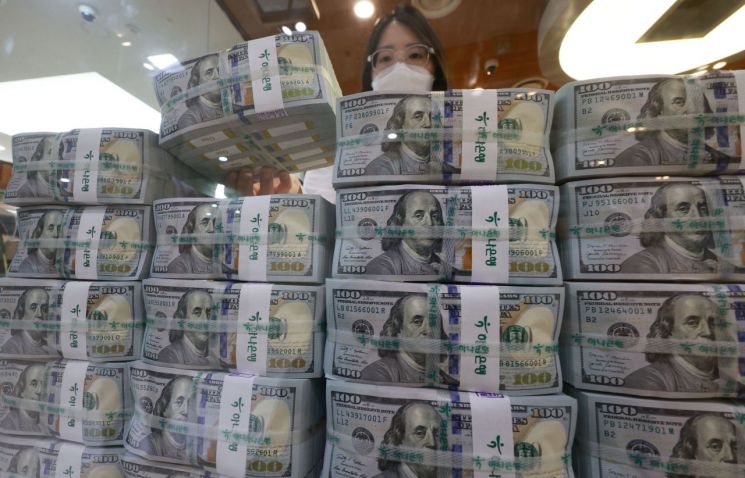
Last month, foreign investors purchased a total of $2.77 billion worth of domestic stocks and bonds. This is interpreted as a partial recovery of financial market instability despite the U.S. Federal Reserve's (Fed) aggressive tightening.
According to the "International Finance and Foreign Exchange Market Trends" released by the Bank of Korea on the 9th, foreign investment funds in domestic stocks recorded a net inflow of $2.77 billion in October. Based on the end-of-October won-dollar exchange rate (1,424.3 KRW), this amounts to approximately 3.9453 trillion KRW.
Foreign securities investment funds saw net inflows of $3.7 billion in July and $1.71 billion in August, but turned to a net outflow of $2.29 billion in September before switching back to net inflows within a month.
Foreign investors' stock funds recorded a net inflow of $2.49 billion. The Bank of Korea explained, "Despite concerns over the Fed's continued tightening, net inflows turned positive mainly in the electrical and electronics sectors due to easing financial instability in the UK and the influx of bargain hunting."
Bond funds shifted from a net outflow of $640 million in September to a net inflow of $280 million last month as private capital inflows expanded. If the Fed's move to slow the pace of tightening becomes more evident, the scale of net foreign capital inflows is expected to increase further.
The won-dollar exchange rate declined despite South Korea's cumulative trade deficit, influenced by the Bank of Korea's base rate hikes, foreign investors' demand for currency conversion to purchase domestic stocks, and expectations of easing China's zero-COVID policy.
As of the end of October, the won-dollar exchange rate stood at 1,424.3 KRW, but it started at 1,376.0 KRW in the Seoul foreign exchange market on the day and has continued to decline. The dollar is showing weakness ahead of the U.S. midterm election results and the October consumer price index announcement.
The won-dollar swap rate (3 months) rose despite the widening interest rate differential between domestic and foreign rates, supported by foreign investors' purchases of non-deliverable forwards (NDF), supply of foreign currency funds, and favorable foreign currency liquidity conditions. As of the 7th, it was -1.51%, up 0.15 percentage points from -1.66% in September.
The currency swap rate (3 years) increased amid stable government bond yields, driven by foreign currency fund demand from institutional investors for overseas investment purposes, swap rate rises, and supply of foreign currency funds for interest rate arbitrage.
Last month, the average daily foreign exchange transaction volume in the domestic interbank market was $29.22 billion, down $200 million from the previous month. The 5-year credit default swap (CDS) premium on foreign exchange stabilization bonds, which indicates the country's credit risk, rose from 0.40 percentage points in September to 0.61 percentage points last month.
© The Asia Business Daily(www.asiae.co.kr). All rights reserved.
![Clutching a Stolen Dior Bag, Saying "I Hate Being Poor but Real"... The Grotesque Con of a "Human Knockoff" [Slate]](https://cwcontent.asiae.co.kr/asiaresize/183/2026021902243444107_1771435474.jpg)
















