Department Store Sales Increased by 16.4% Compared to the Same Period Last Year Through September
Convenience Store Sales Also Rose by 9.9% … Local Supermarkets Increased by Only 0.4%
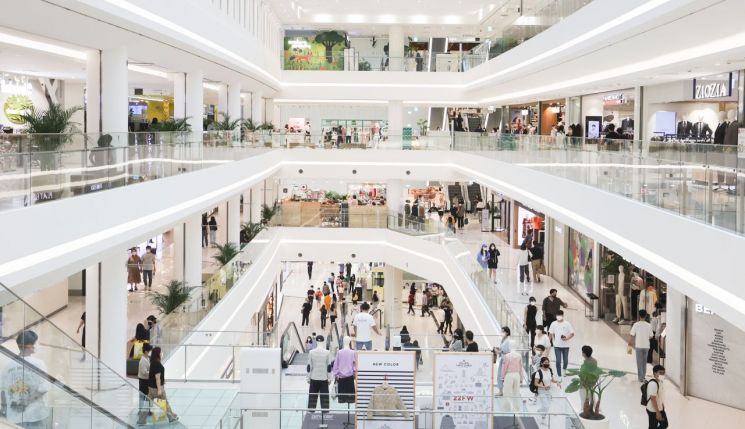
[Asia Economy Culture Young Intern Reporter] Although department store sales have increased significantly this year after the social distancing measures were lifted, neighborhood supermarkets have remained stagnant.
According to Statistics Korea and the Small and Medium Business Research Institute on the 9th, domestic retail sales from the beginning of this year to September reached 408.4 trillion won, a 7.4% increase compared to the same period last year. Among these, department store sales amounted to 27.6 trillion won, increasing by 16.4%, showing the largest growth. The department store sales growth rate was 22.9% for the entire last year, and this year it continues to show double-digit growth.
Convenience stores, operated mainly in franchise form, recorded sales of 23.2 trillion won, up 9.9%. Last year, the convenience store sales growth rate was 7.2%. In contrast, supermarkets mainly operated by small businesses and small merchants posted sales of 34.6 trillion won, increasing by only 0.4%. The sales growth rate for supermarkets and general stores was -2.2% last year but turned positive this year, though it barely reached single-digit growth in decimal points.
The warmth has not spread to neighborhood alley markets like this. In the case of department stores, the base effect due to the COVID-19 pandemic played a role, and strong demand for luxury goods along with designer brands popular among the MZ generation led to strong performance in the high-margin fashion category. High-end alcoholic beverages such as wine and whiskey also became trendy among young people, increasing demand. Additionally, the lifting of social distancing measures brought an increase in foreign tourists, which also helped.
Shinsegae’s sales from January to September were 5.5987 trillion won, up 27.8% from the same period last year. Operating profit increased by 56.4% to 504 billion won. Hyundai Department Store also saw sales rise 38.8% to 3.4317 trillion won and operating profit increase 48.3% to 252.3 billion won during the same period.
Convenience stores also benefited from increased outdoor activities and more users after the COVID-19 pandemic. In the era of high inflation, the cost-effectiveness of items like lunch boxes highlighted the advantages of convenience stores, and due to their low average transaction value, they were less affected by price increases.
Neighborhood supermarkets did not enjoy these effects. Competition has intensified day by day due to the growth of convenience stores and e-commerce companies, leading to continued sluggishness. In the era of high inflation, they inevitably lose out in price competition with large discount stores. Moreover, concerns about economic recession and the resulting contraction in consumption are also worrisome.
Total retail sales in September were 44.8 trillion won, a 5.5% increase compared to the same month last year. This growth rate was the lowest since February (5.3%) and dropped by 4.2 percentage points from the previous month. In particular, sales of supermarkets and general stores fell back into decline, dropping 4.4% to 4.4 trillion won. The department store sales growth rate also slowed from 19.0% in August to 6.2% in September. Convenience store sales growth decreased from 11.8% to 8.9%.
© The Asia Business Daily(www.asiae.co.kr). All rights reserved.

















