Naver and Kakao Slow Hiring Due to Labor Cost Burden
Cash-Strapped IT Startups Undergo Intensive Restructuring
"In the IT industry, developers were almost considered a sacred and inviolable domain, but now there is an atmosphere where they cannot avoid being targets of restructuring. Even CTO-level executives are being vetted and let go."
[Asia Economy Reporters Yuri Choi and Nahum Kang] The hiring market in the IT industry is rapidly freezing. Portal companies like Naver and Kakao have started to slow down their hiring pace by limiting the increase in labor costs. Startups are also conducting restructuring indiscriminately, from developers to C-level executives. This is a distinctly different atmosphere from last year when talent was being poached through salary competition.
Nakao's Rising Labor Costs Slow Down... Conservative Hiring Policy
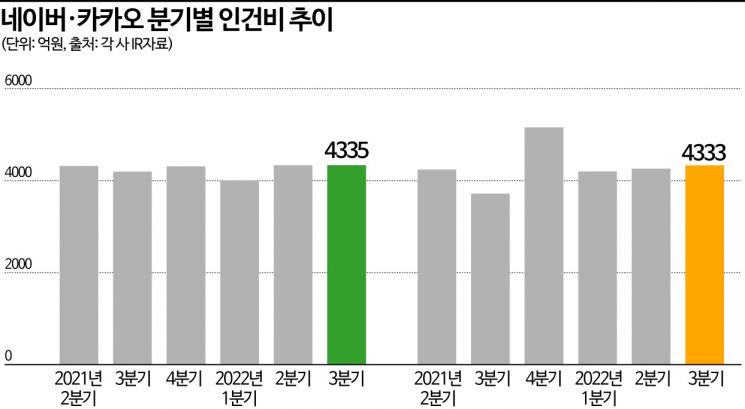
According to the IT industry on the 9th, Naver and Kakao plan to slow down their hiring pace. Until last year, they increased their workforce with triple-digit hiring, but next year they intend to adopt a conservative hiring policy focusing on new businesses.
The change in hiring policy is already noticeable. The labor cost growth, which increased by more than 10% each quarter, began to slow down in the second half of the year. In the third quarter of this year, Naver's labor costs were 433.5 billion KRW, slightly down from the previous quarter. Kakao's labor costs were 433.3 billion KRW, increasing by only 2% compared to the previous quarter.
On the 7th, Naver CEO Su-yeon Choi said during the earnings conference call, "While we have increased overall personnel due to essential hiring for business expansion, the growth rate is slowing down. The headquarters will focus on management, and hiring will be conducted at a reasonable level mainly in subsidiaries that require investment."
The reason the two companies are slowing their hiring pace is that labor cost burdens have increased amid slowing growth. As a result, profitability has also deteriorated. Naver's operating profit in the third quarter was 330.2 billion KRW, down 5.6% year-on-year. Kakao's operating profit also decreased by 10.6% to 150.3 billion KRW.
Park Won-cheol, Vice President of Kakao's HR Operations, said, "Large IT companies always have essential personnel to hire, so they will maintain their hiring policy but will not expand it significantly. I also expect the wage increase competition to gradually decrease."
'Name Your Price' Developers Also Face Restructuring
The situation is even more severe for IT startups. As funding dries up, they are not only halting new hires but also reducing staff through restructuring. Mesh Korea, which operates the delivery platform 'Boorung,' conducted restructuring last month after failing to secure investment. They accepted voluntary retirement applications from all employees, and about 30%, or around 100 people, left the company. Humart Company, which operates the mental care solution 'Troost,' is also reported to have laid off about 30% of its employees recently.
Developers, who were in such high demand that the phrase "name your price" was used, have also become targets of restructuring. Oneul Table, the operator of the seafood same-day delivery service 'Oneulhoe,' laid off most of its staff including the Chief Operating Officer (COO). They currently maintain only a minimal workforce and have partially resumed the suspended service. Logistics startup Two Hands recently notified more than 50% of its headquarters employees, including developers, of recommended resignation.
A startup HR manager said, "In the past, there was a tendency to hire more than necessary to avoid losing developers, but now only essential positions are hired. Reference checks during hiring have become stricter than before, and if performance is not met after hiring, the rate of letting people go has increased."
Another startup official said, "Investors are demanding a lot of management efficiency, so we are tightening our belts on hiring as well. Starting next year, we are reviewing whether some tasks can be outsourced or replaced with temporary workers."
© The Asia Business Daily(www.asiae.co.kr). All rights reserved.

















