Preventing Collapse and Chaos: Building Trust in Inter-Korean Exchanges through Nuclear Safety and Energy Development
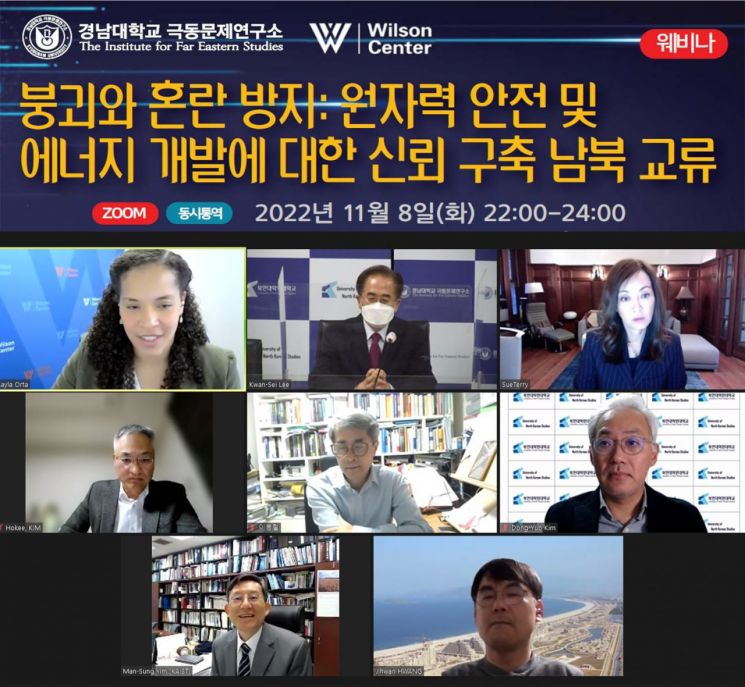 The Institute of Far Eastern Studies at Gyeongnam National University held an academic conference with the Woodrow Wilson Center on the theme of building trust in inter-Korean exchanges through nuclear safety and energy development.
[Asia Economy Yeongnam Reporting Headquarters, Reporter Song Jong-gu] The Kyungnam University Institute of Far Eastern Affairs, under the sponsorship of the Ministry of Unification, held an academic conference on the 8th in collaboration with the Woodrow Wilson Center (WWICS) on the theme "Preventing Collapse and Chaos: Building Trust in Inter-Korean Exchanges through Nuclear Safety and Energy Development."
The first session, titled "Nuclear Energy and Nuclear Safety on the Korean Peninsula," featured presentations by Professor Lim Man-sung of KAIST on "North Korea's Nuclear Energy: Benefits, Risks & Possibilities," Kim Ho-gi from the Korea Institute of Nuclear Safety as a commissioned regulator on "South Korea's Nuclear Safety Cooperation: Lessons from the World's Leading Nuclear Energy Developer," and Francesca Giovannini, Executive Director of the Nuclear Governance Project at Harvard Kennedy School, on "A Disaster of Waiting or Mere Paranoia? Reviewing North Korea's Nuclear Safety Status and Factors for Safety Enhancement."
Professor Lim pointed out "the research gap regarding North Korea's national energy infrastructure using nuclear technology," emphasizing that "a technological diplomacy approach considering nuclear safety and energy development with North Korea from a long-term perspective should be adopted." Following this, Kim from the Institute mentioned "the intervention and background for building nuclear safety capabilities between South and North Korea, the level of nuclear technology capabilities between the two Koreas, and North Korea's nuclear-related laws," arguing for "the necessity of regulatory intervention by the international community, including South Korea, in North Korea's nuclear safety based on international standards." Executive Director Giovannini raised "the need for discussion on North Korea's nuclear safety concerns due to its international isolation and sanctions," proposing "comprehensive engagement and intervention necessary for responding to nuclear accidents that may arise from natural disasters and technical instability."
In response, Professor Lee Byung-chul of Kyungnam University’s Institute of Far Eastern Affairs argued that "inter-Korean energy cooperation should be approached from a sustainability perspective oriented toward the future, and trust-building based on North Korea's denuclearization must precede the establishment of renewable energy infrastructure with North Korea." Professor Kim Dong-yeop of the University of North Korean Studies diagnosed that "if North Korea's nuclear energy development is regarded as a compensation measure for denuclearization, North Korea will not respond to it," adding that "it is realistic to drive North Korea's nuclear energy development and the North Korean nuclear issue on two tracks and create a linkage to prevent backtracking."
The second session, themed "Nuclear Non-Proliferation and Its Implications for the Future," included presentations by Professor Siegfried Hecker of Texas A&M University on "Nuclear Cooperation with North Korea: Is It Desirable? Is It Possible?" and Professor Jeffrey Lewis of the MIIS East Asia Non-Proliferation Project on "The Nuclear Non-Proliferation Treaty from a Historical Perspective: An Opportunity for Energy-Led Cooperation on the Korean Peninsula?"
In response, Professor Kim Jin-ah of Hankuk University of Foreign Studies stated, "To achieve the goal of integrating North Korea into the international regime, a dilemma arises in tolerating potential possibilities that could cause proliferation concerns," arguing that "a realistic judgment on the permissible scope of North Korea's universal rights is necessary." Professor Hwang Ji-hwan of the University of Seoul pointed out that "unlike nuclear cooperation between the U.S. and the Soviet Union, nuclear cooperation between North Korea and the U.S. is structurally different as it involves cooperation between a weak state and a strong power," expressing doubt about "whether the U.S. Congress will agree to nuclear safety cooperation with North Korea and provide energy aid to North Korea."
Director Lee Kwan-se said, "It was meaningful that the most authoritative experts in South Korea and the U.S. gave in-depth presentations on nuclear safety and energy development issues and that Korean experts discussed these," adding, "I hope that related discussions will become more active following this presentation event."
© The Asia Business Daily(www.asiae.co.kr). All rights reserved.

















