International Cryosphere Climate Initiative Announces Cryosphere Status 2022
"Sea Ice Will Continue Melting for 100 Years Even After Achieving Carbon Neutrality"
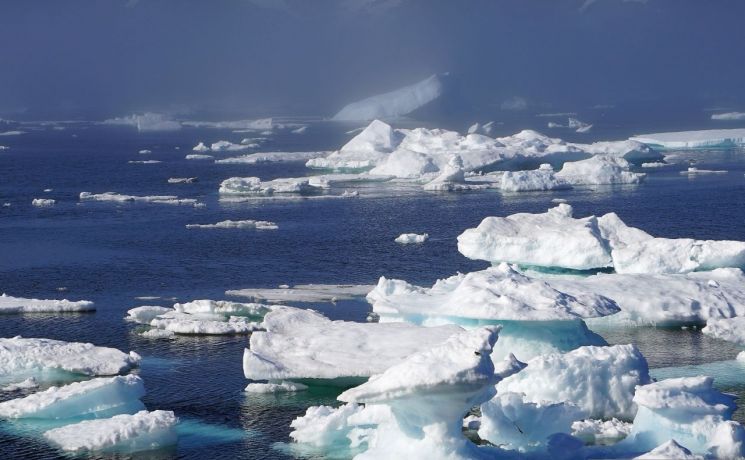
[Asia Economy Reporter Park Hyun-joo] Due to the impact of climate change, it is projected that in 30 years, there will be no summer ice in the Arctic Ocean.
On the 7th (local time), according to The Guardian and others, the International Cryosphere Climate Initiative (ICCI) announced the latest report analyzing polar conditions, "State of the Cryosphere 2022," at the 27th United Nations Climate Change Conference of the Parties (COP27) held in Egypt.
According to the report, the global cryosphere, composed of glaciers, sea ice, and permafrost, is rapidly melting due to global warming. If this trend continues, the sea ice that used to float in the Arctic Ocean every summer is effectively given a deadline to disappear completely by 2050.
Robbie Mallett, co-author of the report and a sea ice researcher at University College London (UCL), stated, "Just as it is no longer possible to keep the global temperature rise below 1.5 degrees Celsius, there is no way to avoid ice-free summers in the Arctic Ocean," adding, "The COP27 meeting will do little to help preserve the Arctic summer sea ice." He expressed concern that "if the Arctic sea ice area decreases, stronger winds and waves will increase erosion, severely impacting regions where more than 4.5 million people live."
Scientists say that to change the trend of climate change, carbon neutrality must be achieved by 2050. To do this, carbon dioxide emissions must be reduced by half compared to 2005 levels by 2030.
However, the report notes that even if the carbon neutrality goal is achieved, it will take time for the cryosphere to stabilize, and glaciers will continue to melt until 2200. For Arctic sea ice to begin reforming, the global temperature rise compared to pre-industrial levels must be limited to about 1 degree Celsius. Even in this case, the report analyzes that some glacier loss may continue for hundreds to thousands of years due to ocean warming, but sea level rise is unlikely to exceed 3 meters.
Meanwhile, voices calling for swift action on the climate crisis were raised at the COP27 summit. United Nations Secretary-General Ant?nio Guterres warned in a speech on the 7th, "The Earth is rapidly approaching the peak of irreversible disruption caused by climate change," and said, "(This situation) is like pressing the accelerator on a highway to climate hell."
He emphasized that developed countries must quickly conclude agreements to financially support greenhouse gas reduction and energy transition in developing countries. Secretary-General Guterres urged, "The United States and China must actively engage in this agreement," and stated, "We are at a point where we must choose either to form this solidarity agreement or head toward collective destruction."
© The Asia Business Daily(www.asiae.co.kr). All rights reserved.

















