Overtaking Toyota for the First Time... Surpassing BMW, Volkswagen, and Hyundai Too
Differences Include Immediate Reflection of Raw Material Price Changes and Active Software Sales
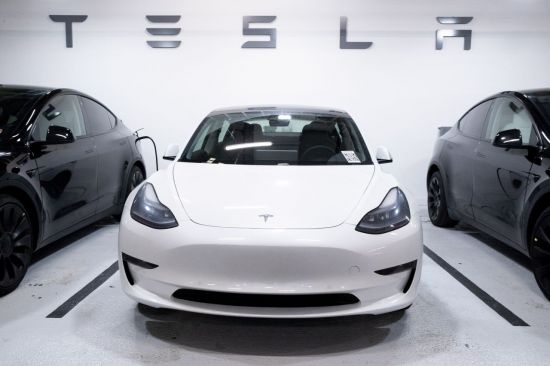
[Asia Economy Reporter Kim Junran] The quarterly net profit of Tesla, the American electric vehicle specialist, has surpassed that of Japanese automaker Toyota for the first time ever. Despite selling about eight times more vehicles than Tesla, Toyota recorded lower profits.
According to foreign media and the automotive industry on the 8th, Tesla posted a net profit of 4.4046 trillion KRW in the third quarter of this year (July to September), based on the average quarterly exchange rate, surpassing Toyota's net profit of 4.203 trillion KRW for the first time. Tesla also outperformed BMW (4.2799 trillion KRW), Volkswagen (2.8752 trillion KRW), and Hyundai Motor Company (2.7717 trillion KRW, excluding provisions), which rank second and third globally in terms of sales volume.
Considering that Tesla's vehicle sales volume is about one-eighth that of Toyota, the profitability gap is even greater. Toyota sold 2.625 million vehicles in the third quarter, while Tesla sold only 344,000 units. Nevertheless, Toyota's profitability was overtaken by Tesla because the operating profit per vehicle for Toyota is approximately 2.07 million KRW, about one-seventh of Tesla's roughly 14.54 million KRW.
The faster-than-expected reversal in net profits between the two companies is partly due to short-term setbacks for Toyota. Toyota has recently been hit hard by soaring raw material prices and its withdrawal from business in Russia. The depreciation of the yen, which caused a sharp rise in electricity costs, was also a major factor worsening profitability. Earlier, Toyota explained in its earnings announcement on the 1st that the business environment had significantly deteriorated due to increased costs of raw materials and labor caused by the sharp rise in the dollar-yen exchange rate.
Mercedes-Benz still holds the top spot with a net profit of 5.3893 trillion KRW, but the industry is paying attention to the fact that a company selling only electric vehicles has surpassed the world's largest automaker. Tesla's unique business model, which immediately reflects raw material price increases in sales prices and actively pursues software sales such as autonomous driving, is credited with driving improved performance.
There is also analysis that the management strategies of Tesla, an electric vehicle specialist, and traditional automakers fundamentally differ. Companies like Toyota produce and sell everything from low-profit small cars to high-profit luxury cars, whereas Tesla focuses on a small variety of high-priced models. The use of giga press manufacturing, which stamps out parts in one go with a large casting machine, and online sales to reduce production and sales costs are also seen as positive factors contributing to profit growth.
Accordingly, existing automakers are also developing new business models by referencing Tesla's example. Hyundai Motor plans to apply software over-the-air update functions to all new cars starting next year and aims to convert all models to 'Software-Defined Vehicles (SDV)' by 2025.
© The Asia Business Daily(www.asiae.co.kr). All rights reserved.

















