No Board Approval Needed Unlike Corporate Bonds
No Credit Rating Evaluation Process
CP Issuance Has No Impact on Average Market Interest Rates
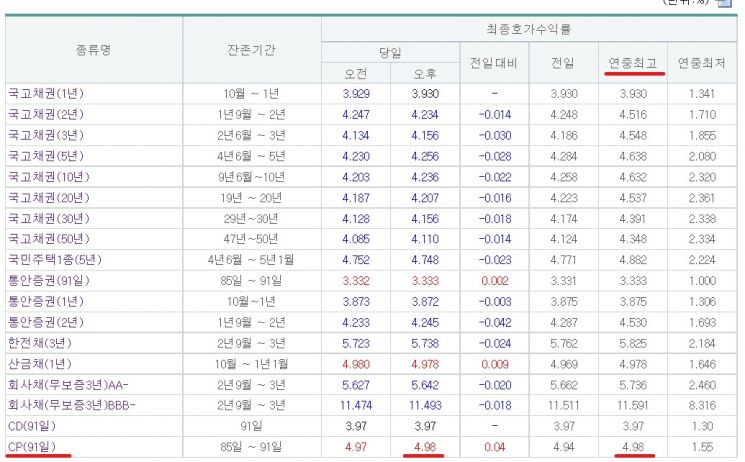
[Asia Economy Reporter Hwang Yoon-joo] The corporate paper (CP) interest rate is approaching 5%. As large corporations flock to the CP market, the interest rate is hitting new daily highs. This is due to the advantage of simpler issuance procedures compared to corporate bonds and the fact that it does not affect the average market interest rate. With a recession becoming more certain, demand for funding to secure operating capital is expected to continue.
According to the Korea Financial Investment Association on the 8th, the interest rate for A1-rated CP (91-day maturity) closed at 4.98%, up 0.04 percentage points from the previous day.
The CP interest rate was only 1.55% per annum on January 3 this year but rose sharply to 2.09% (May 26), 3.01% (August 25), and 4.02% (October 19). The rate had been rising due to the central bank's tightening stance, but recently, companies have been flocking to the CP market as a means of raising funds.
SK Group is a representative example. SK Inc. decided on the 10th to issue 100 billion KRW each of 3-year and 5-year CP. This is the first time SK Inc. has issued long-term CP. Previously, SK Networks issued 100 billion KRW of 44-day CP, and Lotte Construction issued 49 billion KRW of 6-month CP.
An industry insider said, "With the global economy expected to enter a recession, large corporations are proactively raising operating funds through the CP market. While raising funds in the corporate bond market is difficult due to Korea Electric Power Corporation (KEPCO), it is relatively easier for large corporations to issue long-term CP (over one year) in the CP market."
There are three main reasons why companies turn to the CP market. Unlike corporate bonds, CP does not require board resolution. Also, it does not require a credit rating evaluation. Procedurally, it is simpler than corporate bonds.
Secondly, issuing CP does not affect the average market interest rate (the average evaluation rate by private bond rating agencies). Yoon Won-tae, a researcher at SK Securities, explained, "Corporate bond interest rates are determined as 'average market rate + a spread,' and once issued, the rate rarely moves, influencing subsequent corporate bond rates. On the other hand, CP interest rates are unrelated to the average market table, so the issuing company bears less burden."
Above all, the tightening liquidity in the corporate bond market is a major factor. So far, ultra-high-grade (AAA) KEPCO corporate bonds have swept up market funds by offering high interest rates around 5-6% per annum. This is why the industry insider pointed to KEPCO as a reason why raising funds in the corporate bond market is difficult. However, after the shock caused by the 'Legoland ABCP' payment guarantee incident in Gangwon Province, the market froze to the extent that some KEPCO corporate bonds were recently undersubscribed.
For this reason, companies are turning their eyes to the CP market, which is relatively easier to attract investors than the corporate bond market. From the investor's perspective, CP with higher interest rates is considered more advantageous.
However, a financial sector official pointed out, "Since the Monetary Policy Committee has made a rate hike a foregone conclusion, if CP prices fall, investors will also suffer losses, so the CP issuance interest rate is crucial."
He added, "Another point to consider is that if large corporations or high-quality companies flock to the CP market, it will become even more difficult for small and medium-sized enterprises to raise funds. The fact that large corporations are issuing long-term CP is not a good signal."
© The Asia Business Daily(www.asiae.co.kr). All rights reserved.

















