Korea Astronomy and Space Science Institute, Total Eclipse Begins at 7:16 PM
Next Total Lunar Eclipse on September 8, 2025
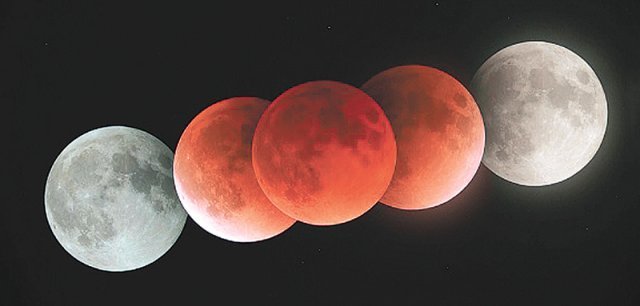
[Asia Economy Reporter Bora Lee] On the night of the 8th, a total lunar eclipse, where the moon is completely covered by the Earth's shadow, is expected to be visible in Korea. It is reported to be a rare opportunity to observe not only the moon but also Jupiter and Saturn using a celestial telescope.
According to the Korea Astronomy and Space Science Institute, today (the 8th) at 6:08 PM, a partial eclipse will begin as the left side of the moon is covered by the Earth's shadow. Then, from 7:16 PM, a total eclipse will follow as the moon fully enters the Earth's shadow.
At 7:59 PM, the 'maximum eclipse,' when the moon is deepest in the Earth's shadow, can be observed. At this time, the moon's altitude is about 29 degrees, and if you are in a place with an open eastern horizon, you can see the maximum eclipse with the naked eye, explained the Korea Astronomy and Space Science Institute.
At 8:41 PM, the moon will exit the Earth's shadow, ending the total eclipse. After that, a partial eclipse will continue until the entire lunar eclipse process concludes at 10:57 PM.
Especially at 8 PM, when the total eclipse is at its maximum, the red light scattered in the Earth's atmosphere will be reflected on the moon, allowing viewers to see the red moon called the Blood Moon. The reason the moon appears red during a total lunar eclipse is due to red light.
Using a celestial telescope, it is expected that not only the moon but also Jupiter and Saturn can be observed simultaneously. Mars is also known to be observable at 9 PM.
A lunar eclipse occurs when the sun, Earth, and moon align in a straight line, causing the moon to be covered by the Earth's shadow. Among these, a total lunar eclipse refers to the case where the moon is completely covered by the Earth's shadow.
A partial lunar eclipse occurs when the sun, Earth, and moon are not perfectly aligned in a straight line but slightly offset, so only part of the moon is covered. This lunar eclipse can be seen in Asia, Australia, the Americas, and the Pacific. In Korea, the next total lunar eclipse is expected to be observed on September 8, 2025.
© The Asia Business Daily(www.asiae.co.kr). All rights reserved.

















