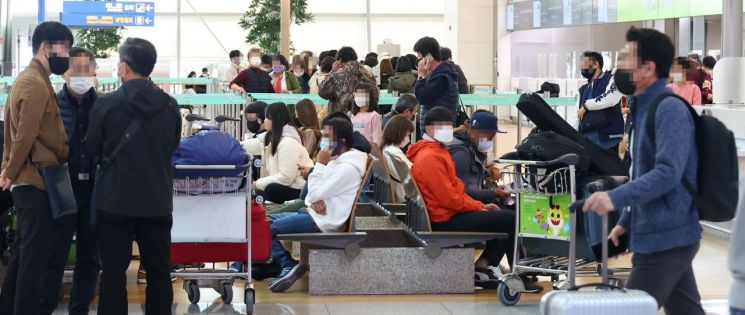
[Asia Economy Reporter Byeon Seon-jin] As the spread of COVID-19 accelerates, the number of new confirmed cases surged to over 60,000 on the 8th. Health authorities predicted that daily confirmed cases could reach up to 200,000 this winter.
The Central Disease Control Headquarters announced that as of midnight on the day, 62,273 new COVID-19 cases were added, bringing the total cumulative confirmed cases to 25,919,183. The number of new cases on this day is the highest in 54 days since September 15 (71,444 cases), and it is 3.3 times (43,602 cases) higher than the previous day (18,671 cases), when the number of tests conducted over the weekend caused a decrease in confirmed cases.
Experts believe that the seventh wave of the pandemic has effectively begun since early this month. The number of cases increased by 3,910 compared to a week ago on the 1st (58,363 cases) and by 18,532 compared to two weeks ago on October 25 (43,741 cases). Moreover, it has shown a weekly increase for four consecutive weeks compared to the same day of the previous week since October 11 (15,465 cases). The number of critically ill patients currently hospitalized is 360, with an ICU bed occupancy rate of 26.6%. The previous day recorded 30 COVID-19 deaths.
With red flags raised on COVID-19 epidemic indicators, health authorities urged high-risk groups to get vaccinated. Currently, the winter vaccine reservation and vaccination rates for those aged 60 and over are low, at 11.3% and 8.6% of the population, respectively. Jung Ki-seok, head of the COVID-19 Special Response Team and member of the National Infectious Disease Crisis Response Advisory Committee, emphasized, “The current vaccine reservation rate is very low. Unlike in the past, in a situation with high transmissibility, all high-risk groups must get vaccinated.”
There are also calls to improve the system to actively administer oral COVID-19 treatments to patients, as the prescription rate is below 30%. Professor Cheon Eun-mi of the Respiratory Medicine Department at Ewha Mokdong Hospital pointed out, “If a patient with a fever at night visits the emergency room and is diagnosed with COVID-19 but cannot be admitted, antiviral drugs should be administered. However, currently, prescriptions for oral treatments are restricted to prevent overcrowding in emergency rooms.” According to the Central Disease Control Headquarters guidelines, oral treatment prescriptions in emergency rooms are only allowed for hospitalized patients, considering the opinions of the Ministry of Health and Welfare and the Korean Society of Emergency Medicine, and prescriptions are not permitted for general emergency cases.
This winter, authorities face great challenges as there is a possibility of a 'multidemic' with the coexistence of not only COVID-19 but also influenza, metapneumovirus, and respiratory syncytial virus (RSV). The government will announce on the 9th the basis for its prediction that up to 200,000 confirmed cases could occur this winter, along with comprehensive prevention plans.
© The Asia Business Daily(www.asiae.co.kr). All rights reserved.

















