Seoul City Announces 'Year-End and New Year Late-Night Boarding Difficulty Comprehensive Measures'
Complete Lift of Personal Taxi Restrictions from the 10th... Priority Night Shift Scheduling and Expanded Hiring for Corporate Taxis
37 Additional Buses on 3 Owl Bus Routes... Temporary Extension of Last City Bus Runs During Year-End
Priority Implementation of 'No Destination Marking' and Other Public Service Improvements
[Asia Economy Reporter Lim Cheol-young] To alleviate the late-year late-night taxi shortage, the Seoul Metropolitan Government will lift the personal taxi restriction system and adjust late-night surcharges to supply an additional 7,000 taxis. Additionally, the city will extend the operation of three owl bus routes?N32, N34, and N72?and extend the last bus times to 1 a.m. for buses passing through densely populated areas in Seoul to support citizens' safe transportation.
On the 8th, Seoul announced a comprehensive late-night ride shortage countermeasure plan aimed at improving citizens' late-night convenience. Baek Ho, Director of Seoul's Urban Transportation Office, explained, "As this is the first year-end and New Year period after the lifting of social distancing, late-night ride shortages are expected. Therefore, we have prepared comprehensive measures ranging from taxis to buses," adding, "We will expand citizens' choices for late-night transportation."
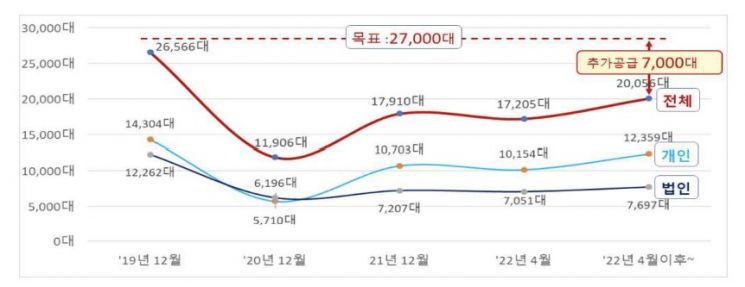
Since April 20, Seoul has implemented policies to increase taxi supply, such as lifting late-night restrictions, expanding late-night exclusive taxis, and encouraging night shift changes, increasing late-night taxi supply to about 20,000 vehicles per day?up to 30% of pre-COVID-19 levels. However, this still remains at about 80% compared to pre-COVID-19 levels. Despite additional measures like increasing owl buses and extending last bus and subway times, the late-night ride shortage has not been resolved.
Full Lift of Personal Taxi Restrictions, Formation of Night Shifts for Corporate Taxis... Additional Supply of 7,000 Taxis
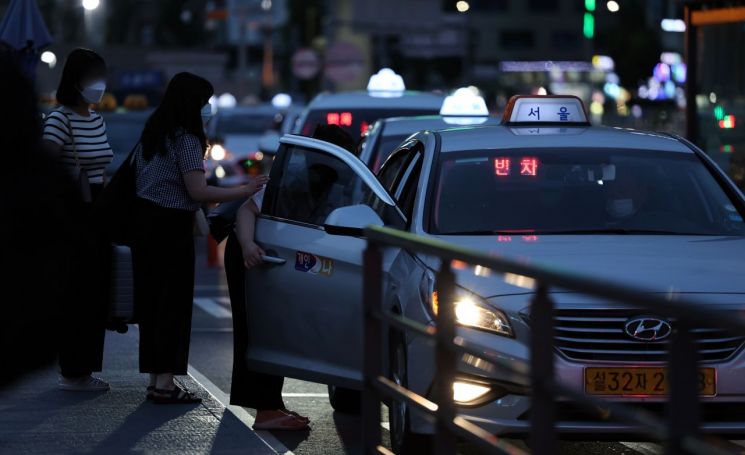
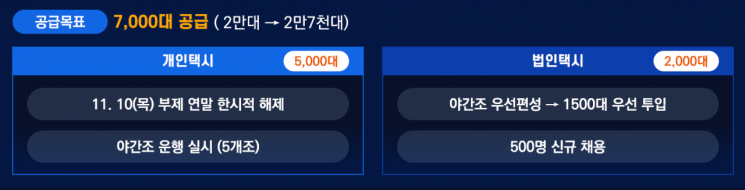
First, Seoul will supply 27,000 taxis during the year-end period, exceeding pre-COVID-19 year-end levels. To supply an additional 7,000 taxis, the personal taxi restriction system will be fully lifted from the 10th for the first time in 45 years, while corporate taxis will increase the proportion of night shift drivers from the current workforce. A job fair will be held in November to actively recruit new drivers, alongside efforts to extend driver tenure. Through this, 5,000 additional personal taxis and 2,000 corporate taxis will be supplied.
Director Baek stated, "After lifting the restriction system, we plan to address issues through administrative sanctions on non-operating vehicles and encourage concentrated night shift deployment on Thursdays and Fridays," adding, "The Ministry of Land, Infrastructure and Transport will take back the authority to lift restrictions and maintain the full lifting of restrictions after the year-end period starting from the 22nd."
From December 1, late-night surcharges will be adjusted. In the first phase, the late-night surcharge period will be moved forward from midnight to 10 p.m., with surcharge rates adjusted up to 40% depending on the time. The second phase will raise the base fare from 3,800 won to 4,800 won, increase by 1,000 won, and reduce the base distance from 2.0 km to 1.6 km, adjusting fares accordingly.
Additionally, Seoul will expand the operation of late-night ride support teams in areas with severe ride shortages to alleviate citizens' inconvenience in hailing taxis. Temporary boarding stands will be installed at 11 locations with severe ride shortages, including Suseo Station and Seoul Station, expanding from the existing three locations?Gangnam Station, Hongdae Entrance, and Jonggak. On-site, city officials and taxi association representatives will support one-to-one matching between passengers and taxis.
Extension of 3 Owl Bus Routes, Addition of 37 Buses... Temporary Extension of Buses Passing Through High-Density Areas
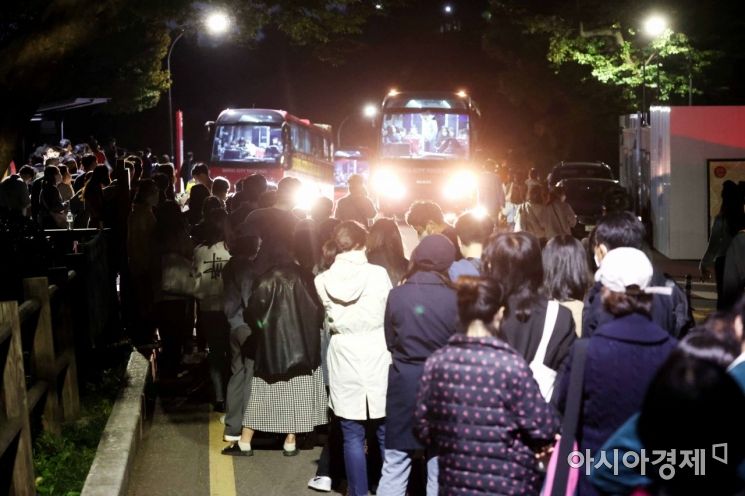 Citizens watching the 2022 Seoul World Fireworks Festival at Namsan, Seoul, are waiting for the bus to go home.
Following taxis, owl buses will also be increased by 37 vehicles starting December 1, including extensions of three routes: N32, N34, and N72. The existing N32 route (Songpa Garage to Sinseol-dong) will be extended and renumbered as N73, operating approximately 76.0 km via Jamsil Station, Konkuk University Station, Euljiro 1(il)-ga Station, and Hongdae Entrance Station, running 8 times daily at an average 35-minute interval.
The existing N34 route (Gangdong Garage to Sinsa Station) will be extended and renumbered as N31, operating approximately 73.7 km via Cheonho Station, Jamsil Station, Gangnam Station, Jonggak Station, and Hyehwa Station, running 8 times daily at an average 35-minute interval. The N72 route (Eunpyeong Garage to Sinseol-dong Station) will be extended to run approximately 70.0 km via Hongdae Entrance Station, Itaewon Station, Cheongnyangni Station, and Sangbong Station, running 9 times daily at an average 30-minute interval.
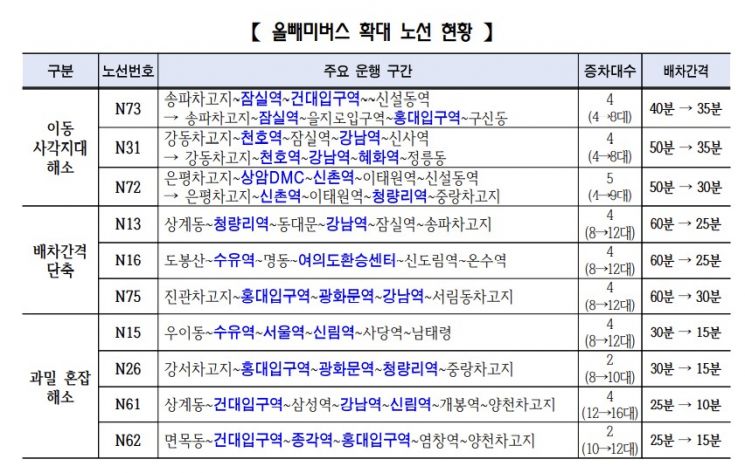
For routes passing through areas with high floating populations such as N13, N16, and N75, late-night dispatch intervals will be shortened to within 30 minutes. Routes running through Gangnam, Hongdae, and Jongno areas, including N15, N26, N61, and N62, will operate with dispatch intervals of 10 to 15 minutes during peak congestion times to reduce onboard crowding. Furthermore, from December 15 to December 31, Seoul will temporarily extend the last bus time to 1 a.m. for 2,364 buses on 88 city bus routes passing through major high-density areas such as Gangnam, Hongdae, and Yeongdeungpo, supporting safe late-night transportation alongside the expansion of owl buses.
Priority on 'Destination Non-Disclosure' That Aggravates Ride Shortages... Improvement of Transportation Workers' Treatment
Seoul will also prioritize addressing the issue of destination non-disclosure, which worsens late-night ride shortages. Currently, when passengers call platform-mediated taxis via apps for free, the passenger's destination is displayed to the driver, enabling drivers to selectively pick rides based on longer distances or preferred directions, known as 'selective picking.' The city will implement strict crackdowns on ride refusals and selective picking, along with a courteous fare refund system, to support citizens in using taxis conveniently.
In particular, to avoid issues like those in past taxi fare increases where only taxi companies profited without benefits reaching transportation workers, supplementary measures have been prepared. For six months after the implementation of late-night surcharge adjustments, the distribution ratio of transportation revenue and excess income will be frozen to ensure that fare increases benefit drivers. Thereafter, except for minimum operating costs, all revenue will be mandated to be used for improving transportation workers' treatment.
If both late-night surcharges and base fare adjustments are implemented, the average monthly pre-tax income of drivers operating during late-night hours is expected to increase from 2.64 million won to 3.44 million won, a rise of 800,000 won (30%), significantly impacting drivers' welfare. Additionally, according to the late-night call fee policy, night shift drivers can earn an extra 200,000 to 300,000 won.
Director Baek said, "We will closely collaborate with the government, taxi industry, and platform companies to establish a virtuous cycle system linking taxi late-night surcharge and fare adjustments → improvement of workers' treatment and service → expansion of taxi supply," adding, "Through expanding public transportation capacity such as owl buses, we will do our best to ensure citizens can return home safely and conveniently late at night."
© The Asia Business Daily(www.asiae.co.kr). All rights reserved.



















