North Korea "Cruise Missile Retaliatory Strike off Ulsan Coast"
Joint Chiefs of Staff "Detection Results Differ from North Korea's Claim"
Seemingly Employing 'Deception Tactics' While Building Justification for Provocation
[Asia Economy Reporter Jang Hee-jun] North Korea claims to have carried out an overwhelming military operation against South Korea in response to the South Korea-U.S. joint air exercise 'Vigilant Storm.' It disclosed detailed information on weapons and strike targets by date. This is interpreted as an attempt to build a justification for military provocations externally while strengthening internal unity and military discipline.
However, North Korea's announcement was found to include many fabricated claims, such as reusing missile launch footage from the past or falsely stating that "retaliatory fire was directed at the waters off Ulsan." In particular, it is analyzed that they are employing deceptive tactics by omitting mentions of the 'Hwasong-17' intercontinental ballistic missile (ICBM), which was classified as a failure, and instead inserting footage of the 'Hwasong-15' launch.
According to the Korean Central News Agency on the 7th, the General Staff of the Korean People's Army stated, "To demonstrate a thorough and resolute will to respond to the grave situation and clear confidence in the military capabilities of the Republic's armed forces, and to add victorious confidence to our soldiers' firm will for retaliation, we conducted a counter military operation from November 2 to 5."
North Korea: "Retaliatory fire at waters off Ulsan"... Joint Chiefs: "No detection"
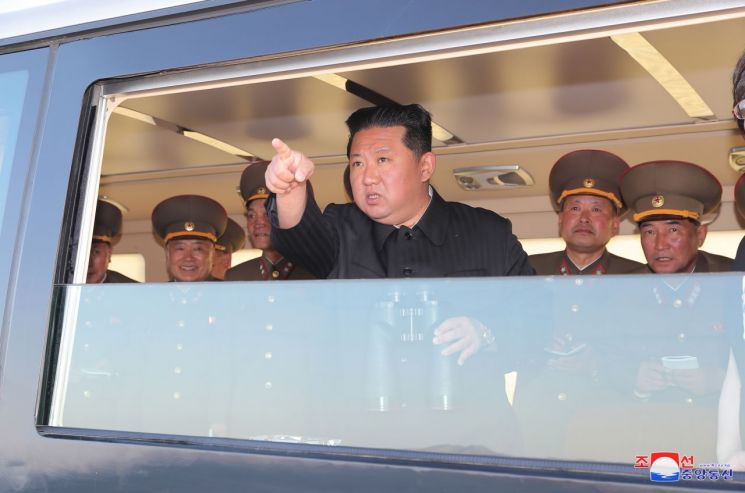 Photos released by the Korean Central News Agency showing Kim Jong-un, General Secretary of the Workers' Party of Korea, observing the test launch of a "new tactical guided weapon" last April.
 [Image source=Yonhap News]
The General Staff disclosed specific operational details and strike targets by date, announcing that missiles targeting South Korea's air bases were launched. On the first day of the operation (2nd), it explained, "Missile units in the Pyonganbuk-do region simulated strikes on enemy air bases and launched four tactical ballistic missiles equipped with cluster warheads and underground penetration warheads targeting an uninhabited island in front of the West Sea Lock."
In the explanation of the first day of the operation, the General Staff stated, "The enemy claimed that our missiles landed near South Korea's 'territorial waters' and recklessly fired air-to-surface guided missiles and glide bombs at our public waters," and "from the Hamgyongbuk-do region, two strategic cruise missiles with a range of 590.5 km were launched as retaliatory strikes at public waters about 80 km off the coast of Ulsan, South Korea."
Earlier, on the 2nd, the South Korean military responded to North Korea's ballistic missile launch south of the Northern Limit Line (NLL) in the East Sea by firing three precision air-to-surface missiles from Air Force F-15K and KF-16 jets into public waters north of the NLL. One of the three short-range ballistic missiles (SRBMs) fired by North Korea was aimed at Ulleungdo, prompting an unprecedented air raid alert across Ulleung County.
However, two contradictions were detected in North Korea's announcement. The General Staff claimed to have launched 'cruise missiles' toward the waters off Ulsan as a counterattack to the South's response, but a Joint Chiefs of Staff official told Asia Economy, "Based on detection and analysis by South Korea-U.S. surveillance and reconnaissance assets, North Korea's claim is false," and flatly denied, "No cruise missiles were detected by our forces at that time."
Especially, the phrase "enemy's claim" regarding the missile landing near South Korea's territorial waters appears to be an attempt to insist that their missiles did not cross the NLL. However, the South Korean military deployed naval rescue vessels to the area and recovered one piece of debris presumed to be from the missile on the 6th. This object is currently undergoing detailed analysis by relevant agencies.
Omission of 'Failed ICBM'...Inserting other missile photos and EMP claims
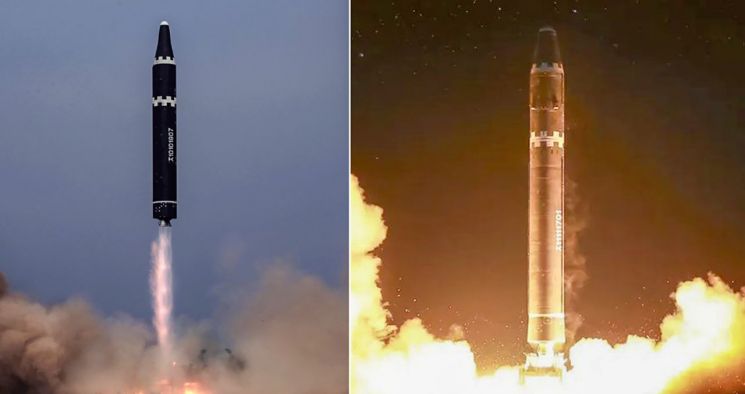 On the 7th, the North Korean military announced that it conducted military operations against South Korea over four days from the 2nd to the 5th in response to the South Korea-U.S. joint air exercise "Vigilant Storm." The South Korean military assessed that North Korea launched a Hwasong-17 intercontinental ballistic missile (ICBM) during these operations. However, photos of the missile launch released by the Korean Central News Agency on the same day show that the nozzle (flame exhaust port) appears to be fewer than the four nozzles of the Hwasong-17, suggesting it may be the existing Hwasong-15. Nonetheless, this missile has a pointed warhead compared to the Hwasong-15 on the right, leading to analysis that it is intended to increase speed upon re-entry into the atmosphere.
 [Image source=Yonhap News]
The General Staff also claimed, "On the second day of the operation (3rd), at the request of the National Defense Science Institute, an important ballistic missile test launch was conducted to verify the operational reliability of a special function warhead designed to paralyze the enemy's operational command system." This appears to refer to the ICBM classified as a failure, but the fact that the ICBM was not directly mentioned is interpreted as indirect acknowledgment of the failure.
Previously, the ICBM launched by North Korea on the 3rd from the Sunan area in Pyongyang was detected flying at a maximum altitude of about 1,920 km, a flight distance of 760 km, and a top speed of Mach 15 (15 times the speed of sound). Although the first and second stage boosters separated successfully after launch, the warhead failed to gain proper speed, leading to its classification as a failure.
Military authorities analyzed the ICBM launched by North Korea as the 'Hwasong-17,' but North Korea released photos presumed to be of a modified 'Hwasong-15' warhead on the same day. Since they had already announced a successful test launch of the Hwasong-17 under the leadership of Kim Jong-un, General Secretary of the Workers' Party, in March this year, it seems they were reluctant to release photos of the failed missile.
Instead, North Korea framed this as a threat involving an electromagnetic pulse (EMP). The 'operational command system' mentioned in the General Staff's claim refers to the command, control, communications, computers, and intelligence (C4I) system. If a missile equipped with a nuclear warhead detonates at a certain altitude, a powerful EMP is generated, which can disable ground command systems.
In the past, North Korea also threatened by releasing three photos of an object claimed to be a 'hydrogen bomb' warhead just before the sixth nuclear test in September 2017, stating, "Our hydrogen bomb is a multifunctional thermonuclear warhead capable of detonating at high altitude for strategic purposes, delivering a super-strong EMP attack over a vast area."
Reused photos and inflated number of military aircraft..."North Korea seems to be employing deceptive tactics"
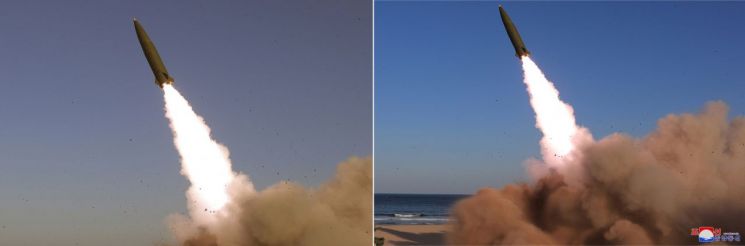 North Korean forces announced on the 7th that they conducted military operations against South Korea for four days from the 2nd to the 5th in response to the South Korea-U.S. joint air exercise "Vigilant Storm." On the left is a missile launch photo related to the military operation released by North Korea's Korean Central News Agency on the same day. On the right is a launch scene of a "new tactical guided weapon" reported on April 17, which is presumed to be reused based on the shape of the missile and flames. [Image source=Yonhap News]
Additionally, on the third day of the operation (4th), North Korea boasted of deploying 500 various fighter jets, an exaggerated claim. On that day, the South Korean military identified only about 180 aircraft tracks, and one fighter jet taking off and landing repeatedly can leave multiple tracks. This is interpreted as an attempt to emphasize that they deployed more than twice the number of fighter jets compared to the approximately 240 air assets mobilized by South Korea and the U.S. for Vigilant Storm.
Kim Jun-rak, spokesperson for the Joint Chiefs of Staff, drew a line under North Korea's inflated claims during a regular briefing that day, stating, "Not all of North Korea's reports are true." This implies that North Korea is employing deceptive tactics.
In fact, among the photos released by the North Korean General Staff through the Korean Central News Agency that day, footage of the launch of a 'new tactical guided weapon' reported in mid-April was reused. Although the past photos were slightly enlarged, edited, and had their saturation altered, they are clearly the same photos to the naked eye.
Notably, North Korea also extensively reported this content in the Rodong Sinmun, combining internal propaganda with external announcements. This is notable because previously, military provocations were only disclosed externally. It is interpreted as an effort to demonstrate determination not to be outmatched by South Korea and the U.S., to portray effective responses to external threats, and to strengthen internal unity and military discipline.
Professor Park Won-gon of Ewha Womans University's Department of North Korean Studies analyzed, "The North Korean military has continuously made exaggerated and inflated announcements," adding, "Internally, they are packaging their responses, and externally, they are boasting of having forces that are not inferior to South Korea and the U.S." He further predicted, "Since this has already been frequently mentioned in the international community, the possibility of a nuclear test timed for the U.S. midterm elections has decreased, but continuous provocations and nuclear tests remain possible at any time."
© The Asia Business Daily(www.asiae.co.kr). All rights reserved.
![Clutching a Stolen Dior Bag, Saying "I Hate Being Poor but Real"... The Grotesque Con of a "Human Knockoff" [Slate]](https://cwcontent.asiae.co.kr/asiaresize/183/2026021902243444107_1771435474.jpg)













