Ministry of Culture, Sports and Tourism Announces 2021 National Reading Status... Annual Total Reading Volume 4.5 Books
Preference for Watching Videos Over Text... Increased Use of E-books and Audiobooks
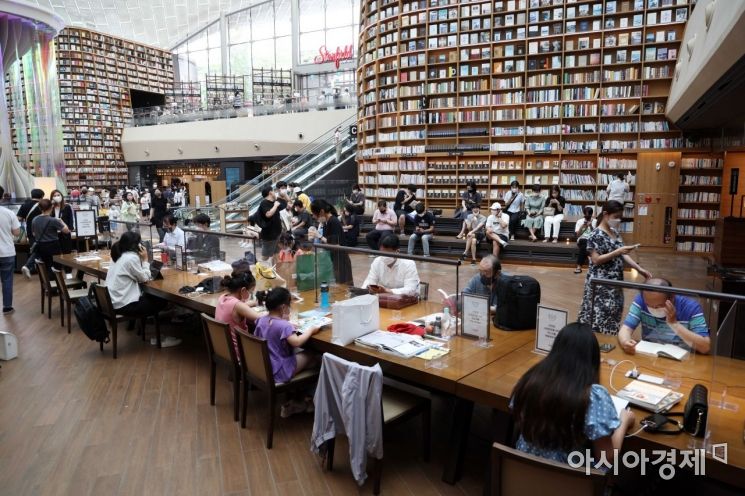
[Asia Economy Culture Young Intern Reporter] The population reading books in South Korea is steadily decreasing. Annual comprehensive reading volume has declined, while reading activities using e-books and other formats have increased, according to a survey.
According to the "2021 National Reading Status" released by the Ministry of Culture, Sports and Tourism, the annual comprehensive reading volume of Korean adults is 4.5 books. This is 3 books less compared to 2019. The annual paper book reading rate among adults is 40.7%, down 11.4 percentage points from 51.1% in 2019. Reading time was limited to 20.4 minutes on weekdays and 27.3 minutes on holidays for adults.
The main reasons for the decrease in reading time were "no time due to work" and "using other media and content such as smartphones, television, and internet games." In contrast, e-books and audiobooks showed an increasing trend. The e-book reading rate was 19% for adults and 49.1% for students, increasing by 2.5 percentage points and 11.9 percentage points respectively compared to 2019.
Recent reading status survey results were similar. Market research firm Embrain Trend Monitor conducted an awareness survey on online and offline bookstore usage and book club participation among 1,000 adults aged 19 to 59 nationwide. The reading experience in the past year was 88.2% overall. However, the average reading volume was only about 2-3 books (27.1%) or 4-5 books (17%).
The perception that reading is essential in life has also decreased compared to previous surveys. In response to the question "Do you think reading is essential?", 79.7% answered "yes" in 2016, but only 67.1% did so in 2022. The perception that "books should only be read by those who need to" increased from 12.4% in 2016 to 19% in 2022.
The response that using the internet is more helpful than acquiring information through books increased from 31.5% in 2016 to 34% in 2022. Additionally, the answer that "to succeed in Korean society, one must read many books" was highest among those in their 50s at 42.4%, followed by 33.6% in their 20s, 27.6% in their 30s, and 36.4% in their 40s. This indicates a deepening stagnation in overall reading culture, which is interpreted as a preference for watching videos over reading text.
While the paper book reading rate is declining, e-book platforms are steadily growing. Millie's Library, which introduced South Korea's first subscription-based e-book service, has had 910,000 subscribers as of August this year and a cumulative total of 5.5 million subscribers since its establishment in 2016. Mr. A, who has been using Millie's Library for two years, said, "It's more convenient to read on my phone like this than to buy books every time or go to the library to borrow them."
However, some express concerns that if the overall book market size continues to shrink, the overall growth of books will slow down. They also worry that since books are close to mental goods, in a situation of sustained high inflation, consumers tend to react sensitively to essential goods.
In response, experts advise that reading promotion policies suitable for the times should be introduced. Professor Kim Eunggyo of the Department of Basic Liberal Arts at Sookmyung Women's University said in an interview with KTV National Broadcasting, "Along with paper books, we should not neglect the development of various media (books), and although the reading rate of paper books is decreasing, we should remember that the usage rate of e-books is increasing and support both sides."
© The Asia Business Daily(www.asiae.co.kr). All rights reserved.

















