Dining Out Prices Rise 8.9% with All 39 Items Increasing... Processed Foods Surge 9.5%
Core Inflation Showing Long-Term Price Trends Also Rises 4.8%, Largest Increase Since Global Financial Crisis
[Asia Economy Sejong=Reporter Kwon Haeyoung] Last month, dining-out prices, which rose by nearly 9%, were identified as the main culprit behind the increase in consumer price inflation. The core consumer price index, which shows the long-term trend of inflation, also soared to its highest level in about 14 years since the global financial crisis.
According to the National Statistical Portal on the 5th, dining-out prices for all 39 items surveyed by Statistics Korea rose by 8.9% compared to the previous month. Although this was 0.1 percentage points lower than the previous month (9.0%), the high upward trend continued.
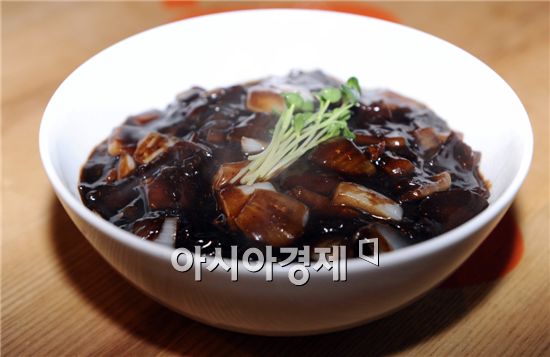
By item, the price of Jajangmyeon rose the most, soaring 13.2% compared to the previous month. Gimbap (13.0%), Galbitang (12.1%), Ramyeon (12.1%), and Hamburgers (12.0%) followed. Next were Kalguksu (11.8%), Haejang-guk (11.7%), Tteokbokki (11.7%), Jjamppong (11.2%), Donkatsu (10.9%), Samgyeopsal (10.6%), Dosirak (10.4%), Chicken (10.3%), and Pizza (10.1%), all recording double-digit growth rates.
Meal costs at company, government office, and university cafeterias, mainly used by office workers and students due to cost burdens, also rose 5.3% compared to the previous month.
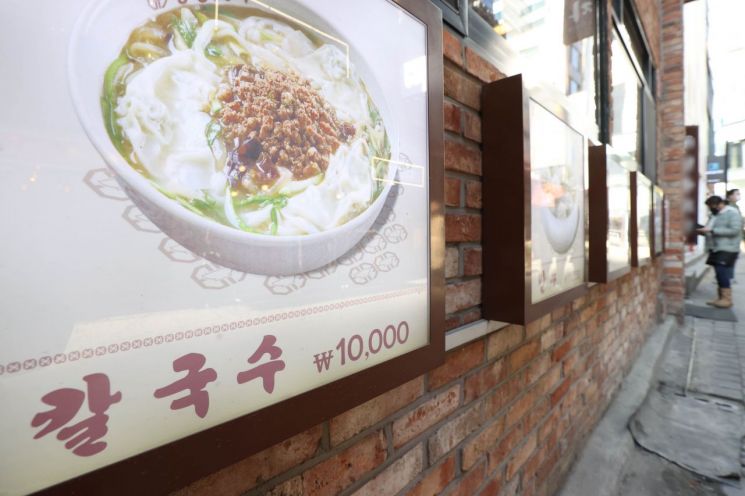
In the case of dining out, prices tend to be downwardly rigid once they rise, so even if the inflation rate slows down, it is pointed out as a factor that will continuously burden high inflation in the future.
Similar to dining out, prices of processed foods, which also have high downward rigidity, led the rise in food prices by jumping 9.5%. Among the 73 items that make up processed foods, prices of 70 items increased, and among them, 28 items (38.4%) recorded double-digit growth rates.
Edible oil rose the most at 42.8%, followed by flour (36.9%), pancake mix (30.8%), noodles (29.7%), starch syrup (28.9%), cheese (27.9%), kimchi (25.3%), cereal (24.4%), jam (21.2%), and crab sticks (20.3%), all showing significant price increases.
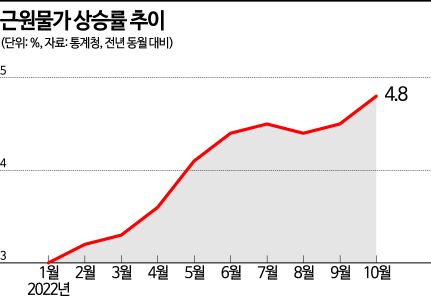
The core inflation index (excluding agricultural products and petroleum products), which shows the underlying trend of inflation, stood at 107.47, rising 4.8% year-on-year. Not only did this expand the increase from the previous month (4.5%), but it also marked the highest level in 13 years and 8 months since February 2009 (5.2%). Core inflation, which excludes items affected by seasonal factors or temporary shocks such as agricultural products and petroleum products, is an indicator showing the long-term trend of inflation. The expanded rise in core inflation last month suggests that the high inflation phenomenon will continue for the time being.
Variables that could stimulate inflation include the sharp rise in exchange rates due to the US's aggressive tightening and the possibility of a global energy crisis caused by a surge in winter energy demand. On the 2nd, Lee Seunghun, Deputy Governor of the Bank of Korea, held a 'Price Situation Review Meeting' and said, "The upward trend of around 5% will continue until the first quarter of next year," diagnosing that "the continuation of high exchange rates and the expansion of production cuts by major oil-producing countries are risk factors."
© The Asia Business Daily(www.asiae.co.kr). All rights reserved.


















