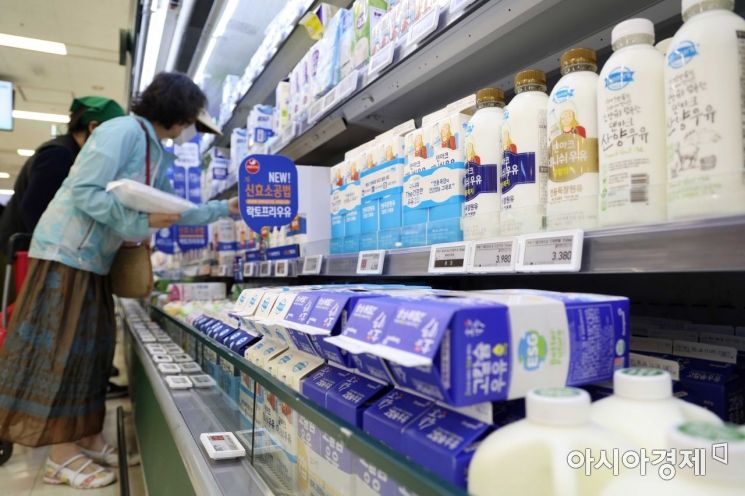
 As consumer prices continue to rise, there is an emergency regarding grocery prices. On the 19th, citizens were shopping at a large supermarket in Seoul. Photo by Mun Ho-nam munonam@
[Asia Economy Sejong=Reporters Son Seon-hee and Song Seung-yoon] As the raw milk price negotiations between dairy farmers and the dairy industry have concluded, the prices of milk and other dairy products are expected to rise across the board due to this increase in raw milk prices. Concerns are also emerging that this 'milkflation' could lead to a rise in prices across the food industry, as the cost of ingredients such as bread and ice cream containing milk also increases.
According to the industry on the 4th, the Dairy Promotion Board decided at its board meeting the day before to raise the raw milk price from 947 won per liter to 999 won, an increase of 49 won. Considering the delay in the price hike, an additional 3 won per liter will be paid this year, making the actual increase 52 won per liter. From next year, the 49 won per liter increase will be applied. This raw milk price increase is the first in 2 years and 3 months since the Dairy Promotion Board decided on a 21 won increase in August 2020.
The government places significance on the fact that the 'differential pricing system by usage,' which has been promoted so far, will be fully implemented from next year. Going forward, raw milk price adjustments will no longer be made annually as before, but negotiations will only be triggered if the production cost fluctuation meets the condition of ±4%. In other words, if the production cost fluctuation is not significant, the raw milk price may remain unchanged for more than three years. Regarding this, Kim Jeong-wook, Director of Livestock Policy at the Ministry of Agriculture, Food and Rural Affairs, held a briefing at the Government Complex Sejong on the same day, stating, "Due to economic uncertainties, overall consumption is shrinking, especially drinking milk consumption continues to decline, so it is expected that dairy companies will find it difficult to significantly raise dairy product prices," adding, "Through meetings and other channels, we are requesting that the price increase of fresh milk, which affects various food prices, be minimized, and while some companies have already raised prices of processed products, we are asking them to refrain from further increases or to minimize the increase."
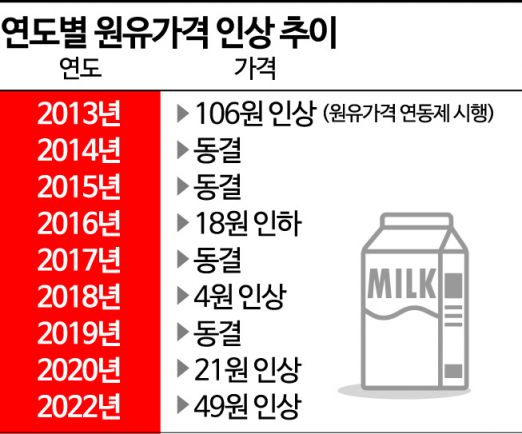
This raw milk price increase is the largest since the raw milk price linkage system was implemented in 2013, when the price rose by 106 won all at once. In 2014 and 2015, the raw milk price was frozen, and in 2016 it was reduced by 18 won. After being frozen in 2017, the price was raised by 4 won in 2018, frozen again in 2019, and increased by 21 won in 2020. At that time, considering the COVID-19 situation, the price application was postponed by one year, so the price was actually applied in August last year.
Typically, once the basic raw milk price is set, major dairy companies such as Seoul Milk, Maeil Dairies, and Namyang Dairy Products have consecutively raised milk prices. Dairy farmers and dairy companies usually start raw milk price negotiations in June and apply the new price in August. However, this year, negotiations were delayed well past August due to differences in opinion over the dairy system reform plan, which changes the price determination system from the existing production cost linkage system to a differential pricing system by usage. Initially, dairy farmers strongly opposed the reform but changed their stance to cooperate after several negotiations, and the Dairy Promotion Board meeting was held only in September this year. From September 20, raw milk price negotiations officially began, discussing raw milk price adjustments and dairy system reform plans.
With the new raw milk price set at 49 won plus a retroactive 3 won, totaling 52 won per liter, the consumer price of fresh milk, currently in the mid-2700 won range per liter, is expected to exceed 3000 won. Last year, when the raw milk price increased by 21 won per liter, the consumer price of fresh milk rose by 150 to 200 won per liter. This is because the consumer price of milk is generally applied at about ten times the raw milk price increase. Considering this increase, the price hike is likely to be decided between the high 400 won and 500 won range per liter.
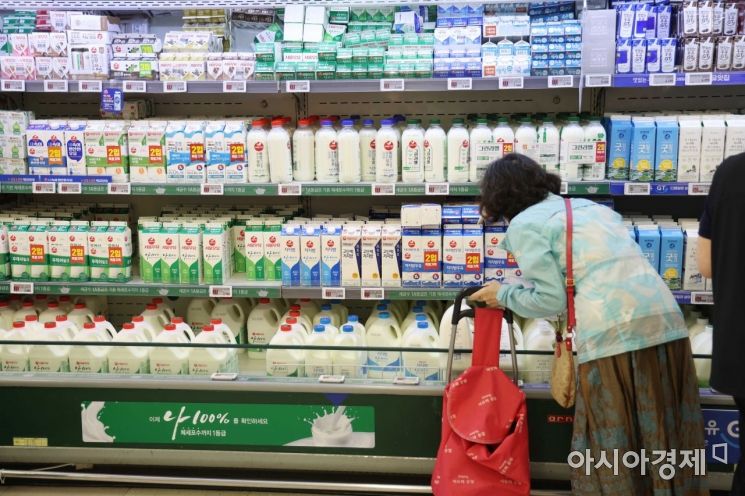 As consumer prices continue to rise, there is an emergency regarding grocery prices. On the 19th, citizens were shopping at a large supermarket in Seoul. Photo by Mun Ho-nam munonam@
This is expected to raise the prices of other dairy products using raw milk, such as creams, cheese, and ice cream, in addition to milk. The industry is solidifying the view that dairy product price increases are a foregone conclusion. Since the raw milk price hike was delayed more than initially expected, a domino effect of price increases is likely to follow immediately. There is also a possibility of price increases across the board in processed foods such as bread and snacks.
Seoul Milk Cooperative raised the prices of all cheese products by 9% in April and increased the shipment price of some cheese products, including cheddar cheese, by about 20% last month. Namyang Dairy Products already raised the prices of cheese products such as Da Vinci by about 10% in the first half of the year and plans to increase prices of some fermented milk and cheese products by more than 10% starting this month. Maeil Dairies raised the prices of fermented milk products by 15-25% last month and also increased the prices of sour cream and whipping cream by 6-7%. If price increases continue again within this year after this negotiation, some companies may raise product prices up to three times a year.
An industry insider said, "It is highly likely that milk price increases will start as early as the end of this month or next month," adding, "With the raw milk price increase and the high exchange rate situation overlapping, raw material costs, logistics costs, and labor costs have surged, exceeding the level that companies can bear."
© The Asia Business Daily(www.asiae.co.kr). All rights reserved.



















