Vice Chairman Park Jeongcheon Launches Missile One Hour After Criticism of "Wrong Choice"
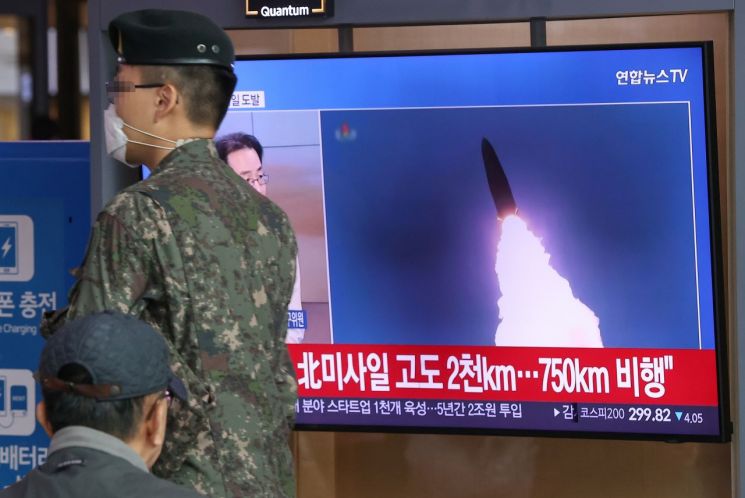
[Asia Economy Yang Nak-gyu, Military Specialist Reporter] North Korea again launched three short-range ballistic missiles (SRBMs) into the East Sea on the afternoon of the 3rd. This appears to be a response to the extension of the joint U.S.-South Korea air exercise "Vigilant Storm."
According to the Joint Chiefs of Staff, the military detected three SRBMs launched from the Goksan area in North Hwanghae Province toward the East Sea between approximately 9:35 PM and 9:49 PM on the 3rd. The missiles were detected flying about 490 km, reaching an altitude of approximately 130 km, and traveling at a speed of about Mach 6 (six times the speed of sound). Detailed specifications are being precisely analyzed by U.S. and South Korean intelligence authorities.
At around 2 PM on the same day, the U.S. and South Korea announced that the Air Force, after consultations due to North Korea's continuous provocations, decided to extend the duration of Vigilant Storm. The end date was not specified. Vigilant Storm is a large-scale exercise involving over 240 air assets, including the latest stealth fighters F-35A and F-35B, EA-18G Growler electronic warfare aircraft, and U-2 high-altitude reconnaissance planes, all of which are forces North Korea fears.
In response, Park Jung-chon, Vice Chairman of North Korea's Central Military Commission, criticized the extension of Vigilant Storm as a "very dangerous and wrong choice" in a statement released by the Korean Central News Agency at around 8:38 PM. Less than an hour later, North Korea acted on this threat by launching three ballistic missiles.
Earlier on the same day, North Korea fired a total of six ballistic missiles, including one intercontinental ballistic missile (ICBM). At around 7:40 AM, an ICBM was launched from the Sunan area in Pyongyang toward the East Sea, reaching a maximum altitude of about 1,920 km, flying approximately 760 km, and traveling at a top speed of about Mach 15 (fifteen times the speed of sound).
After launch, the first and second stages of the propulsion system successfully separated, but the warhead reportedly lost thrust during flight and failed to maintain proper speed. The military believes this missile to be North Korea's latest ICBM, the Hwasong-17.
© The Asia Business Daily(www.asiae.co.kr). All rights reserved.
![Clutching a Stolen Dior Bag, Saying "I Hate Being Poor but Real"... The Grotesque Con of a "Human Knockoff" [Slate]](https://cwcontent.asiae.co.kr/asiaresize/183/2026021902243444107_1771435474.jpg)
















