As of 2021, Seoul Population Density 15,699 per 1㎢
Area 11.8%, Half of Korean Population Lives in Capital Area
Non-Capital Areas Face Extinction Risk Due to Job Polarization and Youth Outflow Increasing
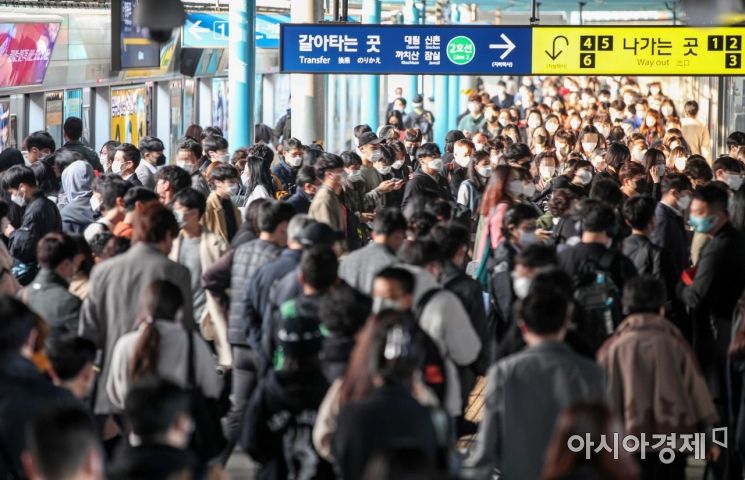 On November 1st last year, citizens are heading to work at Sindorim Station in Guro-gu, Seoul. Photo by Jinhyung Kang aymsdream@
[Asia Economy Reporter Hwang Sumi] The Itaewon disaster, which resulted in a large number of casualties, has brought the issue of overcrowding in daily life to the forefront. Experts have repeatedly criticized the need to raise awareness of the dense situations that have become commonplace, especially in the Seoul metropolitan area where most of the population is concentrated. Some also argue that efforts to disperse South Korea's population, which is heavily concentrated in the metropolitan area, to other regions should be supported.
The disaster that occurred on the 29th of last month in Itaewon-dong, Yongsan-gu, Seoul, has heightened awareness of overcrowding. Since crowded scenes are commonly encountered in Seoul and the metropolitan area, there is an analysis that the risks may have been overlooked.
Juliet Kayem, a U.S. disaster management expert, told CNN, "Seoul citizens are accustomed to crowded spaces," adding, "Because of this tendency, they may not have felt a strong sense of alertness when the streets were packed with people." Professor Gu Jung-woo of the Department of Sociology at Sungkyunkwan University also told Yonhap News Agency, "South Korea's population is concentrated in the metropolitan area, and within that, transportation and other factors have developed conditions favorable for gathering in one place," adding, "We have become quite accustomed to such a lifestyle."
◆ Seoul's Population Density is Four Times That of Busan
According to the National Statistical Portal (KOSIS) of Statistics Korea, as of last year, Seoul's population density was 15,699 people per square kilometer. Population density is the number of people living in a given area divided by the size of that area, indicating the degree of overcrowding within the region. Compared to Busan, which has the second-highest population density at 4,320 people per square kilometer, Seoul has about four times as many people living in the same area.
In particular, the population of the metropolitan area (Seoul, Incheon, Gyeonggi) is approximately 26.02 million, accounting for 50.4% of the total population (about 51.64 million). More than half of the population is concentrated in the metropolitan area, which accounts for only 11.8% of the total land area.
The concentration of population in a small area is influenced by regional job polarization and metropolitan-centered infrastructure. Manufacturing, which was once a key pillar of quality jobs in non-metropolitan areas, began to decline in the early to mid-2010s. As the regional job situation worsened, it led to population outflow, especially among young people. Additionally, the concentration of infrastructure necessary for daily life such as education, jobs, healthcare, and culture in the metropolitan area is also cited as a factor in population movement.
According to a report by the Korea Employment Information Service, the net inflow of population to the metropolitan area, which had been continuously decreasing, began to increase again after hitting a low point in 2015. The outflow of young people is particularly notable. In the 2010s (from 2010 to 2019), over 600,000 people in their 20s moved into the metropolitan area, about three times the total population inflow of 200,000. Most of them moved from underdeveloped rural or industrial decline areas to new metropolitan cities such as Sejong City. The proportion of young people in non-metropolitan areas, which accounted for 34.5% of the total population in 2000, decreased to 24.6% in 2019.
◆ 113 Areas at Risk of Disappearance... Mostly Non-Metropolitan
The increasing outflow of young people is also escalating the risk of regional extinction. Regional extinction is a concept first introduced in a report by Hiroya Masuda from Japan. In 2014, based on Japan's population change projections, he predicted that about 50% of cities, towns, and villages would see their populations decrease by more than half in about 30 years, shocking the local community.
Since then, a regional extinction risk index based on this concept has been measured domestically. The regional extinction risk index is the ratio of women aged 20 to 39 to the population aged 65 and over in a given area. The lower this index (meaning fewer women aged 20 to 39 compared to the elderly population aged 65 and over), the more severe the low birthrate and aging problems in the area, implying a high possibility of disappearance in about 30 years. Specifically, areas with an index of 1 or less are classified as extinction caution areas, and those below 0.5 are classified as extinction risk areas.
According to Statistics Korea, as of March this year, there are 113 extinction risk areas in South Korea, accounting for about half of the 228 cities, counties, and districts nationwide. The number of such areas has been increasing steadily from 33 in 2005 to 80 in 2015 and 102 in 2020.
The problem is that most of these extinction risk areas are located outside the metropolitan area. By province and metropolitan city, Gyeongbuk (19 areas), Jeonnam (18 areas), Gangwon (16 areas), Gyeongnam (14 areas), Jeonbuk (12 areas), and Chungnam (11 areas) have the most extinction risk areas. Particularly, Jeonnam has 10 areas at very high risk of disappearance, including Goheung, Sinan, Boseong, Hampyeong, Gokseong, Gurye, Gangjin, Jangheung, Jindo, and Wando counties. Following are Gyeongbuk with 9 areas (Gunwi, Uiseong, Bonghwa, Cheongsong, Cheongdo, Yeongdeok, Yeongyang, Goryeong, Seongju counties) and Gyeongnam with 7 areas (Hapcheon, Namhae, Sancheong, Uiryeong, Hadong, Hamyang, Goseong counties).
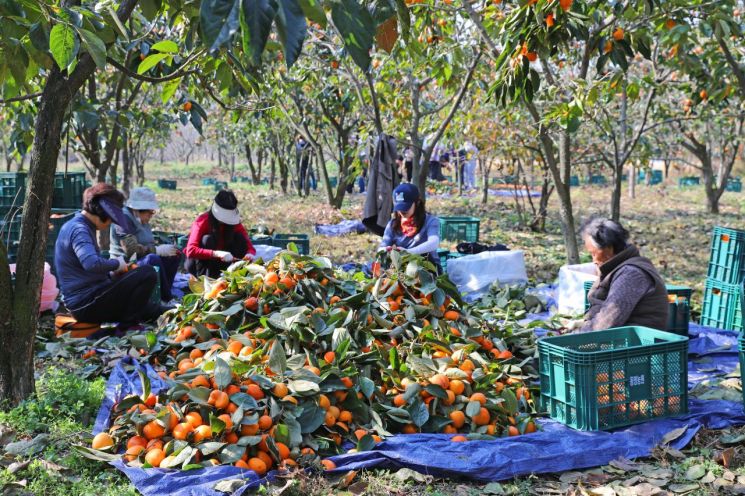 Farmers and public officials from the Gyeongnam Provincial Government are harvesting persimmons at a farm in Pasuri, Haman-myeon, Haman-gun, Gyeongnam. Photo by Yonhap News
◆ Achieving Regional Balanced Development through Talent Dispersion, Job Environment Improvement, and Strengthening Protection for Vulnerable Groups
Experts point out the need to prepare countermeasures for regional decline and youth outflow issues. Park Jin-kyung, a research fellow at the Korea Institute of Local Administration, said in an issue analysis titled "Regional Extinction Risk and Autonomous Response Strategies," "The decrease in demand caused by population decline worsens convenience in daily life, which acts as a factor that reduces the attractiveness of the region."
Regions experiencing demand reduction due to population outflow see a decrease in commercial and public facilities such as transportation and healthcare, and face difficulties attracting companies that can create quality jobs. Park warned that this vicious cycle will prevent new population inflow and hinder regional development. Lee Sang-ho, a research fellow at the Korea Employment Information Service, also stated, "The risk of regional extinction has entered a qualitative deepening stage beyond quantitative expansion," emphasizing the need to properly respond to structural changes related to jobs to achieve regional balanced development.
He stressed the need to disperse talent to decentralize the concentration of planning functions in the metropolitan area. The research fellow said, "Core R&D personnel and professionals should be able to work and settle in regions," adding, "Creating jobs that allow local talent to stay in the region through innovation in local SMEs and universities, and expansion of public and private research institutes is necessary."
He also mentioned the need to strengthen social protection and integration for vulnerable employment groups within regions. Efforts to improve relatively weaker local job environments through improvements in the cooperation structure between primary and subcontractors, innovation in small business workplaces, protection for non-regular workers, and strengthening industrial safety are required.
Finally, he urged both central and local governments to adopt an open attitude. The research fellow said, "The central government should discard the prejudice that it cannot delegate authority because local governments lack capacity and support the accumulation of local capabilities." He added, "Local governments should also seek ways to effectively utilize external capabilities and resources rather than trying to solve everything internally."
© The Asia Business Daily(www.asiae.co.kr). All rights reserved.
![Clutching a Stolen Dior Bag, Saying "I Hate Being Poor but Real"... The Grotesque Con of a "Human Knockoff" [Slate]](https://cwcontent.asiae.co.kr/asiaresize/183/2026021902243444107_1771435474.jpg)












