"Insurance Premium Rates Fixed from 2017
Evaluated Every 5 Years for Aging and Low Birthrate
Adjust Benefits Based on Results
Aiming to Maintain Pension Reserves for 100 Years"
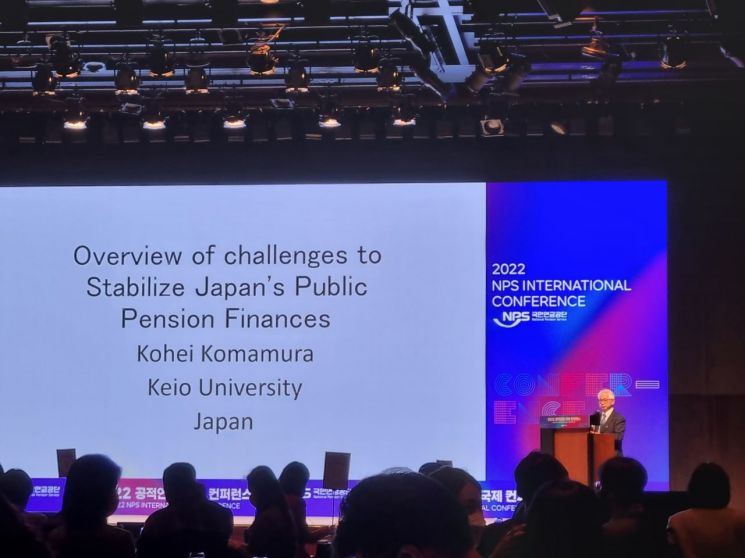 Professor Kohei Komamura of Keio University is presenting at the '2022 Public Pension International Conference' held on the 2nd. Photo by Kim Youngwon
[Asia Economy Reporter Kim Young-won] As the government has raised the anchor of pension reform, Japan, which is facing a situation similar to South Korea due to low birth rates and aging population, began pension reform in 2004 under the leadership of Prime Minister Koizumi. The pension insurance premium rate, which was gradually increased until 2017, has been frozen since then, and the plan is evaluated and revised every five years over a 100-year period according to circumstances such as aging.
Professor Kohei Komamura of Keio University in Japan explained the overview and challenges of Japan's public pension reform at the '2022 International Public Pension Conference' held at the Shilla Hotel in Jung-gu, Seoul on the 3rd.
Japan's pension system is structured in three tiers. The first tier is the National Pension, which all citizens aged 20 to under 60 must join. The second tier is the Employees' Pension Insurance, an income-proportional pension for salaried workers. The third tier consists of privately subscribed pensions such as retirement pensions.
Discussions on pension reform in Japan began as the rapid economic growth after World War II started to stagnate. Professor Komamura said, "During the period of continuous economic growth, there was little resistance to raising insurance premiums, but from the 1990s, when economic growth stagnated, continuously raising premiums faced very strong public resistance." This was the background for Prime Minister Koizumi's 2004 pension reform decision not to raise the premium rate beyond the 18.3% cap after 2017.
Instead of a fixed premium rate, Japan introduced an automatic stabilization mechanism to maintain pension finances. This mechanism evaluates factors affecting pension contributions and benefits, such as low birth rates and aging, and reduces benefit amounts accordingly. Professor Komamura explained, "This plan is to be evaluated and revised every five years in line with the population census over a 100-year period." For example, if the proportion of elderly people is predicted to be higher than expected, the benefit amount is reduced by the corresponding increase to maintain balance.
Professor Komamura emphasized that the core of Japan's pension reform is to maintain pension financial balance over 100 years based on this system, but this does not mean that the system can be considered completely secure for 100 years. He said, "The then Minister of Health, Labour and Welfare, who was in charge of the reform, sent a message that 'this system will secure Japan's pension for 100 years,' but there are some issues with that. No country has a pension system that can be guaranteed for 100 years. The message should have been that the system aims to maintain balance with a view toward 100 years, not that it is secure for 100 years."
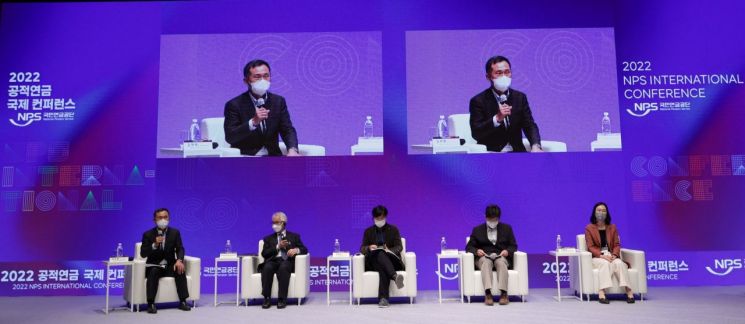 At the '2022 Public Pension International Conference' held on the 2nd, Professor Kim Yeon-myeong of Chung-Ang University's Department of Social Welfare served as the chair, leading a discussion on Japan's public pension system with Professor Gohei Komamura of Keio University, Professor Yang Jae-jin of Yonsei University's Department of Public Administration, Professor Lee Sang-eun of Soongsil University's Department of Social Welfare, and Director Seong Hye-young of the National Pension Research Institute.
 Photo by National Pension Service
In response to aging, Japan also adjusted the pension slide linked to prices and wages downward. Even if prices rise by 2%, pensions can only be increased by about 1%, not proportionally by 2%. Professor Komamura said, "Pensions should be raised in proportion to prices, but as aging becomes more severe, pension payments cannot be increased. Adjustments are being made in a way that does not cause pain to the public."
The goal was set to maintain a minimum income replacement rate of 50%. However, whether the 50% income replacement rate can be maintained depends on economic conditions. Professor Komamura said, "If the economic growth rate is good until 2040 and people in their 60s can continue working, this goal can be achieved," but added, "If the economic situation worsens, there are reports that 50% cannot be maintained."
Despite Japan's pension reform being evaluated as successful, Professor Komamura said, "Japan's pension finances are by no means in a good situation." He noted that South Korea and Japan face similar problems such as low birth rates and aging, and said, "There are discussions about raising the pension eligibility age to 70 or extending the contribution period in the future."
Seong Hye-young, a researcher at the National Pension Research Institute who participated in the discussion, evaluated, "Japan's 2004 pension reform was a radical reform pursued for financial sustainability and can be seen as a successful reform." However, she added, "As Professor Komamura pointed out, ensuring adequate retirement income remains a challenging task. Pension amounts should effectively rise in line with price and wage increases to maintain purchasing power, but after the introduction of the automatic stabilization mechanism, Japan's basic pension amount actually decreased in 2018 compared to 2016, and in 2022 compared to 2019."
Additionally, Researcher Seong questioned, "Japan is making many efforts to include short-term workers in the pension system, but is it possible that efforts to include new forms of irregular workers such as platform workers have not yet been considered?" Professor Komamura responded, "Pension enrollment for new employment types is an issue in Japan, and there is ongoing consideration on how to include them in the Employees' Pension Insurance."
© The Asia Business Daily(www.asiae.co.kr). All rights reserved.
![User Who Sold Erroneously Deposited Bitcoins to Repay Debt and Fund Entertainment... What Did the Supreme Court Decide in 2021? [Legal Issue Check]](https://cwcontent.asiae.co.kr/asiaresize/183/2026020910431234020_1770601391.png)
















