The Largest Animal Existing on Earth... Up to 33m
Searching for Food at Depths of 50m to 250m with High Microplastic Concentration
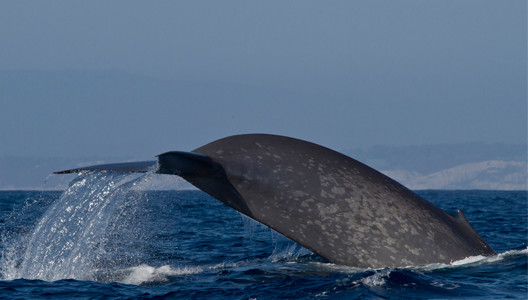 Giant whale off the coast of California. Photo by Craig Hayslip, Oregon State University. NOAA/NMFS
[Asia Economy Reporter Kim Jeong-wan] A study has revealed that the blue whale, known as the largest existing animal on Earth, can ingest up to 10 million microplastics per day.
On the 1st (local time), according to foreign media including AFP, a research team led by Dr. Shirel Kahein-Laporte from California State University in the United States published their findings in the scientific journal Nature Communications, showing that blue whales, fin whales, and humpback whales consume enormous amounts of microplastics daily.
The research team attached electronic tags with satellite transmitters to the backs of 191 whales, including blue whales, humpback whales, and fin whales, from 2010 to 2019, tracking their feeding activities. They combined this data with microplastic data from the Pacific California Current where these whales inhabit, using modeling methods to calculate the amount of microplastics ingested.
As a result, it was found that blue whales swallow up to 10 million microplastics per day. This amounts to approximately 43.5 kg, and it is estimated that they consume over 1 billion microplastics annually. Fin whales, which primarily feed on krill, were also found to ingest about 6 million microplastics daily.
The research team discovered that whales mainly feed at depths of 50m to 250m, which coincides with the depths where microplastic concentrations are highest in the ocean. It was found that 99% of the microplastics accumulated in the whales' bodies were absorbed during this process.
The team stated, "The fact that whales absorb microplastics through their food has significant implications for humans as well," adding, "Krill are at the bottom of the food chain pyramid, and humans consume anchovies and sardines that feed on krill."
The blue whale is known as the largest animal on Earth, reaching lengths of up to 33 meters. It was once pushed to the brink of extinction due to overhunting by whaling ships in the past and is currently classified as an international endangered species (EN: Endangered).
Microplastics are small plastic fragments less than 5mm in size, and their concentration in the ocean has been increasing over recent decades. Based on this study, the research team plans to investigate how ingesting microplastics affects the health of whales.
© The Asia Business Daily(www.asiae.co.kr). All rights reserved.
















