70 Million Insomnia Patients Era, Sleep Tech Market Growth
Innovative Technology-Based Startups Like A-Sleep and Sambun-ui-il Active
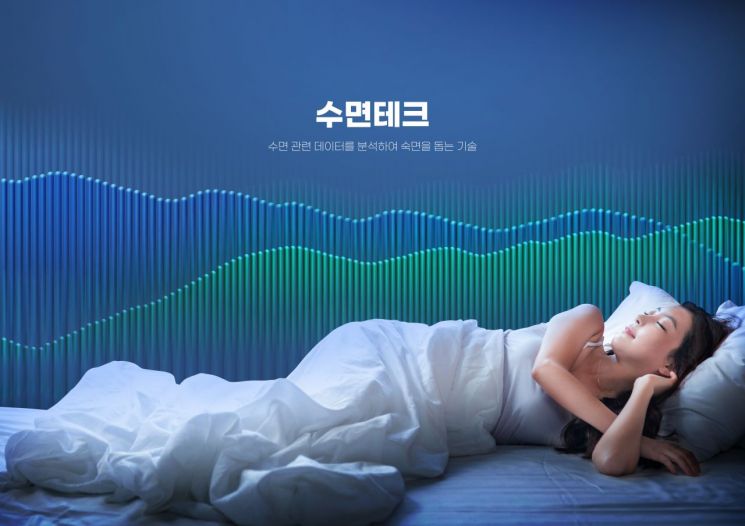
#Housewife Lee Kyung-ja (alias) has struggled with insomnia for years and decided to change her mattress. She had previously relied only on prescribed sleeping pills, but recently heard that mattresses incorporating various technologies to promote deep sleep are being released, so she decided to give it a try. Even if the price is a bit high, she is willing to open her wallet as long as she can sleep comfortably.
#Office worker Kim Kyung-wan (alias) these days turns on a smartphone application (app) before going to bed. This app automatically measures sleep quality and plays sounds that help users fall asleep. After using the app and sleeping the same amount of time, Kim feels refreshed and plans to continue purchasing subscriptions if the effect lasts.
'Sleep tech' is on the rise. As more people suffer from sleep disorders due to stress and other factors, interest in technologies that help achieve restful sleep has surged. Related companies in this market are growing rapidly, and startups boasting new technologies are emerging one after another.
The sleep-specialized brand 'Sambun-ui-il' is a representative example. Founded in 2017, this startup introduced 'memory foam mattresses' into the spring mattress market dominated by large corporations. Currently, it is developing a mattress that provides personalized optimal sleep temperature based on artificial intelligence (AI) technology. Expected to launch in the first half of next year, this product is inspired by sleep research findings that a person's core body temperature must drop about 1℃ for sleep onset, rather than skin temperature.
Jeon Ju-hoon, CEO of Sambun-ui-il, conducted interviews with about 50 businesspeople before developing this concept mattress to understand how they measure and manage their sleep. A representative of Sambun-ui-il explained, "While existing companies branding themselves as sleep tech providers offer data diagnosing sleep, Sambun-ui-il's biggest feature is providing solutions that enable deep sleep along with data diagnosis."
'A-Sleep,' which received 16 billion KRW in Series B funding this year and was valued at 90 billion KRW in less than two years since its establishment, is also considered an innovative sleep tech startup. A-Sleep developed a non-contact sleep examination method using breathing sounds and wireless internet technology and is collaborating with Amazon's AI speaker Alexa. This sleep examination method is characterized by showing sleep status during sleep time without wearing wearable devices. It is explained that AI technology can verify more reliable sleep data than contact methods using only smartphone voice. A-Sleep plans to introduce a sleep platform ecosystem combining apps, lighting, speakers, and more.
Recently selected as a 'Baby Unicorn' by the Ministry of SMEs and Startups, 'Curaum' is also a sleep tech startup. This company, which produces medical devices for treating sleep apnea, measures patient data through an oral insertion device and transmits it to the patient's medical staff via mobile, helping medical professionals propose optimal treatment plans for patients.
'Moonis,' which won the Excellence Award at this year's 11th Chung Ju-yung Startup Competition, is also a sleep tech startup that developed and launched the app 'Miracle Night,' which creates and plays sounds that improve sleep quality. Moonis CEO Kwon Seo-hyun explained, "The principle is to activate delta waves through monaural beats to induce brainwave entrainment and help achieve comfortable sleep." She added, "We have already secured 12,000 users and have customers who have actually solved sleep problems."
The rise of sleep tech startups is due to the rapid increase in patients suffering from sleep disorders who cannot sleep every day. According to the National Health Insurance Service, the number of sleep disorder patients in South Korea exceeded 670,000 in 2020 and has increased by an average of 7.9% annually since 2016. As insomnia patients increase, market prospects are bright.
According to market research firm Global Market Insights, the global sleep tech market size is expected to grow to 32.1 billion USD (approximately 45 trillion KRW) by 2026. An industry insider said, "Considering the increase in sleep disorder patients and economic losses caused by sleep deprivation, the potential of the sleep industry is huge," adding, "In the sleep tech market, competition will unfold between existing companies and startups with innovative technologies."
© The Asia Business Daily(www.asiae.co.kr). All rights reserved.










![The Special Connection Between the Statue of Martyr Lee Jun in Jangchungdan Park and Mayor Oh Sehoon ③ [Current Affairs Show]](https://cwcontent.asiae.co.kr/asiaresize/319/2026012110001599450_1768957215.jpg)
