Panic Bars Installed After Victoria Hall Disaster, Emergency Exit Lights Added Following Chicago Theater Fire
Japan Distributes 'Crowd Accident Prevention Manual' to Police After Akashi Suffocation Incident
Safety Awareness Still Lacking in Korean Society Despite Sampoong Department Store Collapse, Sewol Ferry Sinking, and Daegu Subway Fire
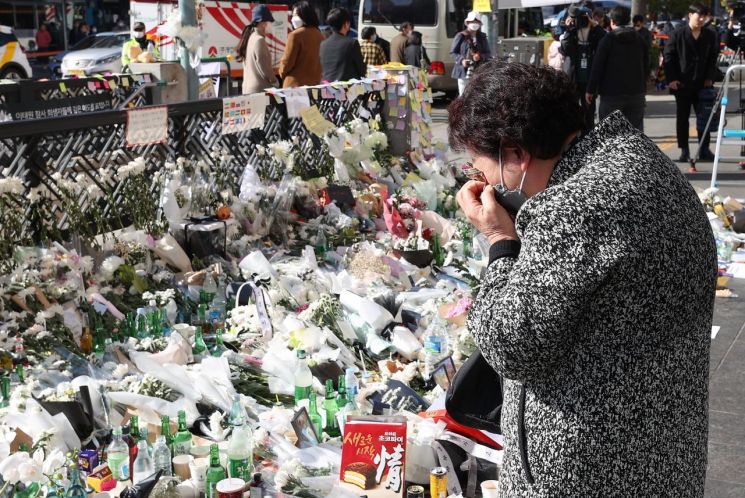 On the 2nd, a bereaved family member who lost their granddaughter is shedding tears at the memorial space in front of Exit 1 of Itaewon Station, Yongsan-gu, Seoul. Photo by Yonhap News
[Asia Economy Reporter Bang Je-il] Incidents influence a nation's laws and systems, while accidents affect public perception. In the Itaewon crowd crush disaster, 156 people died and 152 were injured. Some argue that this tragedy was merely the worst outcome of individual choices. Others point to it as a man-made disaster caused by the government's inadequate prevention and management. Despite differing views, the most important thing is to revise laws and systems to ensure such tragedies never happen again and to prevent complacency about safety.
As the saying goes, "Safety is written on someone's blood," human history has flowed through countless mistakes and failures. Within this, there have been many changes and developments. Major disasters that changed social structures and people's awareness of safety are no exception.
The History of Humanity Repeating Numerous Mistakes and Failures
A representative example is the fire at the Iroquois Theatre in Chicago, USA, on December 30, 1903. Before this fire, Chicago had already experienced a major fire. Because of this, the Iroquois Theatre heavily promoted itself as fire-safe, and when the fire broke out, quick response initially contained the flames early.
The problem was the "doors." At that time, the Iroquois Theatre had 27 emergency exits, but most were locked to prevent people from sneaking in. The doors opened inward, which was problematic. It took more time to escape during the fire. Especially, as crowds pushed through narrow door gaps, 602 people suffocated from smoke inhalation.
After this disaster, Chicago mandated the installation of emergency exit signs and legally required emergency exits to be kept open. Furthermore, the structure of emergency exit doors was changed to open outward from the inside. Emergency exit handles were also modified to be easily opened.
Another disaster that greatly influenced modern accident prevention was the Victoria Hall disaster in Sunderland, England, UK, on June 16, 1883. Most victims were children. After a magic show held under the name of "the best gift for children," an event distributing candy and toys caused a sudden crush as many children rushed at once. Children descending from the third to the second floor and then to the first floor got stuck at a door installed on a narrow staircase and could not move properly. This accident caused the suffocation deaths of 183 children aged 3 to 14.
Queen Victoria I, who was the British monarch at the time, ordered the state to pay funeral and compensation costs and to establish safety measures since such a great disaster occurred in a theater named after her. After the Victoria Hall disaster, the UK enacted laws requiring minimum emergency exits in public facilities. The "panic bar," which allows emergency exits to be easily opened by pushing a horizontal latch, was also invented as a result of this accident.
The deadliest accident of the 20th century occurred on July 1990 in Mecca, the Islamic holy site in Saudi Arabia. During the Muslim festival of Eid al-Adha, pilgrims heading to Mecca tried to exit a tunnel first, leading to a massive disaster. This accident resulted in 1,426 deaths.
Even after the accident, many casualties occurred annually as pilgrims continued to flock to Mecca. The Saudi government limited the number of visitors and restricted pilgrimage times during this period for safety. They also deployed nearly 100,000 safety personnel and took thorough safety measures. Wearing an ID and an electronic bracelet embedded with a GPS chip became mandatory to enter the Grand Mosque.
Professor Kwak Geum-ju of Seoul National University (Department of Psychology) said, "The Mecca area, which gathers many people every year, has established countermeasures after numerous crowd crush accidents, but Korean society has no defense posture against such crush accidents." She added, "Since this is the first large-scale crowd crush accident Korea has experienced, measures to prevent recurrence are absolutely necessary." She also pointed out, "Eight years have passed since the Sewol ferry disaster in 2014, but during that time, complacency about safety has reemerged and vigilance has decreased." She explained, "The government also failed to strongly respond to voluntary gatherings, which led to this tragedy."
The First Large-Scale Crowd Crush Disaster Experienced by Korean Society
Japan also experienced an accident similar to the Itaewon disaster: the Akashi crowd crush accident. Around 8:30 p.m. on July 21, 2001, at a pedestrian bridge connecting the fireworks event site on the Akashi coast in Hyogo Prefecture and the nearby Asagiri Station, more than 6,000 people crowded onto a 100-meter-long, 6-meter-wide pedestrian bridge enclosed on the top and sides. This caused 11 deaths, including 9 children, and 247 injuries.
Following this accident, Japan significantly strengthened security systems at crowded events. One year after the accident, in 2002, the Hyogo Prefectural Police created and distributed a "Crowd Accident Prevention Manual" nationwide based on the Akashi accident experience. The manual included specific measures such as making congested roads one-way by default, installing exits wider than entrances, and guiding crowd flow as straight as possible. Furthermore, in 2005, Japan revised the Security Business Act and the National Public Safety Commission regulations to add a "crowd security" section to the security work certification exam.
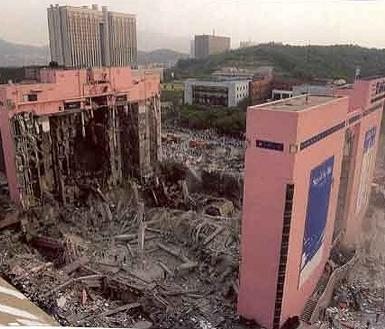 The collapse of the Sampoong Department Store that occurred in 1995. Photo by Asia Economy DB
Large-scale accidents with significant casualties have also frequently occurred in Korea. In particular, the Itaewon disaster is not the first large-scale casualty accident in the heart of Seoul. The collapse of the Sampoong Department Store in Seocho-dong, Seocho-gu, Seoul, on June 29, 1995, was also a major disaster in the city center. Originally designed as a shopping complex, the Sampoong Department Store was converted into a department store with excessive design changes, structural modifications, and expansions. Cracks and other signs appeared months before the collapse, but the department store only responded with emergency measures. Ultimately, it could not avoid a major disaster with 502 dead or missing and 937 injured.
Large-scale accidents continued into the 2000s. The Daegu subway disaster occurred in 2003, and in April 2014, the Sewol ferry disaster happened. At that time, 304 people, including students from Danwon High School in Ansan who boarded the Sewol for a school trip to Jeju Island, died and 142 were injured. In the same year, in February, the roof of the Kolon Mauna Ocean Resort gymnasium in Yangnam-myeon, Gyeongju, collapsed, killing 10 people, including students from Busan University of Foreign Studies, and injuring 204.
After various disasters, Korean society structurally changed many things. First, after the Sampoong Department Store collapse, the government conducted safety evaluations of all buildings. Many buildings underwent structural reinforcement, and emergency response manuals were created. Changes also occurred in firefighting and disaster prevention, such as establishing the 119 Central Rescue Team in major cities. After the Daegu subway disaster, the National Assembly enacted the "Framework Act on the Management of Disasters and Safety" in 2004 by integrating the Disaster Relief Act, Disaster Prevention Act, and Disaster Management Act, and established the National Fire Agency. In 2006, the Railway Safety Act was also enacted.
However, despite safety measures and follow-up policies made after major disasters, accidents still occur. Although these disasters happened at different times and places, they share a common structural cause: the government and Korean society did not thoroughly investigate the truth and take a series of measures to prevent recurrence. Some netizens lamented the Itaewon disaster by citing the Sewol ferry case, saying "Nothing has changed."
Dulled Awareness of Safety
That said, it is not only the government to blame. Currently, Korean society's awareness of safety is greatly dulled. Especially in spontaneous protests and gatherings without organizers, there is always a risk of accidents, but the police are unable to strongly control them.
Regarding this, Professor Kwak Geum-ju said, "Many people resent strong police control over citizens' voluntary gatherings. Since people have such resentment, the government also failed to respond strongly, so when discussing follow-up measures, social consensus on police control is necessary."
Regarding why disasters recur, Professor Seol Dong-hoon of Jeonbuk National University (Department of Sociology) also said, "Every time a disaster occurs, talks about preventing recurrence arise, yet accidents repeatedly happen. This ultimately means Korean society is structurally still unsafe." He pointed out, "Although Korea has experienced many disasters in the past, the repeated occurrence of large accidents proves that government and National Assembly recurrence prevention measures have always been detached from reality and lacked active efforts." He added, "More urgent than government policies is to prioritize securing citizens' safety first, and then change awareness about safety."
© The Asia Business Daily(www.asiae.co.kr). All rights reserved.

![Clutching a Stolen Dior Bag, Saying "I Hate Being Poor but Real"... The Grotesque Con of a "Human Knockoff" [Slate]](https://cwcontent.asiae.co.kr/asiaresize/183/2026021902243444107_1771435474.jpg)















