Genetic Analysis by Research Team at the Natural History Museum, London
Interbreeding with Modern Human Ancestors Reduced Neanderthal Fertility
2% of Non-African Modern Human Genes Derived from Neanderthals
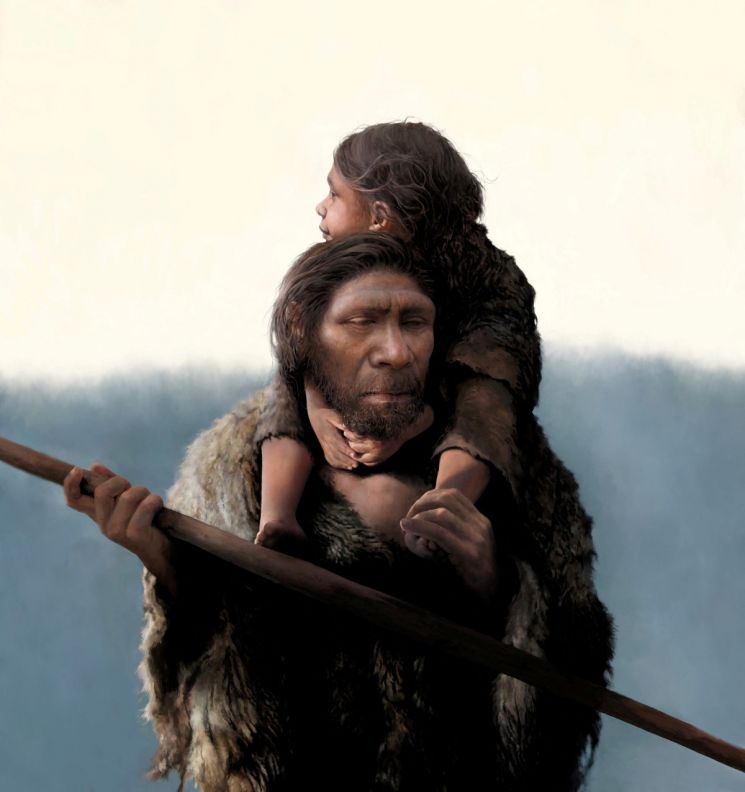
[Asia Economy Reporter Hyunju Park] New research suggests that Neanderthals, who disappeared about 40,000 years ago, went extinct not due to competition or conflict with the ancestors of modern humans, but because of love.
A research team led by Professor Chris Stringer, head of human evolution research at the Natural History Museum (NHM) in the UK, proposed a hypothesis based on genetic analysis that interbreeding with the ancestors of modern humans reduced the reproductive capability among Neanderthals, leading to their extinction. This hypothesis was published in the academic journal PalaeoAnthropology.
The basis of the hypothesis is that although about 2% of the genes of non-African modern humans have been confirmed to come from Neanderthals due to interbreeding with the ancestors of modern humans, there is no evidence of Homo sapiens DNA mixed in the Neanderthal genome.
The research team acknowledged that since genome analyses have been conducted on only 32 Neanderthals so far, this could be a sampling issue. They also anticipated that as DNA sequencing technology advances and more samples can be analyzed, verification of this hypothesis will become possible.
Homo sapiens and Neanderthals belong to the same genus (Homo, a classification that includes modern humans and their direct ancestors) and diverged about 600,000 years ago. Since then, the ancestors of modern humans evolved independently in Africa, while Neanderthals evolved across Eurasia.
Based on genetic analysis data, it is estimated that the two species met about 250,000 years ago when the ancestors of modern humans left Africa to hunt, during which sporadic interbreeding occurred. The research team explained, "This interbreeding may have been the result of mutual courtship or could have occurred under less friendly circumstances. Studies on chimpanzees, the animals closest to humans, show that both behaviors occur when separated groups meet."
However, there is still no evidence that the genes of modern human ancestors mixed into Neanderthals about 40,000 to 60,000 years ago. The team speculated that this might be because the second-generation offspring born between Neanderthals and Homo sapiens could only reproduce with Homo sapiens.
Professor Stringer suggested, "While Neanderthal females may have been captured by Homo sapiens and reproduced, the reverse situation might not have occurred. Even if Homo sapiens genes entered the Neanderthal gene pool, it could have been extremely rare, or some hybrids might have been fertile only in one direction, so second-generation reproduction may not have occurred within Neanderthal groups."
The research team stated that if further analyses of Neanderthal genes continue to show no traces of Homo sapiens DNA, interbreeding between the two species should be considered a significant factor in Neanderthal extinction.
Meanwhile, various hypotheses have been proposed regarding Neanderthal extinction. The main theories include failure to adapt to climate change, diseases brought by modern humans, and defeat in competition with modern humans.
© The Asia Business Daily(www.asiae.co.kr). All rights reserved.
![Clutching a Stolen Dior Bag, Saying "I Hate Being Poor but Real"... The Grotesque Con of a "Human Knockoff" [Slate]](https://cwcontent.asiae.co.kr/asiaresize/183/2026021902243444107_1771435474.jpg)
















