Minutes of the October Monetary Policy Direction Meeting Released
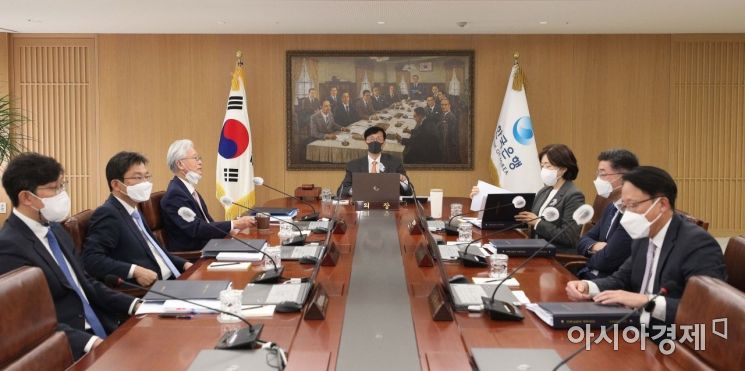 Lee Chang-yong, Governor of the Bank of Korea, is presiding over the regular Monetary Policy Committee meeting held on the 12th at the Bank of Korea in Jung-gu, Seoul. Photo by Joint Press Corps
[Asia Economy Reporter Seo So-jeong] The Monetary Policy Committee of the Bank of Korea cited the continued high inflationary pressure, additional inflationary pressure due to the rise in the won-dollar exchange rate, and increased foreign exchange risks as the main reasons for implementing a big step (a 0.50 percentage point increase in the base interest rate) last month.
According to the minutes of the October Monetary Policy Committee meeting published on the Bank of Korea's website on the afternoon of the 1st, one committee member stated, "Considering the domestic economy, inflation, financial, and foreign exchange conditions comprehensively, it is appropriate to raise the base interest rate by a larger margin of 0.50 percentage points than usual to actively respond to inflationary pressures and the concentrated expectations in the foreign exchange sector."
The member added, "Inflation continues at a high rate in the mid-to-high 5% range. Although the consumer price inflation rate has somewhat declined since peaking in July, considering the previous rise in the won-dollar exchange rate and the increase in personal service prices, the upside risks to inflation over the next year are judged to have increased." He emphasized, "While the inflation gap remains at a high level, the output gap is close to zero, so it is necessary to maintain a monetary policy stance focused on curbing inflation. The growth loss caused by the interest rate hike is at a tolerable level, and a significant increase in the base interest rate will also help buffer the one-sided expectation sentiment in the foreign exchange market."
Another committee member who voted for the big step said, "Our economy is experiencing simultaneous inflation and exchange rate instability due to expanding macroeconomic internal and external imbalances, and financial stability is also being threatened as a result. Above all, efforts should be focused on stabilizing domestic and foreign currency values." He added, "The recent rise in inflation driven by demand-side factors centered on core inflation rather than supply factors such as crude oil suggests the need for a more proactive policy response."
Another member also supported the big step, stating, "The inflation level still significantly exceeds the Bank of Korea's inflation target of 2%, and we must be cautious about the spread and persistence of high inflation." He warned, "The widening interest rate differential between domestic and foreign rates not only causes instability in the foreign currency sector, such as expectations of won depreciation and intensified capital outflows, but also acts as an additional inflationary pressure."
On the other hand, two members (Joo Sang-young and Shin Sung-hwan) expressed minority opinions favoring a baby step (a 0.25 percentage point increase) due to concerns about an economic recession.
One member said, "Unless other conditions change, I believe the upper limit of the base interest rate to stabilize the core inflation rate around 2% in the medium term without excessively contracting the economy and employment is around the low 3% range. After reaching that level, we should respond while confirming the speed of inflation decline and the possibility of convergence to the target."
Another member stated, "As the global economy is expected to enter a recession phase next year, our small open economy will be significantly affected, and the outlook for the semiconductor industry, which accounts for a considerable portion of the domestic economy, is quite uncertain. Excessive interest rate hikes in response to the current domestic inflation conditions will have limited short-term effects on price stabilization and may act as additional downward pressure on the growth path in the medium term, intertwined with external risk factors."
He continued, "Considering the lag effect of monetary policy, the recent monetary policy is expected to significantly slow domestic economic growth in the mid-to-late next year. Since the impact of the domestic-foreign interest rate differential on the won-dollar exchange rate is limited, a flexible monetary policy based on the situation's development is more desirable than a preemptive monetary policy fearing capital outflows and exchange rate increases in terms of risk management for the real economy and inflation path."
© The Asia Business Daily(www.asiae.co.kr). All rights reserved.
![From Bar Hostess to Organ Seller to High Society... The Grotesque Con of a "Human Counterfeit" [Slate]](https://cwcontent.asiae.co.kr/asiaresize/183/2026021902243444107_1771435474.jpg)
















