Russia Declares Unilateral Withdrawal from Black Sea Grain Export Agreement
EU Foreign Affairs Chief Discusses with UN Secretary-General
Turkey Persuading Russia through Phone Diplomacy
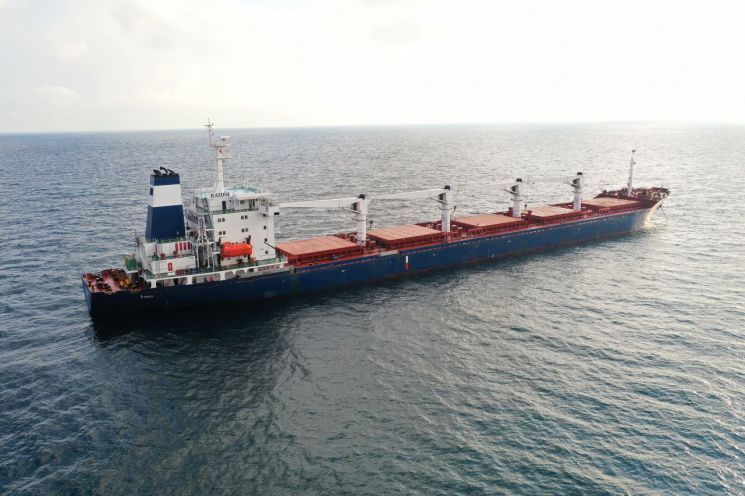
[Asia Economy Reporter Lee Ji-eun] Russia declared its withdrawal from the Black Sea Grain Export Agreement, citing an attack by Ukrainian forces using drones on its fleet stationed in the Crimean Peninsula. T?rkiye and the European Union (EU) have urged Russia to reverse its decision and are working on countermeasures.
Josep Borrell, the EU High Representative for Foreign Affairs and Security Policy, stated on social media on the 30th (local time), "With Russia's declaration of non-participation in the agreement, the main export routes for grain and fertilizer, which are crucial to resolving the food crisis triggered by the war in Ukraine, are now at risk," and urged Russia to retract its decision.
Borrell added, "I had a phone call with Ant?nio Guterres, the United Nations (UN) Secretary-General, to discuss coordination measures to ensure the agreement."
UN Secretary-General Ant?nio Guterres has postponed his attendance at the Arab League summit in Algeria scheduled for the 1st of next month to address the issue of the Black Sea grain export agreement.
Earlier in July, Ukraine and Russia, mediated by the UN and T?rkiye, reached an agreement to resume grain exports through the Black Sea. Since the agreement took effect on August 1, Ukraine has exported 8.5 million tons of grain via a total of 380 vessels. However, on the 29th, Russia unilaterally declared its withdrawal from the agreement, which was temporarily maintained until the 19th of next month, raising concerns that grain and fertilizer export prices will soar.
As the agreement faced the risk of collapse, T?rkiye also moved to persuade Russia. Hulusi Akar, T?rkiye’s Minister of National Defense, stated in a press release, "We are conducting negotiations in Moscow and Kyiv to revive the Ukraine grain export talks," and requested both sides to avoid provocations that could affect the resumption of the agreement.
Sputnik News cited a Turkish official saying, "Diplomatic phone talks with Russia are ongoing at all levels," and that negotiations to persuade Russia are underway. The official explained that although the extension of negotiations remains uncertain, there is still a possibility of reaching an agreement.
Additionally, T?rkiye agreed with the UN and Ukraine on the movement plans for 14 vessels in Turkish waters on the same day. This means inspections will continue for vessels that departed before Russia declared its withdrawal from the agreement.
Major foreign media outlets suspect that Russia intentionally withdrew from the agreement to exert economic pressure on countries heavily dependent on food exports. Although Russia cited Ukraine’s attack on its Black Sea fleet as the reason for its withdrawal, it is effectively weaponizing food to gain a strategic advantage in the war.
The Wall Street Journal reported, "Russia is using food as a weapon to pressure non-Western countries to side with Russia," and added, "The Black Sea blockade also places severe economic pressure on Ukraine, which generates 10% of its gross domestic product (GDP) from food exports."
Bloomberg expressed concern, stating, "If the Black Sea blockade continues, it will cause a major shock to the global grain market," and warned that this would increase food inflation and worsen hunger in the world’s poorest countries."
© The Asia Business Daily(www.asiae.co.kr). All rights reserved.
![Clutching a Stolen Dior Bag, Saying "I Hate Being Poor but Real"... The Grotesque Con of a "Human Knockoff" [Slate]](https://cwcontent.asiae.co.kr/asiaresize/183/2026021902243444107_1771435474.jpg)
















