[Seoul District News] Gwanak-gu Pilots 4 Neighborhoods This Year, Expands to All 21 Neighborhoods in 2023 ... Installation of 'Reusable Cup Unmanned Collection Machine' for Zero Cafe in Jung-gu Office ... Mapo-gu Creates Upcycling Experience Space ... Songpa-gu Develops and Operates Non-Face-to-Face Carbon Neutral Practice App 'OnTree', Receives High Praise and Ministry of Environment Green City Award
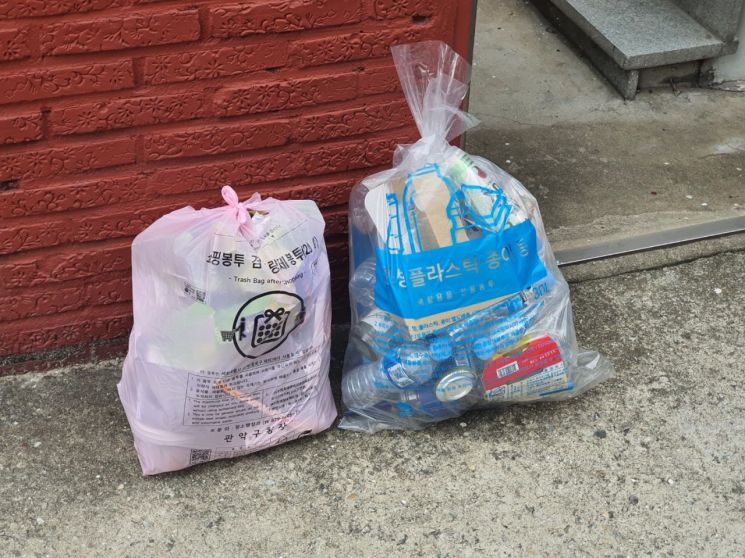
[Asia Economy Reporter Park Jong-il] Gwanak-gu (Mayor Park Jun-hee) is promoting a project to provide 'free dedicated recycling bags by item' in single-family housing areas, striving to create a sustainable resource circulation city.
In single-family housing areas without separate recycling collection spaces like apartments, the principle is to separate and dispose of recyclables in translucent plastic bags that show the contents. However, this is often not properly followed, requiring garbage trucks to collect and then re-sort the recyclables.
Accordingly, in 2021, Gwanak-gu became the first autonomous district in Seoul to provide three types of dedicated recycling bags to single-family houses and multi-family houses built before 2010, establishing a system for item-specific recycling disposal.
The dedicated bags come in three colors: ▲orange bags for transparent PET bottles ▲purple bags for vinyl products, which can only be disposed of on Thursdays ▲blue bags for cans and plastics, which can be disposed of on all days except Thursday. Recycling waste must not be disposed of on Saturdays.
Last year, the district piloted the program in two neighborhoods, Euncheon-dong and Sinsa-dong, and this year expanded it to four neighborhoods including Namhyeon-dong and Jowon-dong. As a result, the street scenery became noticeably cleaner, and the number of illegal dumping cases decreased.
Therefore, the district plans to expand the dedicated recycling bag project to all neighborhoods in 2023.
Meanwhile, one-room and multi-unit houses not eligible for dedicated recycling bags can apply for customized recycling collection stations at their local community centers and install and use them.
In addition, the district has been recognized for creating a resource circulation city that reduces carbon emissions through initiatives such as ▲operation of smart recycling collection boxes ▲ice pack recycling projects ▲community resource circulation education ▲recycling of disposable paper packs ▲and the transparent PET bottle deposit system ‘Eco Tomorrow,’ winning the ‘2022 Korea Urban Awards’ special prize in the climate change category.
Mayor Park Jun-hee said, “We expect that the use of dedicated recycling bags will help residents make recycling a daily habit, improving urban scenery and advancing carbon neutrality,” adding, “We will continue to cooperate with residents to promote various projects for a sustainable resource circulation city in Gwanak.”
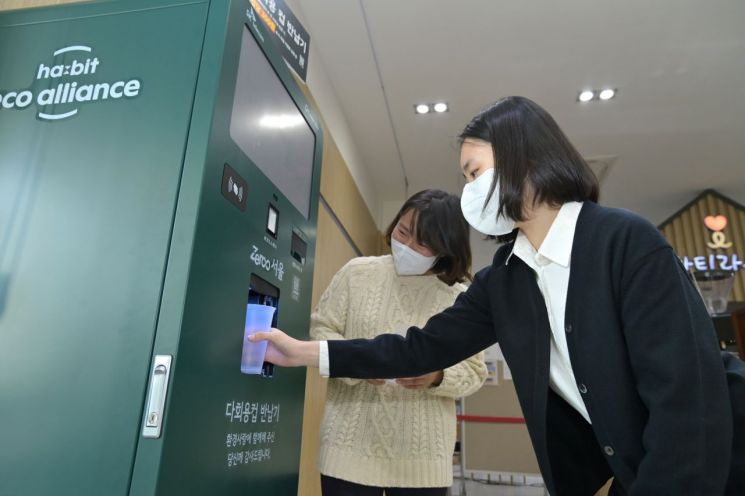
Since the 24th, employees of Jung-gu Office have been using personal tumblers or reusable cups when using the cafe on the first floor of the district office building, as the district office cafe operates as a 'Zero Cafe.'
Jung-gu (Mayor Kim Gil-sung) has installed unmanned reusable cup return machines in the district office in response to the expanded regulations on single-use items starting November 24, actively working to reduce single-use items beginning at the district office.
Two unmanned return machines were installed: one at the first-floor cafe of the main district office building and another in front of the comprehensive situation room. When ordering a drink, customers pay a 1,000 KRW deposit for the reusable cup, and upon returning the used cup to the unmanned return machine, the deposit is immediately refunded in cash or points.
Previously, about 450 single-use cups were used daily at the district office cafe, meaning nearly half of the approximately 900 employees used them.
This resulted in daily carbon emissions of about 13.8 kg (10,797 g), considering that a single-use cup emits 30.66 g of carbon.
Based on 20 working days per month, approximately 275 kg of carbon is emitted monthly from the Jung-gu district office cafe. Using a multi-purpose cup, which emits 1.39 g of carbon, reduces daily carbon emissions by 13.2 kg and monthly emissions by about 264 kg.
"Now is the time to part ways with single-use items for the sake of the Earth. Reducing inconvenience is the first step to protecting the planet."
Jung-gu plans to implement various policies that enable the practice of 'zero waste'?a global movement to reduce waste by minimizing packaging or using recyclable materials?in daily life.
Due to the temporary increase in single-use item use in food service establishments during COVID-19 prevention measures and stricter regulations at public resource recovery facilities such as the Sudokwon Landfill Site, interest in resource circulation of recyclables has increased.
First, in line with Seoul City's 'Reusable Cup Utilization Activation Plan,' the district office cafe will operate as a 'Zero Cafe' to lead resource recycling efforts in public institutions. Following amendments to the 'Act on the Promotion of Saving and Recycling of Resources,' which expanded regulated industries and items, the district office plans to stop bringing in single-use paper cups.
Additionally, cafes in affiliated institutions such as the Cultural Foundation and Facilities Corporation will also be required to use reusable cups.
To encourage active participation from the private sector, notices will be sent to small business cafes in areas like Myeong-dong and Euljiro to promote participation in the 'Zero Cafe' initiative to reduce single-use cups.
Furthermore, the district is supporting 'mobile recycling separation stations' at various events and festivals held for residents exhausted by COVID-19.
Previously, large amounts of mixed waste including recyclables were often generated after events, making waste management difficult. Therefore, the event organizing departments have installed recycling bins throughout event venues to allow separation of recyclables during the event rather than after.
This initiative was first introduced at the dried fish and beer festival at Sinjungbu Market on October 14 and will be seen at many upcoming events in Jung-gu.
The recycling bag exchange program, launched by Jung-gu in October last year, has seen active resident participation. Residents who bring transparent PET bottles, paper packs, and used batteries to community centers can exchange them for a 10-liter volume-based waste bag. By September this year, over 12,000 residents participated, exchanging more than 40,000 bags.
Due to positive responses, next year the exchange locations will expand to comprehensive social welfare centers, and exchangeable items will increase to include waste fluorescent lamps and vinyl.
Also, under the leadership of the waste research institute 'Saerom,' unique to Jung-gu, 24 people who completed a 10-week resource circulation specialist training course will engage in sustainable resource circulation activities, fostering consensus on waste separation and reduction and practicing these in daily life.
Graduates have responded enthusiastically, with many saying the education opened their eyes to resource circulation. Plans are underway to expand the training courses for resource circulation activists next year.
Mayor Kim Gil-sung said, "The power to change the world comes from small actions. No matter how good the ideas and policies are, they have no effect without practice," adding, "I hope the small actions started by Jung-gu employees and residents will spread and become a force to protect the Earth."
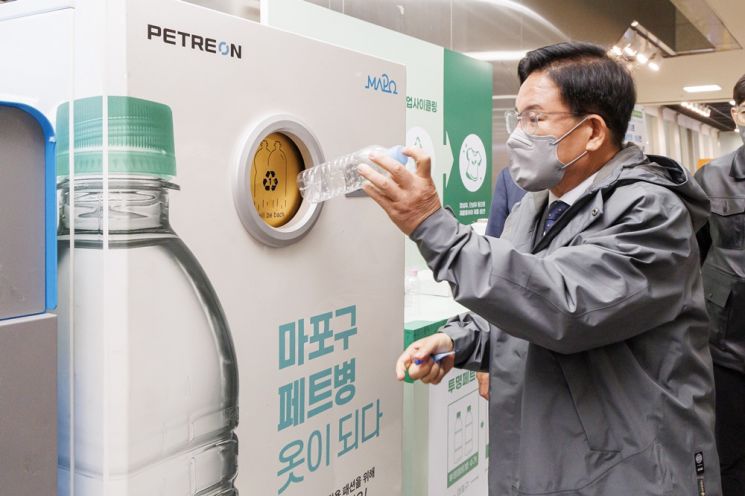
Mapo-gu (Mayor Park Kang-soo) is conducting a campaign to collect plastic water bottles and transform them into ‘textiles.’
South Korea ranks among the top countries globally in per capita plastic usage. Especially after the COVID-19 pandemic, the rise of non-face-to-face consumption culture has significantly increased plastic waste, raising concerns about a waste crisis.
Among these, transparent PET bottles have low contamination levels, allowing high-quality recycling. Since 2020, a separate collection system for transparent PET bottles has been implemented, but all local governments face difficulties due to residents' lack of awareness.
To raise awareness of the value of recyclable resources and the importance of separation, Mapo-gu has established an upcycling experience space within the district office that collects transparent PET bottles and turns them into textiles. The experience space on the first floor of the district office explains in an easy-to-understand way the reasons for separating transparent PET bottles and how PET bottles are utilized.
When transparent PET bottles are inserted into the input slot at the experience space, they are finely crushed into flakes (uniform flat pieces), washed, and then transformed into small spherical chips. These chips are processed into cotton yarn used for making clothes. For example, 32 water bottles are used to make a jacket, and 15 bottles for a short-sleeve T-shirt.
The transparent PET bottle upcycling machine is a collaboration between Mapo-gu and the outdoor brand Black Yak. The newly established experience space demonstrates how effectively waste can be reduced through recycling in everyday life.
An official from the district said, “High-quality recycling of plastic waste can significantly solve waste problems that cause environmental pollution through landfill or incineration, which is highly meaningful.”
Mayor Park Kang-soo of Mapo-gu said, “Starting with this transparent PET bottle separation experience space, we plan to expand upcycling equipment throughout Mapo-gu,” adding, “We hope residents recognize the value and importance of resource circulation and actively participate in recycling through proper separation.”
Meanwhile, while Seoul City has selected Mapo-gu as a candidate site for a new metropolitan resource recovery facility, Mapo-gu is demanding a complete cancellation. Recently, Mayor Park Kang-soo argued that incineration of household waste is not the only solution and emphasized the need for efforts to efficiently sort recyclable waste such as plastic and vinyl through ‘pre-treatment facilities’ to greatly reduce incineration volumes.
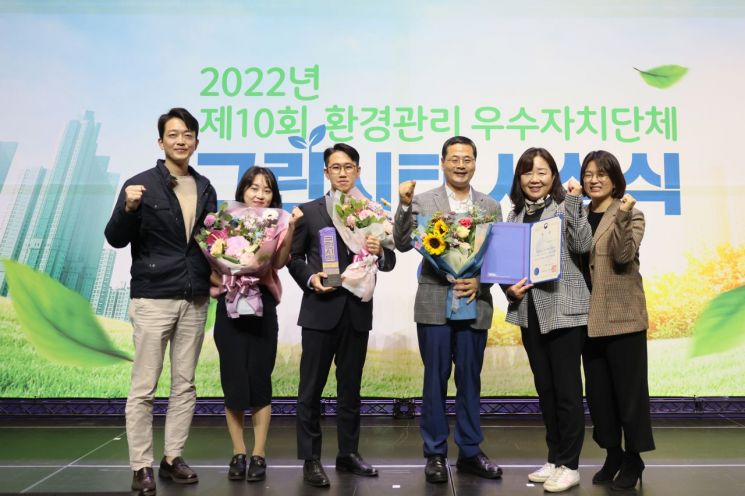
Songpa-gu (Mayor Seo Gang-seok) was selected as an excellent local government in environmental management at the 10th Green City Selection Project in 2022, enhancing its status as an environmental city.
The district received the Minister of Environment Award at the 10th Green City Awards ceremony held at Suwon Convention Center in Suwon City on the afternoon of the 27th.
The Ministry of Environment’s Green City selection has been conducted biennially since 2004 to promote eco-friendly local administration. This evaluation was based on written and on-site assessments across nine items in three categories: carbon neutrality, urban environment, and environmental policies.
Songpa-gu received high marks for developing and operating ‘OnTree,’ the nation’s first non-face-to-face carbon neutrality practice app. Residents complete 12 environmental protection missions such as using tumblers and growing air-purifying plants, upload their achievements to the app, and earn points. When a certain number of points are accumulated, the district supports tree planting, encouraging residents’ environmental protection efforts.
Additionally, Songpa-gu was the first among Seoul’s autonomous districts to establish a long-term comprehensive environmental plan called the ‘Carbon Neutrality Implementation Plan,’ aiming to reduce greenhouse gas emissions by 50% by 2030. The district is actively promoting 40 detailed projects in areas including buildings, transportation, waste, public sectors, and green infrastructure.
Other efforts include ▲construction of a resource circulation complex cultural space called the Upcycling Center ▲creation of eco-friendly waterfront spaces ▲installation of fine dust clean zones on elementary school routes ▲operation of fine dust-free zones for bus passengers ▲and establishment of smart indoor air quality management systems in daycare centers and senior centers.
With this award, Songpa-gu received a Green City plaque and prize money, and will be prioritized for ongoing support in future environmental evaluation projects by the Ministry of Environment.
Mayor Seo Gang-seok of Songpa-gu said, “We are very pleased to be selected as an excellent local government in environmental management,” adding, “We will continue to discover and implement eco-friendly policies to play a leading role in creating an ecological city where people and the natural environment coexist harmoniously.”
© The Asia Business Daily(www.asiae.co.kr). All rights reserved.
![Clutching a Stolen Dior Bag, Saying "I Hate Being Poor but Real"... The Grotesque Con of a "Human Knockoff" [Slate]](https://cwcontent.asiae.co.kr/asiaresize/183/2026021902243444107_1771435474.jpg)


















