Concerns Over China's Economic Slowdown... Year-End Steel Raw Material Prices Drop
POSCO and Hyundai Steel Q3 Profits Plunge... Profitability Deteriorates
[Asia Economy Reporter Oh Hyung-gil] Steel raw material prices have fallen to their lowest level of the year. Weak demand for steel products due to the economic recession is further driving down steel product prices. The steel industry, which is recording poor performance due to high exchange rates and flood damage, is raising concerns that it has entered a downturn.
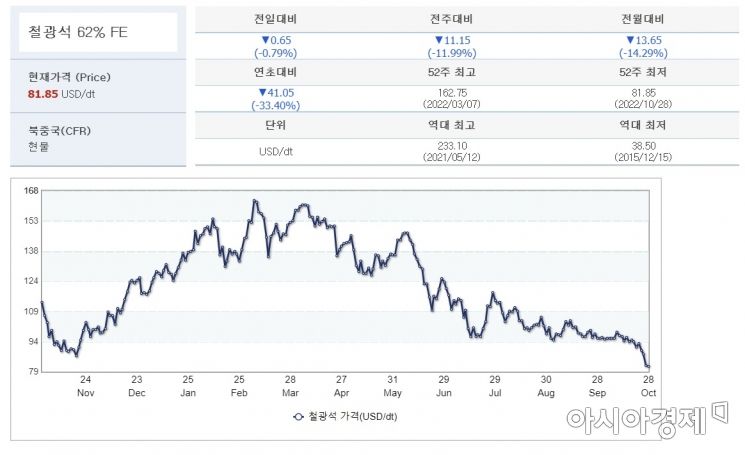
According to raw material price information from the Ministry of Trade, Industry and Energy on the 31st, the price of iron ore on the 28th was $81.85 per ton based on China's import (CFR), marking the lowest price of the year after falling for four consecutive trading days. This price is 11.9% lower than the previous week and has been trading below the $90 mark for the first time in 2 years and 5 months since May 2020.
China is pulling down iron ore prices ahead of the year-end amid concerns over an economic recession caused by COVID-19 lockdown measures. The World Steel Association analyzed that the European power crisis and China's economic downturn are expected to reduce global steel demand this year, influencing the decline in iron ore prices.
The price of thermal coal has also been declining since the end of September, in line with the recent drop in international oil prices. The average price of thermal coal (fuel coal) in the third week of October was $390.59 per ton, down 0.7% from last week's $393.33. Although it peaked at $193 at the end of last month, downward pressure increased due to concerns over slowing economic activity.
With major raw material prices turning downward, the steel industry is cautiously analyzing that the 'supercycle' market conditions, which continued until the first half of this year after the COVID-19 pandemic, have peaked and entered a downward trend.
The third-quarter performance of steel companies also failed to avoid a decline. Hyundai Steel reported an operating profit of 373 billion KRW in the third quarter on a consolidated financial statement basis, down by half (54.9%) compared to 826.2 billion KRW in the same period last year. This is largely attributed to the rise in raw material import prices due to the won-dollar exchange rate exceeding 1,400 won following the US interest rate hikes, while steel demand weakened due to the economic recession.
POSCO Holdings also recorded a staggering 71% drop in operating profit to 920 billion KRW (provisional) in the third quarter on a consolidated financial statement basis compared to the same period last year. Flood damage caused by the flooding of the Naechon River further reduced steel product production. Third-quarter sales of thick plates decreased by about 170,000 tons and wire rods by about 150,000 tons compared to the previous quarter. Sales of 'WTP (World Top Premium)' products, considered high-profit products, also fell by 21.1% year-on-year to 2.2 million tons.
Product prices are inevitably expected to continue declining until the end of the year. The price of thick plates, currently under negotiation with the shipbuilding industry, is also expected to be slightly reduced. At the earnings presentation on the 24th, POSCO Holdings explained, "We plan to complete price negotiations with shipbuilders by next month for the fourth quarter," adding, "We expect prices to be maintained or slightly reduced by about 50,000 KRW per ton compared to the third quarter." However, the price reduction of thick plates is seen as helpful for the recovery of the shipbuilding industry's performance.
The steel market is expected to rebound only in the second half of next year. A steel industry official said, "In the first half of next year, a tedious phase of bottoming out without sharp price fluctuations will unfold due to continued economic policies such as tightening, ongoing demand decline, and limited supply expansion," adding, "We expect demand to improve from the second half of next year."
© The Asia Business Daily(www.asiae.co.kr). All rights reserved.


















