Spring thaw, autumn rainy season impact... Massive losses if tanks and armored vehicles are lost
One of the reasons for Napoleon's Russian campaign and Hitler's Russian offensive failures
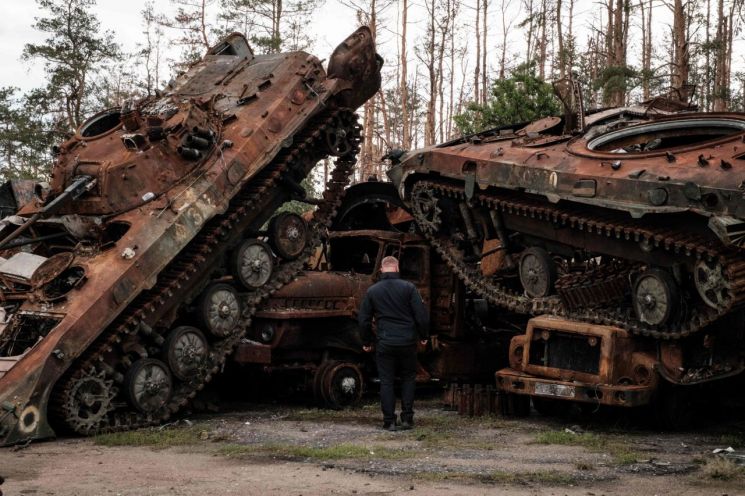 A police officer is looking at scrapped Russian military armored vehicles in Lyman, Donetsk Province, eastern Ukraine. Photo by AFP Yonhap News
[Asia Economy Reporter Hwang Sumi] After recapturing the Donetsk area in eastern Ukraine, the Ukrainian military, which was rapidly advancing toward the southern Kherson front, is reportedly at risk of being stalled by an unexpected obstacle known as the autumn rains, according to foreign media reports.
According to a recent report by The New York Times (NYT), the Ukrainian forces are facing difficulties reclaiming the southern occupied Kherson region due to the Rasputitsa phenomenon.
Rasputitsa refers to the annual spring and autumn phenomenon in Russia and Ukraine where the ground turns into a muddy quagmire, making transportation difficult. In spring, the ground thaws after being frozen all winter, and in autumn, the rainy season begins with heavy rains turning unpaved roads and plains into vast mudfields.
During this time, the softened soil makes it difficult for passenger vehicles to pass. Especially in wartime, there is a risk of tanks and military vehicles getting stuck, leading to enormous losses.
Historically, Rasputitsa has been cited as a cause of failure in both Napoleon’s 1812 Russian campaign and Adolf Hitler’s 1941 Russian offensive. At that time, Napoleon’s main artillery units moved very slowly, limiting the advance speed and resulting in defeat due to food shortages. Similarly, Nazi German forces lost most of their combat vehicles after tanks and armored cars got stuck in the mud, leading to heavy losses and failure to capture Moscow.
Earlier, Russia also suffered from the Rasputitsa phenomenon last spring. In April, when Russia declared a large-scale offensive in the Donbas region, the thawed muddy terrain created by melting frozen ground during winter slowed their advance.
However, this time, NYT forecasts that the phenomenon will act as an unexpected obstacle for the Ukrainian forces poised to recapture the southern occupied Kherson. As autumn brings cold and humid weather, both Ukrainian and Russian forces are struggling with the muddy conditions, but Rasputitsa tends to disadvantage the attacking side more.
Especially in the Kherson region, which is an open plain crisscrossed with irrigation canals between farmlands, the situation is even more severe. Regarding this, Serhiy Haidai, governor of Luhansk Province on the Ukrainian side, said, "Heavy rains are causing difficulties in moving military equipment," adding, "Other regions outside Luhansk Province are facing similar situations."
Despite these conditions, the momentum between both sides around Kherson remains tense. Kherson, the first city occupied by Russia after its invasion of Ukraine in February, is considered a strategic key point connecting the pro-Russian separatist-controlled eastern Ukraine and the Crimean Peninsula by land. Accordingly, Ukraine has declared its intention to recapture not only Kherson but also the Crimean Peninsula, which was forcibly annexed by Russia in 2014, while Russia has strengthened its defensive lines by deploying up to about 1,000 additional troops.
© The Asia Business Daily(www.asiae.co.kr). All rights reserved.

















