Over 1,200 Foreign Workers Forced to Evict from Apartments Near Doha Capital
6,500 Migrant Workers at World Cup Stadium Construction Face Harsh Conditions, Some Lose Lives
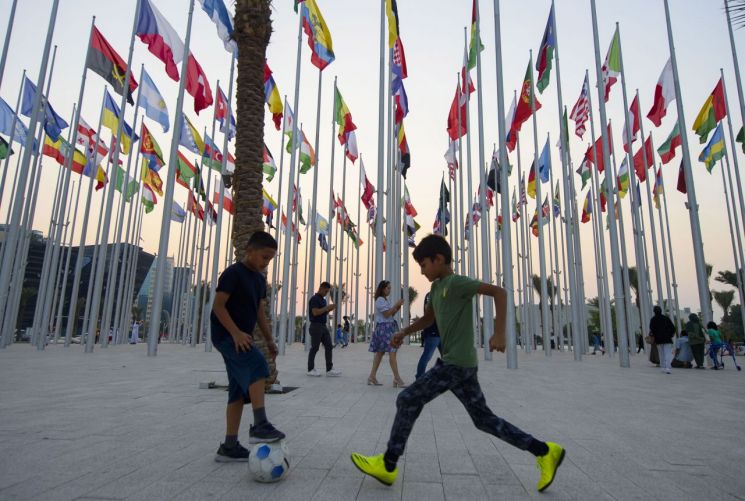 On the 20th (local time), children are playing soccer at the Flag Square in Doha, the capital of Qatar. Photo by EPA Yonhap News
[Asia Economy Reporter Hwang Sumi] Qatar, about 20 days ahead of the World Cup opening, is once again embroiled in controversy over human rights issues. Following criticism that migrant workers were subjected to harsh working conditions during the World Cup preparations, it is now accused of forcibly evicting thousands of workers who were staying near the accommodation areas for World Cup tourists.
According to major foreign media on the 28th (local time), the Qatari government recently forcibly evicted more than 1,200 foreign workers living in apartments near the capital, Doha, without prior notice. These apartments are adjacent to the area where authorities planned to rent accommodations to World Cup tourists.
The authorities vacated about 10 apartment buildings and sealed the doors, forcing the suddenly evicted workers to find places to stay. However, many workers had no choice but to sleep on nearby roads. A man preparing to sleep outdoors with about 10 others told the media, "We have nowhere to go."
Most of these workers, originating from Asia and Africa, did not disclose personal information such as their names or ages due to fears of retaliation from the Qatari government. It is known that unlike large construction companies with dedicated accommodations, these workers were employed by small construction firms where they had to arrange their own lodging.
Regarding this, Bani Saraswati, director of the Migrant Rights Project, a Middle Eastern foreign workers' human rights organization, criticized, "This is Qatar trying to hide the fact that it exploited cheap labor while showing only a luxurious and wealthy facade," adding, "Evicting people without prior notice is an incomprehensible and inhumane act."
This is not the first time labor rights controversies have arisen in Qatar ahead of the World Cup. Since winning the bid for the 2010 World Cup, Qatar has been embroiled in controversy over exploiting migrant workers during the preparation process, investing astronomical funds.
In January, the British daily newspaper Daily Mail reported that more than 6,500 migrant workers involved in the construction of Qatar World Cup stadiums lost their lives due to poor working conditions. The media criticized that despite these repeated situations, the Qatari government and FIFA remain silent, stating, "The World Cup is stained with blood."
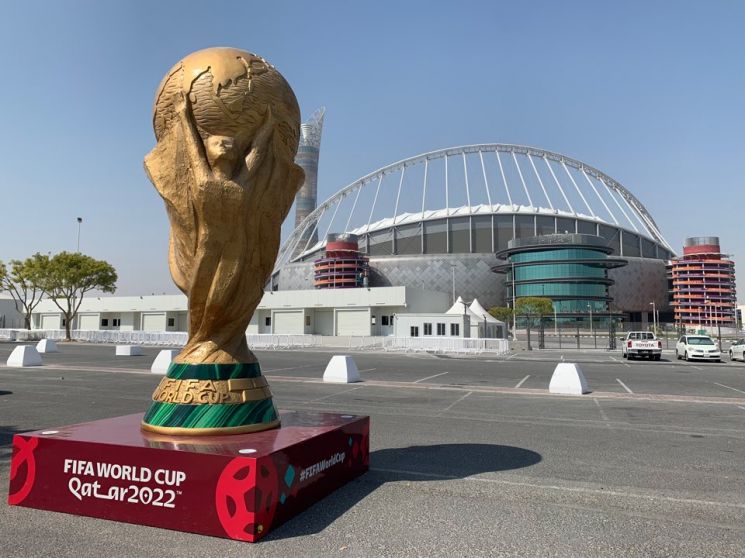
As a result, international criticism against Qatar appears to be spreading. Nancy Faeser, Germany's Minister of the Interior, recently stated in an interview with German public broadcaster ARD that countries that do not guarantee human rights are not qualified to host major sporting events such as the World Cup. She said, "The selection of World Cup host countries and the preparation process must ensure compliance with human rights standards," adding, "It is better that countries that do not adhere to mandatory standards are not selected as hosts."
The Denmark national football team included messages criticizing Qatar's human rights issues on their new uniforms. For this World Cup, the Danish team will wear uniforms composed of calm, solid colors without flashy elements. Additionally, the third uniform, worn when the home and away team colors are similar, is black. This is intended to honor the migrant workers who died during the construction of Qatar World Cup stadiums and to protest Qatar's human rights issues.
In France, the 2018 Russia World Cup champions, major cities such as Paris and Strasbourg have declared a boycott of public street broadcasts of the Qatar World Cup. According to the Associated Press, Pierre Rabadan, Paris's deputy mayor in charge of sports, told reporters on the 4th that due to "environmental and social conditions during the organization of this World Cup," they decided not to hold street broadcasts using large screens.
Meanwhile, Qatar has completely denied these allegations of human rights violations. The criticism that thousands of migrant workers' lives and health were endangered during the World Cup preparations is not true, according to their position.
They also explained that the recent eviction of workers was carried out through proper procedures. The authorities claim this was part of a long-standing redevelopment project in the Doha area and unrelated to the World Cup. They added that the workers are being relocated to safe and appropriate accommodations.
© The Asia Business Daily(www.asiae.co.kr). All rights reserved.
![Clutching a Stolen Dior Bag, Saying "I Hate Being Poor but Real"... The Grotesque Con of a "Human Knockoff" [Slate]](https://cwcontent.asiae.co.kr/asiaresize/183/2026021902243444107_1771435474.jpg)

















