Car Journalists Association Symposium on Autonomous Driving Commercialization
"Legal and Regulatory Reforms Needed," Experts in Unison
AI Technology Advances to Accelerate Commercialization
"Tesla and Nvidia Leading... Korea Must Catch Up"
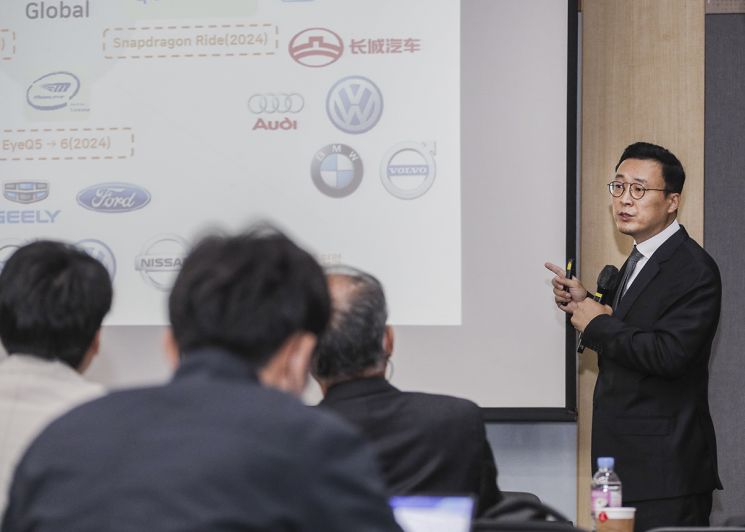 Kotaebong, Head of Research at Hi Investment & Securities, is presenting at the Autonomous Vehicle Symposium held at Daegu EXCO on the 27th.
 [Asia Economy Reporter Choi Dae-yeol] As the commercialization of autonomous vehicles may arrive sooner than expected, there are calls to accelerate the development of laws and regulations. Competition has intensified not only among existing automakers but also new electric vehicle startups and global big tech companies. Experts point out that without proper regulations or standardization, it is difficult for companies to generate profits, making it necessary for sustainable research and development conditions.
At a symposium organized by the Korea Automobile Journalists Association on the 27th, Ko Tae-bong, Head of Research at Hi Investment & Securities, said, "While the century-old internal combustion engine is certain to be rapidly replaced by electric vehicles, autonomous vehicles equipped with intelligence tend to be dismissed as a distant future possibility. However, the gap between traditional automakers and leading companies armed with artificial intelligence (AI) technology is widening rapidly."
He added, "The shift to autonomous driving will determine the future success of automobiles. Autonomous driving, a convergence of numerous high-tech fields, is no easy challenge, but if successful, it can be applied across various industries, guaranteeing revolutionary growth potential."
He identified Tesla, the world's largest electric vehicle company, and Nvidia, a GPU design company, as the leaders in autonomous driving technology. Tesla has automated data labeling tasks traditionally done by humans using AI technologies such as its self-developed supercomputer Dojo and is collecting data from over 50 countries worldwide, taking a comprehensive approach. Data is the most critical element in the commercialization of autonomous driving, and Tesla's capabilities in processing and learning from data are far ahead.
Nvidia emphasizes openness, similar to how the Android mobile operating system did. It collaborates with various companies such as Mercedes-Benz and BYD and is expanding partnerships through AI technology. While many automakers used Mobileye for advanced driver-assistance systems (ADAS), a clear example is the gradual shift to Nvidia, which has superior AI technology.
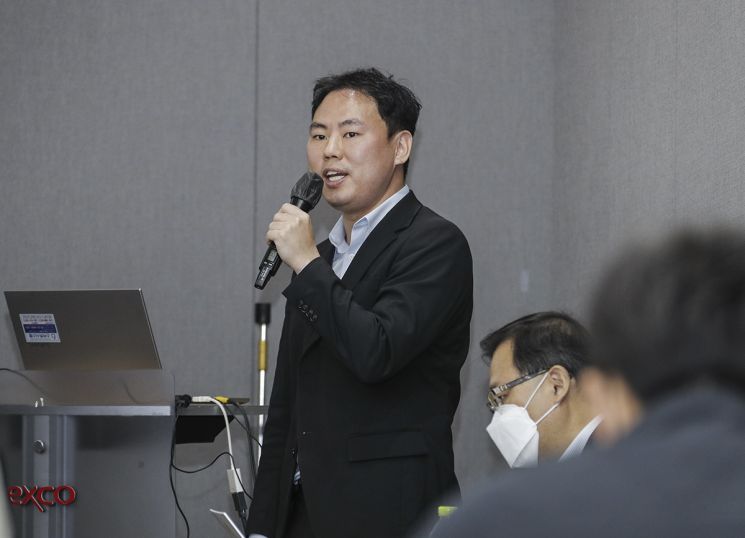 Shin Hyun-seong, an official from the Ministry of Land, Infrastructure and Transport, is presenting at the Autonomous Vehicle Symposium held on the 27th at Daegu EXCO.
 With the sale and operation of Level 3 autonomous vehicles expected by the end of this year, the government is also taking multifaceted steps to revise regulations and revitalize the industrial ecosystem. Shin Hyun-sung, Officer of the Advanced Vehicle Division at the Ministry of Land, Infrastructure and Transport, said, "To prepare for the commercialization of autonomous vehicles, we are revising safety standards and insurance systems while operating a temporary operation permit system for demonstration and data accumulation. We are sequentially building the next-generation intelligent transportation system (C-ITS), and aiming to complete a 3D high-precision road map by 2030, currently focusing on general national roads."
He continued, "We are proactively preparing for the Level 4 autonomous driving era and will significantly expand pilot operation zones to increase demonstration services. We will improve the temporary operation permit procedures to be demand-oriented and support the startup, research, and investment activities of autonomous driving startups," he added.
Professor Kim Jung-yoon of Daegu Catholic University’s Department of Future Automotive Engineering, who chaired the symposium, said, "Efforts toward the commercialization of autonomous vehicles are active, and there is interest and expectation, but there is also anxiety about whether they will be safe. Since evaluation metrics or methods to quantify passenger safety have not yet been established, there are difficulties in commercializing autonomous vehicles." He suggested that expert discussions in various fields should become more active regarding personal data processing methods for utilizing autonomous driving infrastructure and methods for accident judgment and analysis of autonomous vehicles.
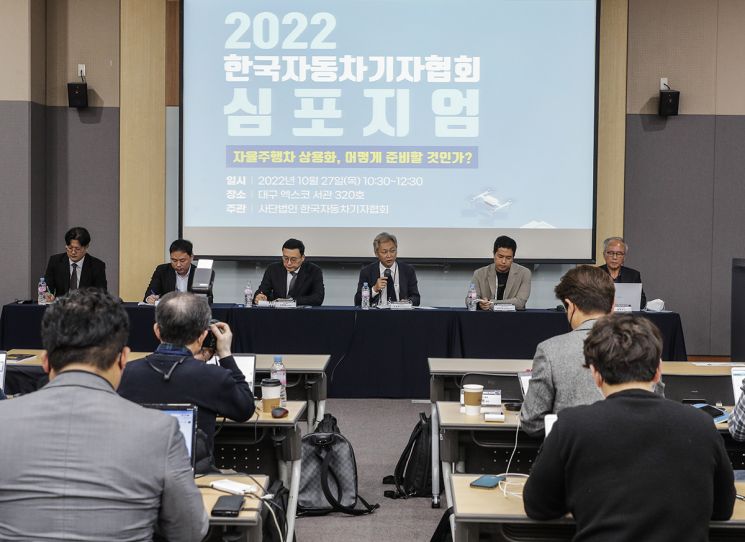
Jung Kwang-bok, Secretary General of the Autonomous Driving Technology Development Innovation Project Group, said, "We plan to designate one city and build it as an autonomous driving living lab starting in 2026, where citizens can directly experience various autonomous driving services and verify the technology through research projects." Yoo Min-sang, Executive Director of Vehicle Platform Development at Autonomous A2Z, said, "Even if Level 4 autonomous vehicle regulations are enacted in 2025, it will likely be after 2027 when companies receive certification, start sales, and generate profits. From the companies’ perspective, they must endure more than five years without profit. Therefore, it is necessary to implement support policies to create an industrial ecosystem so that the autonomous vehicle industry can survive until commercialization."
Lee Seung-yong, Chairman of the Korea Automobile Journalists Association, said, "Autonomous vehicles have attracted interest and participation in technology development from various companies beyond traditional automakers, including those in electricity, electronics, telecommunications, and IT. There are numerous challenges to address, including laws and regulations, technology development, infrastructure, AI ethics, insurance, and safety." Chae Young-seok, Advisor to the Automobile Journalists Association, said, "Although autonomous driving has started to be applied in limited areas such as robotaxis, shuttles, and highway large trucks, it is still uncertain whether it will be applied to general passenger cars. There are many technical obstacles that humans have not thought of and that cannot be learned through big data."
© The Asia Business Daily(www.asiae.co.kr). All rights reserved.



















