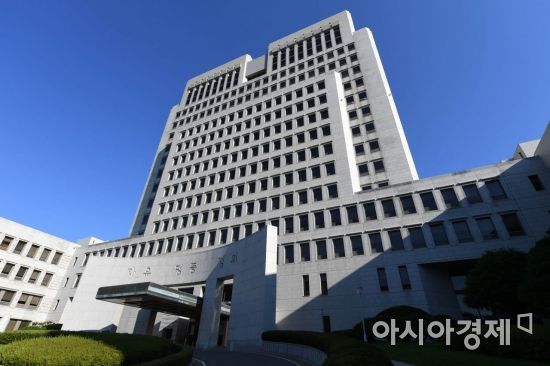
[Asia Economy Reporter Choi Seok-jin, Legal Affairs Specialist] The Supreme Court has issued its first ruling that the provision in the Criminal Procedure Act suspending the statute of limitations for criminals who flee abroad applies only to the general statute of limitations that runs from the end of the criminal act, and does not apply to the so-called trial statute of limitations (deemed statute of limitations), which presumes the statute of limitations is completed after a certain period has passed without a final judgment following indictment.
The Supreme Court's First Division (Presiding Justice Oh Kyung-mi) announced on the 27th that it upheld the lower court's ruling dismissing the appeal of liquor wholesaler A, who was indicted on charges of fraud under the Act on the Aggravated Punishment of Specific Economic Crimes.
The court stated, "It is appropriate to uphold the first trial court's ruling that dismissed the case against the defendant on the grounds that 15 years had passed since the indictment without a final judgment, thus completing the statute of limitations as stipulated in Article 249(2) of the former Criminal Procedure Act," and added, "There is no error in the lower court's judgment that would affect the ruling by misunderstanding the scope of application of Article 253(3) of the Criminal Procedure Act as argued in the grounds for appeal."
The pre-amendment Article 249(2) of the Criminal Procedure Act (Duration of the Statute of Limitations) applied in this case states that "For crimes for which prosecution has been initiated, if 15 years have passed since the prosecution without a final judgment, the statute of limitations shall be deemed completed."
This provision uses the "time of indictment" as the starting point for calculation, distinguishing it from the general statute of limitations that runs from the "end of the criminal act," and is practically referred to as the "trial statute of limitations" or "deemed statute of limitations."
This provision was amended in December 2007 to extend the period to 25 years before the statute of limitations is deemed completed.
Article 253(3) of the Criminal Procedure Act (Suspension and Effect of the Statute of Limitations), established in 1995, states that "If the offender is abroad to avoid criminal punishment, the statute of limitations shall be suspended during that period."
A was indicted in August 1997 on charges of defrauding victims of 560 million won to finance the acquisition of a nightclub.
After indictment, A repeatedly traveled to the United States and returned five times from September 12, 1997, to April 14, 1998, and finally left for the U.S. on April 28, 1998, without returning.
Ultimately, the first trial court proceeded with the trial in the defendant's absence and dismissed the case on April 3, 2020, on the grounds that the statute of limitations had been completed.
The legal issue was whether Article 253(3) of the Criminal Procedure Act, which suspends the statute of limitations for offenders who flee abroad to avoid punishment, applies to Article 249(2) of the same law, which deems the statute of limitations completed after a certain period without a final judgment following indictment.
The prosecution argued that ▲ there is a need to punish defendants who flee abroad after indictment to avoid punishment, ▲ it is unfair that the statute of limitations is suspended for suspects who flee abroad before indictment but not for defendants already indicted with clearer charges, and ▲ since Article 253(3) was enacted after Article 249(2), the principle of "lex posterior derogat priori" dictates that it should naturally apply to the trial statute of limitations as well.
However, the first trial court stated, "While it is undeniable that there is a need to punish defendants who flee abroad after indictment and considering fairness with suspects who fled abroad before indictment, interpreting Article 253(3) as applying to Article 249(2) would excessively extend or analogize criminal laws to the defendant's disadvantage, violating the principle of legality," and rejected the prosecution's argument.
The court cited two grounds for this judgment: ▲ the balance with Articles 253(1) and (2) of the Criminal Procedure Act, and ▲ the formal structure of Article 249(2) of the former Criminal Procedure Act.
First, the court noted that Article 253(3), which suspends the statute of limitations for offenders who flee abroad, is stipulated under the heading "Suspension and Effect of the Statute of Limitations" along with paragraphs (1) and (2), so the scope of application must consider the preceding paragraphs.
Specifically, Articles 253(1) and (2) regulate the suspension of the statute of limitations due to prosecution of the offender or accomplice, so if these provisions applied to Article 249(2), it would create a contradiction where the statute of limitations for crimes already prosecuted would be suspended by the prosecution of the defendant or accomplice.
Additionally, the court judged that the trial statute of limitations under Article 249(2), which creates the legal effect of "deeming the statute of limitations completed," requires the legal condition that 15 years have passed since the indictment without a final judgment, and is a system unrelated to the actual completion of the statute of limitations, thus unrelated to suspension. This means that, structurally, Article 253 on suspension does not apply.
The second trial court also agreed with the first trial court's judgment.
The court stated, "Article 253(3), which regulates suspension of the statute of limitations, applies to the period from the end of the criminal act to the prosecution, whereas Article 249(2) of the former Criminal Procedure Act, which deems the statute of limitations completed, only starts the period from the time of prosecution, so the two provisions apply at different times," and added, "Therefore, the fact that Article 253(3) was enacted after Article 249(2) does not mean it should be applied preferentially over Article 249(2)."
The Supreme Court shared the same view.
The court stated, "The legislative intent of Article 253(3) of the Criminal Procedure Act is to appropriately realize criminal jurisdiction by preventing the statute of limitations from progressing during the period when the offender stays abroad, where Korea's judicial authority does not effectively reach, as a means of evasion."
It continued, "Considering the wording and intent, the 'statute of limitations' subject to suspension under Article 253(3) refers to the statute of limitations under Article 249(1) of the former Criminal Procedure Act, which runs from the end of the criminal act and is suspended by prosecution, and does not include the statute of limitations under Article 249(2), which deems the statute of limitations completed after a certain period from prosecution without a final judgment."
Finally, the court concluded, "Therefore, even if the defendant is abroad to avoid punishment after prosecution, the period under Article 249(2) of the former Criminal Procedure Act is not suspended during that time."
A Supreme Court official said, "This is the first case explicitly confirming that the statute of limitations suspension provision for overseas flight does not apply to the statute of limitations (trial statute of limitations) under Article 249(2) of the Criminal Procedure Act, emphasizing the principle of legality that prohibits analogical or expansive interpretation to the defendant's disadvantage in criminal law."
© The Asia Business Daily(www.asiae.co.kr). All rights reserved.

















