Registered as WHO Group 2 Carcinogen... Causes Oral Cancer, Addiction, and Stimulant Symptoms
Classified as Herbal Medicine in Korea and Imported... Korea Customs Service and MFDS Play Ping-Pong with No Measures
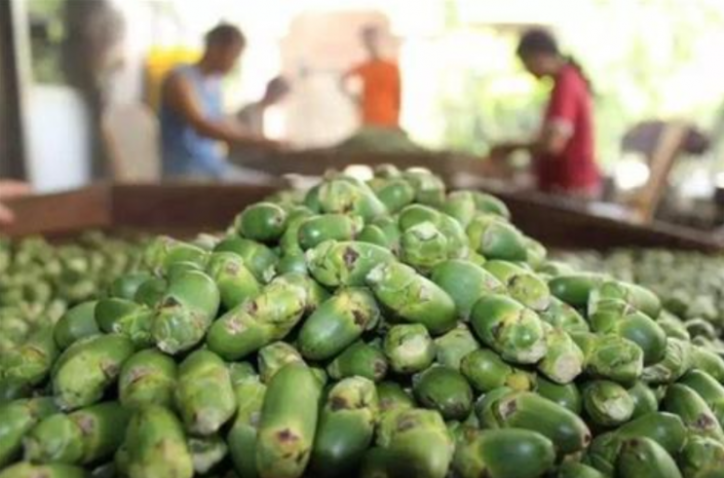
[Asia Economy Reporter Kim Jung-wan] The "fruit of death," betel nut, designated as a Group 2 carcinogen by the World Health Organization (WHO), has been imported into South Korea in quantities exceeding 100 tons over the past five years.
According to data submitted by the Korea Customs Service and disclosed by Hong Seong-guk, a member of the Democratic Party of Korea, the amount of betel nuts imported into the country over the last five years was 103.2 tons.
The "arecoline" component contained in betel nuts is known to cause oral cancer, addiction, and stimulant effects. Arecoline was registered as a Group 2 carcinogen by the WHO International Agency for Research on Cancer in 2004.
In China, where betel nuts are consumed in large quantities as a recreational product, they were removed from the food category in 2020. Since last year, online promotion and sales have been completely banned. In some regions, measures have even been taken to collect displayed products.
However, in South Korea, betel nuts are classified as herbal medicine, allowing imports without customs clearance restrictions, resulting in over 103 tons imported in five years. Notably, as of the end of August this year, 30.3 tons were imported, marking a 1.42-fold increase compared to the total amount last year.
Representative Hong criticized, "Despite repeated warnings, the responsible agencies, the Korea Customs Service and the Ministry of Food and Drug Safety, have failed to present any effective measures."
The Korea Customs Service stated that since betel nuts are managed as herbal medicine under the Pharmaceutical Affairs Act, imports cannot be restricted if inspection certificates are provided. The Ministry of Food and Drug Safety has announced plans to conduct safety evaluations of betel nuts and related substances by 2025, but it is reported that the lead research institution has not yet been selected.
Representative Hong emphasized, "Since no safety evaluation has been conducted from the start, the risk remains unverified, and the Ministry of Food and Drug Safety and the Korea Customs Service are playing ping-pong with responsibility. Prompt safety evaluations and swift measures by the responsible agencies are urgently needed."
© The Asia Business Daily(www.asiae.co.kr). All rights reserved.

















