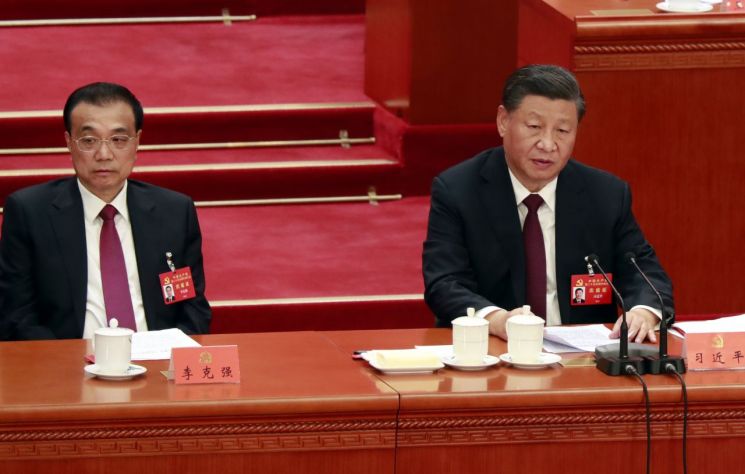
 On the 22nd, Chinese President Xi Jinping and Premier Li Keqiang attended the closing ceremony of the 20th National Congress of the Communist Party of China at the Great Hall of the People in Beijing, China. [Image source=Yonhap News]
China's fiscal deficit has soared to an all-time high. This is interpreted as a deterioration in fiscal conditions due to heavy spending to maintain the zero-COVID policy combined with a real estate market downturn.
According to an analysis by Bloomberg on June 26 of the Chinese Ministry of Finance's announcement, the cumulative fiscal deficit of central and local governments reached 7.16 trillion yuan (1,403 trillion won) as of the end of last month this year.
This amount is three times the deficit of 2.6 trillion yuan recorded during the same period last year.
China increased spending by pushing for large-scale tax refunds to stimulate the economy while maintaining a strong zero-COVID policy. Additionally, the fiscal condition worsened as revenues declined due to the real estate market slump.
Spending heavily on quarantine measures, such as conducting polymerase chain reaction (PCR) tests every 2 to 3 days for citizens to prevent the spread of COVID-19, also contributed to the fiscal deterioration.
Due to the government's economic stimulus policies, the gross domestic product (GDP) growth rate, which had fallen to 0.4% in the second quarter, rose to 3.9% in the third quarter.
© The Asia Business Daily(www.asiae.co.kr). All rights reserved.
![Clutching a Stolen Dior Bag, Saying "I Hate Being Poor but Real"... The Grotesque Con of a "Human Knockoff" [Slate]](https://cwcontent.asiae.co.kr/asiaresize/183/2026021902243444107_1771435474.jpg)
















